

How to Make an App Like Allrecipes
Introduction
Allrecipes is one of the most recognisable names in the digital food space. With millions of monthly visitors, a library of user-submitted recipes, and a thriving community of home cooks leaving reviews and photos, it has become the benchmark for what a recipe platform can be.
If you are thinking about building an app like Allrecipes, you are entering a market with real, proven demand. People cook every single day, they search for inspiration constantly, and they are increasingly willing to plan meals, shop for groceries, and share results through a single app.
This guide walks through what makes Allrecipes work, the features your app needs, the technology behind it, how to monetise it, and roughly what it costs to build.
Why Build a Recipe App?
The food and recipe category sits at a rare intersection of daily habit and high engagement. A few reasons founders keep coming back to it:
- Repeat usage by default. Meal decisions happen multiple times a day, which means natural retention without artificial gamification.
- User-generated content scales cheaply. Once a community forms, your users create the content library for you.
- Strong monetisation paths. Food brands, grocery retailers, and kitchenware companies all spend heavily on advertising and partnerships.
- Adjacent revenue streams. Grocery delivery, meal kits, nutrition coaching, and cookware affiliate sales all plug in naturally.
- Data richness. Cooking behaviour tells you about dietary preferences, household size, budget, and shopping habits.
Understanding What Makes Allrecipes Successful
Before writing a line of code, it helps to break down why Allrecipes has stayed relevant for decades.
Community Over Curation
Unlike editorially-driven food publications, Allrecipes is built on submissions from everyday cooks. The recipes feel achievable, the reviews are honest, and the photos are real. That authenticity is the product.
Reviews That Actually Improve Recipes
The review section is not just social proof. Users post modifications, substitutions, and warnings. Over time, a recipe becomes a collaborative document. Any clone needs to treat reviews as a first-class feature, not a bolt-on.
Search That Understands Intent
People search by ingredient, occasion, cuisine, dietary restriction, cook time, and skill level. Allrecipes supports all of it, including the very common "what can I make with what is in my fridge" use case.
Personalisation
Saved recipes, collections, and recommendations keep users coming back. The more a user interacts, the more relevant the home feed becomes.
Core Features of an App Like Allrecipes
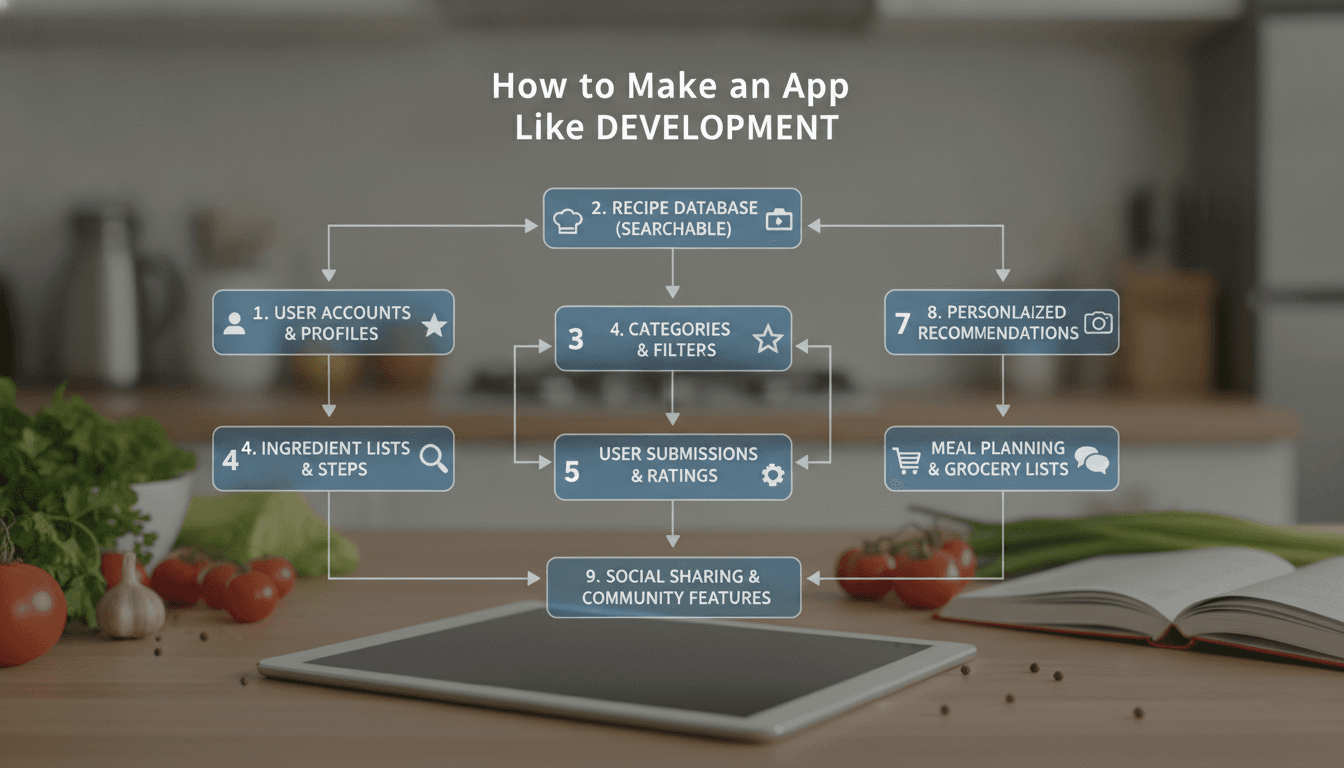
1. User Onboarding and Profiles
Keep signup frictionless with email, phone, and social login options. During onboarding, collect a light set of preferences:
- Dietary restrictions (vegetarian, vegan, gluten-free, keto, halal, etc.)
- Allergies
- Cuisine preferences
- Skill level
- Household size
Profiles should display submitted recipes, saved collections, reviews written, and follower counts.
2. Recipe Discovery and Search
This is the heart of the app. Users need:
- Keyword search with typo tolerance and synonym handling
- Ingredient-based search, including "include these" and "exclude these" filters
- Faceted filters for cook time, calories, difficulty, meal type, and diet
- Trending and seasonal collections
- Personalised recommendations based on saved and viewed recipes
3. Recipe Detail Pages
A well-designed recipe page reduces friction while someone is actually cooking:
- Hero image and optional short video
- Ingredient list with serving-size scaling (2x, 4x, half)
- Unit toggle between metric and imperial
- Step-by-step instructions with optional step images
- Built-in timers triggered from instruction steps
- Nutrition breakdown per serving
- Cook mode that keeps the screen awake and uses larger text
- Save, share, and print options
4. Recipe Submission
Let users contribute through a structured, guided form:
- Title, description, and category tagging
- Ingredient builder with quantity, unit, and item fields
- Ordered instruction steps
- Photo and video upload
- Prep time, cook time, and yield
- Draft saving before publishing
5. Ratings, Reviews, and Photos
Allow star ratings, written reviews, "made it" photos, and helpful-vote sorting. Surface the most useful reviews first rather than the most recent.
6. Collections and Meal Planning
Users want to organise what they find. Support custom collections ("Weeknight Dinners", "Holiday Baking") and a calendar-based meal planner where recipes are dragged onto specific days.
7. Smart Shopping Lists
Generate a consolidated shopping list from selected recipes or a weekly meal plan. Group items by supermarket aisle, merge duplicate ingredients, and allow manual additions. Integrating with grocery delivery APIs turns this feature into a revenue stream.
8. Social and Community Layer
- Follow other cooks
- Activity feed of recipes from followed users
- Comments and replies
- Badges or contributor levels to reward quality submissions
9. Notifications
Push notifications for new reviews on your recipes, weekly meal plan reminders, seasonal collections, and recipes from cooks you follow. Keep them opt-in and segmented to avoid uninstalls.
10. Offline Access
Kitchens have bad Wi-Fi. Cache saved recipes locally so they open instantly without a connection.
Advanced Features Worth Considering
AI Recipe Generation
Let users describe what they have or what they feel like eating and generate a recipe on demand. This works well as a premium feature and differentiates you from established players.
Photo-Based Ingredient Recognition
Users photograph their fridge or pantry and the app suggests recipes from detected ingredients. Computer vision models make this practical, though accuracy needs careful tuning.
Voice-Guided Cooking
Hands-free navigation through steps using voice commands, plus integrations with smart speakers.
Nutrition and Health Tracking
Automatic macro calculation, calorie goals, and syncing with Apple Health or Google Fit.
Video Recipes and Short-Form Content
A vertical video feed of cooking clips borrows engagement mechanics from social platforms and works especially well for younger audiences.
Smart Kitchen Integrations
Send cooking instructions directly to connected ovens, air fryers, or multi-cookers.
Technology Stack
Frontend
- Cross-platform: Flutter or React Native to ship iOS and Android from one codebase, ideal for early-stage budgets.
- Native: Swift for iOS and Kotlin for Android when you need maximum performance, deep hardware access, or advanced camera features.
- Web: React or Next.js, with server-side rendering for SEO. For a recipe platform, organic search traffic is enormous, so a strong web presence is not optional.
Backend
- Languages and frameworks: Node.js, Python (Django or FastAPI), or Go
- Architecture: Start with a modular monolith and extract microservices for search, media processing, and recommendations as you scale
Databases
- PostgreSQL for structured recipe, user, and review data
- Elasticsearch or Algolia for fast faceted search
- Redis for caching hot recipes and session data
- S3 or equivalent for images and video, fronted by a CDN
AI and Machine Learning
- Recommendation engine using collaborative filtering plus content-based signals
- LLM APIs for recipe generation and natural-language search
- Vision models for ingredient detection
- Moderation models to screen submitted text and images
Infrastructure
AWS, Google Cloud, or Azure, with containerised deployments, autoscaling, CI/CD pipelines, and monitoring via tools like Datadog or Grafana.
Design and User Experience
Recipe apps live or die on usability in the kitchen. Practical UX principles:
- Large touch targets. Users have messy hands and may be tapping with a knuckle.
- High-contrast typography. Instructions must be readable from arm's length.
- Minimal steps to value. Search results should appear within a tap or two of launch.
- Beautiful, consistent photography. Food is a visual product. Provide submission guidelines and light auto-enhancement.
- Progressive disclosure. Show the essentials first; tuck nutrition details and variations behind expandable sections.
- Accessibility. Support dynamic type, screen readers, and adequate colour contrast.
Monetisation Strategies
Advertising
Display and native ads remain the dominant model for large recipe platforms. High traffic volumes and clear contextual targeting make inventory valuable to food and grocery brands.
Freemium Subscription
Charge for ad-free browsing, unlimited meal plans, advanced nutrition tracking, AI recipe generation, and offline collections. Typical pricing sits between three and eight dollars per month.
Affiliate and Commerce
Earn commission on grocery orders, meal kit signups, cookware, and ingredient purchases linked from recipes.
Sponsored Content
Brands pay to feature recipes built around their products. Clearly label these to preserve trust.
Premium Content
Sell curated cookbooks, courses from known chefs, or specialised meal plans as one-off purchases.
Development Cost and Timeline
Costs vary heavily by region, team seniority, and scope. Broad ranges:
MVP (3 to 4 months): $35,000 to $65,000 Includes authentication, recipe browsing and search, recipe detail pages, saving, basic submission, and reviews on one platform plus a simple web presence.
Full-featured app (6 to 9 months): $80,000 to $160,000 Adds meal planning, shopping lists, social features, notifications, admin and moderation tools, and both mobile platforms.
Advanced platform (9 to 15 months): $180,000 to $350,000+ Adds AI recipe generation, computer vision, video content, grocery integrations, and a recommendation engine built for scale.
Budget an additional 15 to 25 percent annually for maintenance, infrastructure, content moderation, and feature iteration.
Step-by-Step Development Roadmap
- Validate the niche. Competing head-on with Allrecipes is hard. Pick an angle: budget cooking, a specific cuisine, allergy-friendly meals, single-serving recipes, or air fryer cooking.
- Research competitors. Study Allrecipes, Yummly, Tasty, Paprika, and Mealime. Note what users complain about in reviews.
- Define the MVP. Choose the smallest feature set that delivers real value.
- Solve the content cold start. Licence a recipe database, seed with in-house recipes, or partner with food creators. An empty recipe app is worthless.
- Design wireframes and prototypes. Test cook-mode flows with real users in real kitchens.
- Build in sprints. Two-week cycles with demos keep scope honest.
- Test thoroughly. Functional, performance, offline, and accessibility testing across devices.
- Launch and optimise. Invest in App Store optimisation and SEO for the web version.
- Iterate on data. Track search terms with no results, drop-off points in recipes, and save-to-cook conversion.
Common Pitfalls to Avoid
- Launching with too few recipes. Users bounce immediately from a thin library.
- Ignoring SEO. Most recipe discovery starts in a search engine, not an app store.
- Weak moderation. Spam, plagiarised recipes, and unsafe instructions destroy credibility fast.
- Overcomplicated submission forms. Every extra field cuts contribution rates.
- Poor search relevance. If the first page of results is wrong, nothing else matters.
- Neglecting the cooking experience. Browsing is only half the job; the app must work while hands are busy.
- Copyright carelessness. Recipe lists of ingredients are generally not protectable, but descriptions, photos, and instructions are. Have clear submission terms.
Key Metrics to Track
- Monthly active users and weekly retention
- Search-to-recipe-view conversion
- Recipe save rate and cook-mode activation
- Reviews and photos submitted per thousand active users
- Meal plans created per user
- Shopping list generation and grocery conversion
- Average revenue per user
Final Thoughts
Building an app like Allrecipes is less about replicating a feature list and more about earning a community's trust. The technology is well understood: search, media handling, personalisation, and a clean mobile experience. The hard part is content quality, moderation, and finding a positioning that gives people a reason to choose you over an established giant.
Start focused. Serve one audience exceptionally well, build the contribution loop that turns readers into creators, and expand from a base of genuine engagement. Get that right and the platform grows on its own momentum.
Have a project in mind? Contact Sodio Technologies to discuss your requirements and explore the right technology solution for your business.
/// Work with us
Talk to the engineers who'd build it
You'll get a technical scope, timeline and cost estimate from the people doing the work, not an account manager. In-house team, no subcontracting, since 2016.