

How to Make an App Like Youper
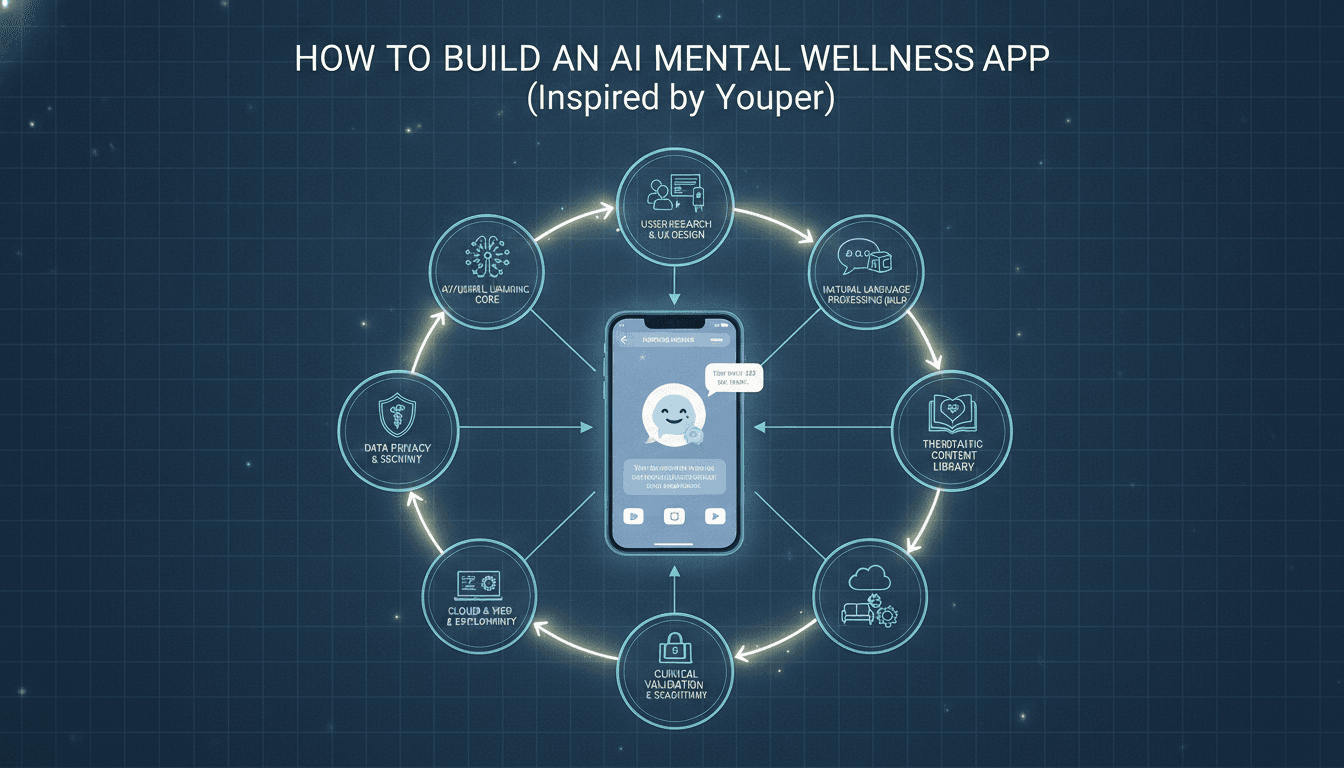
Mental health support has moved from the therapist's waiting room to the palm of your hand. Youper, an AI-powered emotional health assistant, has become one of the most recognizable names in this space — blending conversational AI, cognitive behavioral therapy (CBT) techniques, and mood tracking into a single, approachable chat interface.
If you're considering building something similar, this guide walks you through what Youper actually does, the features you'll need, the technology stack that makes it possible, the regulatory landmines to avoid, and what it realistically costs to build.
You may also find our article on How to Make an App Like Wysa useful.
What Is Youper, Exactly?
Youper positions itself as an "AI therapy assistant." Instead of pairing users with a human counselor, it offers a chatbot that guides people through structured conversations rooted in evidence-based psychology — primarily CBT, but also acceptance and commitment therapy (ACT) and mindfulness practices.
We cover a closely related subject in How to Make an App Like Sanvello.
A typical session looks like this:
- The app asks how the user is feeling.
- The user selects or describes an emotion.
- The AI probes gently for context — what happened, what thoughts came up.
- It helps the user identify cognitive distortions (catastrophizing, black-and-white thinking, mind reading).
- It offers a reframe, an exercise, or a coping technique.
- The interaction is logged so patterns become visible over time.
The magic isn't just the AI. It's the combination of low friction (no appointment, no waiting list, no judgment), clinical grounding (real therapeutic frameworks, not generic advice), and longitudinal data (users see their own emotional trends).
Why This Market Is Worth Entering
- Demand vastly outstrips supply. There simply aren't enough licensed therapists to serve everyone who needs help, and wait times in many regions stretch into months.
- Stigma is lower with software. Many people will type their feelings to an app long before they'll say them out loud to a stranger.
- Cost accessibility. A subscription costs a fraction of weekly therapy sessions.
- Proven willingness to pay. Digital mental wellness apps have demonstrated healthy subscription conversion and retention when the experience genuinely helps.
- Employer and insurer channels. B2B2C distribution through corporate wellness programs and health plans is a substantial revenue path beyond direct consumer sales.
Core Feature Set
Must-Have Features (MVP)
Conversational AI companion The heart of the product. A chat interface that feels warm, responsive, and non-robotic. It should handle open-ended text input, offer quick-reply chips to reduce typing effort, and maintain context across a session.
Emotion check-ins and mood logging Lightweight, repeatable check-ins — emoji scales, emotion wheels, or short sliders. Speed matters enormously here; if logging a mood takes more than fifteen seconds, users stop doing it.
Guided CBT exercises Structured modules: thought records, cognitive restructuring, behavioral activation, gratitude journaling, and exposure ladders. Each should be a short, completable interaction rather than a long reading assignment.
Personalized insights dashboard Charts showing mood over time, correlations with sleep or activity, most frequent triggers, and most common distortion patterns. This is the feature that converts casual users into committed ones — seeing your own data is genuinely motivating.
Onboarding assessment Validated screeners (PHQ-9 for depression, GAD-7 for anxiety) to establish a baseline and personalize the experience. Re-administer periodically to demonstrate measurable progress.
Crisis detection and safety escalation Non-negotiable. The system must detect language indicating self-harm, suicidal ideation, or acute crisis and immediately surface hotline numbers, emergency contacts, and clear next steps. Build this before you build anything else fun.
Reminders and habit loops Configurable notifications that nudge without nagging. Streaks, gentle check-in prompts, and time-of-day personalization.
Features for Version Two and Beyond
- Meditation and breathing library with audio guidance
- Sleep tracking integration via HealthKit and Google Fit
- Human therapist handoff — a marketplace or referral layer for users who need more than an app
- Medication and symptom tracking for users under psychiatric care
- Voice-based sessions for people who'd rather talk than type
- Community or peer support (moderate aggressively or skip entirely — unmoderated mental health communities are a liability)
- Clinician dashboard so therapists can view a client's between-session data
- Wearable integration to correlate heart rate variability and sleep with mood
The AI Architecture
This is where most teams either succeed or create something dangerous. Here's how to think about it.
Don't Rely on a Raw LLM Alone
Handing a user directly to an unconstrained large language model is a mistake in a mental health context. You need guardrails. The proven pattern is a hybrid architecture:
Layer 1 — Intent and risk classification. Every user message passes through a classifier that determines intent (venting, seeking advice, crisis, off-topic) and risk level. High-risk messages bypass the conversational engine entirely and trigger the safety protocol.
Layer 2 — Dialogue management. A state machine or decision tree governs the therapeutic flow. This ensures a thought record actually follows the correct clinical sequence instead of the AI improvising.
Layer 3 — Language generation. Here an LLM generates the natural-sounding phrasing within the boundaries the dialogue manager sets. Use tight system prompts, retrieval-augmented generation against a curated library of clinically reviewed content, and output filtering.
Layer 4 — Output validation. Before anything reaches the user, screen for medical advice, diagnostic claims, harmful suggestions, and tone violations.
Model Choices
| Approach | Pros | Cons |
|---|---|---|
| Commercial API (GPT, Claude, Gemini) | Fast to launch, excellent quality | Per-token cost, data residency questions, less control |
| Open-weight model, self-hosted (Llama, Mistral) | Full data control, predictable cost at scale | Infrastructure burden, tuning effort |
| Fine-tuned smaller model | Cheap inference, domain-specific | Needs quality training data, ongoing maintenance |
| Rule-based + template library | Fully predictable and auditable | Feels rigid, limited coverage |
Most teams start with a commercial API plus heavy prompt engineering, then migrate high-volume paths to a self-hosted or fine-tuned model once unit economics matter.
Sentiment and Emotion Analysis
Beyond the conversation, you'll want models that extract emotional signals — valence, arousal, specific emotion labels — from free text. These feed your insights dashboard and personalization engine.
Recommended Technology Stack
Mobile front end Flutter or React Native gives you iOS and Android from one codebase, which matters when your differentiation is clinical content rather than platform-specific polish. If you need deep wearable integration or best-in-class performance, native Swift and Kotlin are worth the extra cost.
Backend Python (FastAPI or Django) is the natural choice given the ML-heavy workload — your AI pipeline and your API layer share the same ecosystem. Node.js with NestJS is a reasonable alternative if your team leans JavaScript.
Databases
- PostgreSQL for user accounts, subscriptions, and structured mood entries
- A vector database (Pinecone, Weaviate, pgvector) for retrieval over your therapeutic content library
- Redis for session state and rate limiting
Infrastructure AWS, GCP, or Azure — all three offer HIPAA-eligible services and signable Business Associate Agreements. Containerize with Docker, orchestrate with Kubernetes or a managed equivalent.
Analytics and experimentation Mixpanel or Amplitude for product analytics, plus a feature-flag and A/B testing service. You will iterate constantly on conversation flows, and you need data to know what's working.
Security End-to-end encryption in transit (TLS 1.3) and at rest (AES-256), field-level encryption for conversation content, comprehensive audit logging, and biometric app lock.
Compliance and Ethics: Read This Twice
Mental health apps sit in a heavily scrutinized space. Getting this wrong is existential.
Regulatory frameworks to understand
- HIPAA (US) if you handle protected health information or partner with covered entities
- GDPR (EU) — mental health data is a "special category" requiring explicit consent and strong justification
- FDA guidance — general wellness apps are largely unregulated, but claiming to treat or diagnose a condition can classify you as a medical device
- State-level laws like the California Consumer Privacy Act and Washington's My Health My Data Act
Practical rules to build by
- Never claim to diagnose or treat. Use language like "supports emotional wellbeing," not "cures anxiety." Have a lawyer review every marketing claim.
- Be radically transparent that users are talking to an AI. No pretending to be human. Ever.
- Never sell or share mental health data. Not for advertising, not for "partners." This has destroyed the reputation of competitors.
- Minimize data collection. Collect what you need to deliver value and nothing more.
- Involve licensed clinicians from day one. Have psychologists design and review your therapeutic content. This isn't just ethics — it's your credibility and your defense.
- Publish your safety protocol. Tell users exactly what happens when the app detects a crisis.
- Make export and deletion trivial. Users should be able to take their data and leave in two taps.
Design and UX Principles
Mental health UX has different rules than most consumer apps.
- Calm over engaging. Avoid dark patterns, aggressive gamification, and manipulative retention tactics. Your users are vulnerable; exploiting that is both wrong and bad business.
- Soft visual language. Muted palettes, generous whitespace, rounded forms, gentle motion. Nothing jarring.
- Minimal cognitive load. Someone in emotional distress has limited executive function. One decision per screen.
- Escape hatches everywhere. Users should be able to exit any flow without guilt or a "are you sure you want to give up?" prompt.
- Accessibility as a baseline. Screen reader support, dynamic type, high contrast modes, reduced motion. Mental health conditions frequently coexist with other disabilities.
- Warm, human copy. Your microcopy is the product's personality. Invest in a writer who understands therapeutic tone.
Monetization Models
Freemium subscription — the dominant model. Free tier offers basic mood tracking and limited conversations; premium unlocks unlimited AI sessions, full exercise library, and advanced insights. Typical pricing runs $10–$15 monthly or $60–$100 annually.
B2B employer wellness — sell seat licenses to companies. Higher contract values, longer sales cycles, and requires SOC 2 compliance and admin reporting.
Payer and provider partnerships — integrate with health insurers or clinics. The most durable revenue but the longest path.
Hybrid marketplace — app subscription plus commission on human therapy sessions booked through the platform.
Avoid advertising entirely. Ads in a mental health app are a trust catastrophe.
Development Roadmap and Cost
| Phase | Scope | Timeline |
|---|---|---|
| Discovery and clinical design | Research, clinical advisory, conversation scripting, compliance plan | 3–5 weeks |
| UX and UI design | Wireframes, design system, prototypes, usability testing | 4–6 weeks |
| AI pipeline build | Classifier, dialogue manager, LLM integration, safety layer | 6–10 weeks |
| App and backend development | Cross-platform app, APIs, dashboards, integrations | 10–16 weeks |
| QA and clinical validation | Functional testing, red-teaming the AI, clinician review | 4–6 weeks |
| Launch and iteration | Store submission, monitoring, rapid fixes | 2–4 weeks |
Ballpark budgets
- Lean MVP (one platform, core chat, mood tracking, basic insights): $55,000 – $95,000
- Full-featured launch (both platforms, rich exercise library, integrations, robust AI stack): $110,000 – $220,000
- Enterprise-grade platform (clinician dashboards, SOC 2, payer integrations, custom models): $250,000+
Ongoing costs are significant and often underestimated: LLM inference, cloud hosting, clinical content updates, compliance audits, and a support team trained to handle sensitive escalations. Budget 20–30% of build cost annually for maintenance, plus variable AI inference costs that scale with usage.
How to Differentiate
Youper and its peers already exist, so "an AI mental health chatbot" isn't a strategy. Consider:
- Niche down. Build specifically for new parents, teenagers, healthcare workers, veterans, or people managing chronic illness. Specificity beats breadth.
- Go deeper on one modality. Best-in-class ACT app, or the definitive tool for OCD exposure work.
- Own a geography or language. Culturally adapted mental health support in underserved markets is a genuine gap.
- Integrate the physical. Tight wearable coupling that links sleep, HRV, and activity to emotional patterns.
- Bridge to human care. Be the layer that makes therapy more effective rather than a replacement for it.
Common Pitfalls
- Building the AI before the safety layer. Crisis handling is your foundation, not a feature.
- Skipping clinical expertise. Engineers writing therapy content produces plausible-sounding harm.
- Over-promising in marketing. Regulatory and reputational risk isn't worth the download bump.
- Ignoring retention mechanics. Mental health apps famously bleed users after week two. Design for the long arc.
- Treating this as a standard app project. It isn't. The compliance, clinical, and ethical overhead is real and needs budget.
Getting Started
If you're serious about building in this space, the sequence matters:
- Validate with real users — interview twenty people in your target niche about how they currently manage their mental health.
- Recruit a clinical advisor before writing a line of code.
- Define your safety protocol and get it reviewed.
- Build a narrow MVP around a single therapeutic use case.
- Instrument everything, then iterate on conversation quality relentlessly.
- Layer in compliance infrastructure as you approach B2B or regulated channels.
Building an app like Youper is genuinely difficult — not because the technology is exotic, but because doing it responsibly demands clinical rigor, ethical discipline, and engineering care in equal measure. Done well, though, it's one of the few categories where a software product can measurably improve someone's life on the worst day they've had in months. That's worth building carefully.
To explore this further, see How to Make an App Like MindDoc.
If you're planning a mental health or AI wellness product and want help mapping the technical and clinical architecture, it's worth talking to a team that's navigated healthcare compliance and conversational AI before you commit to a stack.
Have a project in mind? Contact Sodio Technologies to discuss your requirements and explore the right technology solution for your business.
/// Work with us
Talk to the engineers who'd build it
You'll get a technical scope, timeline and cost estimate from the people doing the work, not an account manager. In-house team, no subcontracting, since 2016.