

How to Make an App Like Wysa
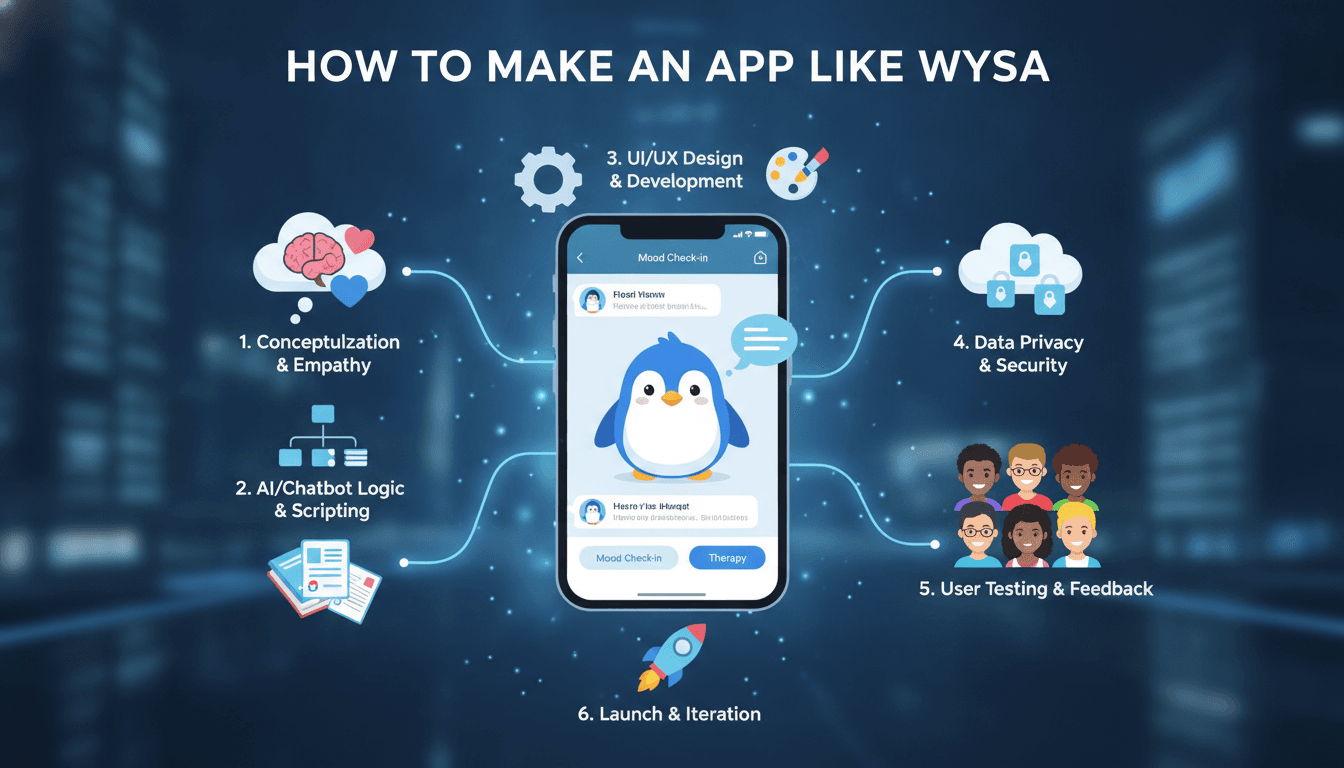
How to Make an App Like Wysa
Mental health support has moved from the therapist's waiting room to the smartphone screen. Wysa, an AI-powered emotional wellness app, has guided millions of conversations using a friendly penguin chatbot, evidence-based CBT techniques, and optional access to human coaches. Its success has inspired founders, healthcare providers, and digital health startups to ask a simple question: how do we build something like this?
This guide walks through what Wysa actually does, the features you need, the technology stack that powers it, the regulatory and ethical guardrails you cannot skip, and what it realistically costs to build.
Related reading: How to Make an App Like Youper.
What Makes Wysa Work
Before writing a single line of code, it helps to understand why Wysa resonates with users.
Anonymity lowers the barrier. Users do not need to create a profile with their real name or talk to a person on day one. That removes the stigma that keeps many people from seeking help.
The AI is structured, not open-ended. Wysa does not simply generate free-form chat. It guides users through clinically validated exercises drawn from Cognitive Behavioural Therapy (CBT), Dialectical Behaviour Therapy (DBT), mindfulness, and motivational interviewing.
The tone is warm and non-clinical. A cartoon penguin, gentle language, and short conversational turns make the experience feel safe rather than diagnostic.
There is a human escalation path. Paid tiers connect users to real therapists and coaches, and crisis detection routes at-risk users toward emergency resources.
Any app you build in this space needs to nail all four of these, not just the chatbot.
Core Feature Set
Conversational AI Companion
The heart of the product. Your bot should recognise user intent and emotional state, respond empathetically, and steer conversations toward useful therapeutic exercises. Most successful implementations blend scripted therapeutic flows with an AI layer that handles natural language understanding and free-text responses.
Mood Tracking and Journaling
Let users log how they feel, add context, and see patterns over time. Visual mood graphs, streaks, and weekly summaries give users a reason to return and create a data trail that makes conversations more personal.
Self-Help Toolkit
Build a library of guided exercises: breathing techniques, grounding routines, sleep stories, thought reframing worksheets, gratitude prompts, and progressive muscle relaxation. Organise them by goal — anxiety, sleep, stress, self-esteem, relationships.
Human Coach or Therapist Access
A premium tier with text-based or video sessions with licensed professionals. This requires practitioner onboarding, credential verification, scheduling, secure messaging, and payment handling.
Crisis Detection and Escalation
Non-negotiable. Your system must detect language indicating self-harm, suicidal ideation, or abuse, then immediately surface region-appropriate helplines and emergency contacts. Build this with clinical input, test it exhaustively, and err heavily on the side of caution.
Personalisation Engine
Track which exercises a user completes, what they respond to, and when they engage. Use that to tailor recommendations and nudge at the right moments.
Progress Dashboard
Show users measurable improvement using validated instruments like PHQ-9 and GAD-7, alongside engagement metrics such as sessions completed and tools practised.
Notifications and Check-Ins
Gentle, well-timed reminders. Over-notifying a person struggling with anxiety is counterproductive, so make frequency user-controlled.
Technology Stack
Mobile front end: Flutter or React Native gives you iOS and Android from one codebase, which matters when budgets are tight. Native Swift and Kotlin are worth it if you need deep platform integration with HealthKit or Google Fit.
Backend: Node.js, Python (Django or FastAPI), or Go. Python is a natural fit if your AI and data science work lives in the same ecosystem.
Database: PostgreSQL for structured user and clinical data, MongoDB for conversation logs, Redis for session caching.
AI and NLP layer: Large language models via API (OpenAI, Anthropic, Google) for natural conversation, combined with fine-tuned classification models for intent, sentiment, and risk detection. Many teams use a retrieval-augmented approach so the model draws only from a vetted library of therapeutic content rather than improvising clinical advice.
Real-time communication: WebSockets or Firebase for live chat, WebRTC or a vendor like Twilio for video sessions with coaches.
Cloud and infrastructure: AWS, Google Cloud, or Azure — all three offer HIPAA-eligible services and Business Associate Agreements.
Analytics: Mixpanel or Amplitude for product behaviour, with strict separation from identifiable health data.
Building the AI Responsibly
This is where mental health apps succeed or fail.
Constrain the model. An unconstrained LLM will eventually say something harmful or clinically wrong. Use system prompts, guardrails, content filters, and a curated knowledge base. Route anything outside safe boundaries to scripted fallbacks.
Involve clinicians from day one. Psychologists and psychiatrists should write and review every therapeutic flow. This is not a nice-to-have; it is your credibility and your legal defence.
Be explicit about what the app is not. Wysa states clearly that it is not a replacement for therapy and not a crisis service. Your onboarding must do the same.
Test adversarially. Have testers deliberately try to elicit unsafe responses. Log failures, patch, repeat.
Keep humans in the loop. Flag conversations for clinical review, especially those that touch on risk.
Compliance and Data Privacy
Mental health data is among the most sensitive category of personal information.
- HIPAA applies in the US if you handle protected health information or work with covered entities.
- GDPR governs EU users, with mental health data classified as a special category requiring explicit consent.
- FDA guidance may apply if you make clinical treatment claims. Wellness positioning avoids this; treatment claims do not.
- App store policies for both Apple and Google impose additional rules on health apps.
Practically, that means end-to-end encryption, encryption at rest, role-based access controls, audit logging, data minimisation, clear retention policies, and an honest privacy policy written in plain language.
To explore this further, see How to Make an App Like Sanvello.
Monetisation Models
Freemium subscription. The Wysa approach — free AI chat, paid access to premium tools and human coaching. Typically $15 to $100 per month depending on tier.
B2B2C through employers. Sell to companies as an employee wellness benefit. Higher contract values and far lower customer acquisition costs.
Healthcare and insurer partnerships. Integrate with providers and payers who reimburse digital therapeutics. Long sales cycles, but durable revenue.
Education and institutional licensing. Universities and schools increasingly buy student mental health platforms.
Avoid advertising. Monetising vulnerable users' attention in a mental health context is both ethically fraught and reputationally risky.
Related reading: How to Make an App Like Happify.
Development Roadmap
Phase 1 — Discovery (3 to 5 weeks). Market research, clinical advisory board, feature scoping, compliance mapping.
Phase 2 — Design (4 to 6 weeks). Wireframes, conversational design, visual identity, accessibility review.
Phase 3 — MVP Build (12 to 16 weeks). Core chatbot, mood tracking, a starter set of exercises, authentication, crisis escalation.
Phase 4 — Clinical Validation and Testing (4 to 8 weeks). Safety testing, usability trials, pilot study with a small cohort.
Phase 5 — Launch and Iterate (ongoing). Store submission, onboarding optimisation, content expansion, coach marketplace.
Cost Expectations
A lean MVP with an AI chatbot, mood tracking, and a basic exercise library typically lands between $60,000 and $100,000. A full-featured platform with human coaching, video sessions, personalisation, HIPAA compliance, and admin tooling generally runs $150,000 to $300,000+.
Ongoing costs matter too: LLM API usage scales with conversation volume, clinical content needs continuous updating, and compliance requires recurring audits. Budget 20 to 30 percent of build cost annually for maintenance and content.
How to Differentiate
Wysa already exists, so cloning it is not a strategy. Consider:
- Niche focus — new parents, veterans, teenagers, healthcare workers, people in recovery.
- Cultural and linguistic localisation — most mental health apps are built for Western, English-speaking users.
- Deeper clinical integration — a bridge between self-help and a user's actual care team.
- Specific modality depth — going all-in on DBT, ACT, or trauma-informed care rather than generic CBT.
- Wearable integration — using sleep, heart rate variability, and activity data to trigger proactive support.
Final Thoughts
Building an app like Wysa is as much a clinical and ethical project as a technical one. The engineering is achievable with a competent team; the hard part is earning trust, keeping users safe, and proving that the app actually helps. Start with a narrow, well-validated feature set, involve mental health professionals at every stage, treat privacy as a product feature, and measure real outcomes rather than just engagement.
Get those fundamentals right and you have the foundation for a product that does more than compete with Wysa — one that genuinely helps people.
Have a project in mind? Contact Sodio Technologies to discuss your requirements and explore the right technology solution for your business.
/// Work with us
Talk to the engineers who'd build it
You'll get a technical scope, timeline and cost estimate from the people doing the work, not an account manager. In-house team, no subcontracting, since 2016.