

Menu Digitisation: Why Restaurant Onboarding Caps Growth
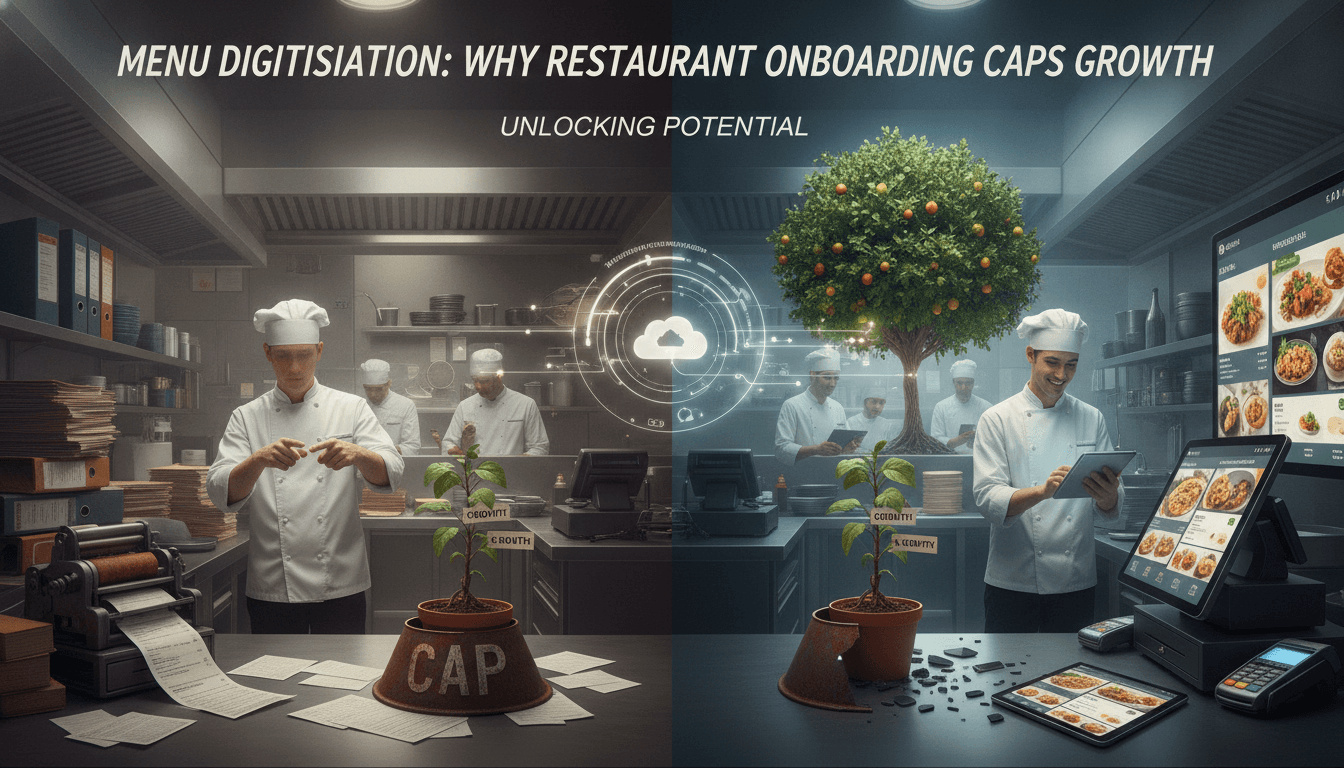
Menu digitisation sounds like the easy part of onboarding a restaurant onto a food-tech platform. It rarely is. At scale, it becomes the single biggest bottleneck between signing a restaurant and making it live — and most platforms underestimate the problem until they're trying to onboard 500 restaurants in a quarter.
Why Onboarding Throughput Is a Business Metric, Not an Ops Detail
Every day a restaurant sits in the onboarding queue is a day it isn't generating GMV. If your average restaurant does ₹40,000 in daily orders through your platform, a five-day digitisation delay per outlet costs real money — and it compounds across your restaurant partner base.
Onboarding speed is also a competitive signal. Restaurant owners talk. If your competitor gets them live in 48 hours and you take a week, you lose negotiations before they start. This is especially true in Tier 2 and Tier 3 cities where restaurants are choosing between two or three aggregators simultaneously.
The problem is almost never willingness to digitise. It is format chaos.
What Does a Restaurant Actually Hand You?
This is where the engineering problem begins. Restaurants hand over menus in formats that range from a photographed handwritten chalkboard to a 47-tab Excel workbook that the owner's nephew built in 2019. In practice, you will encounter:
- WhatsApp images of printed menus, often at an angle, often in two languages
- PDF menus generated from Canva or Photoshop, with no embedded text layer
- Word documents with inconsistent column structures
- Verbal lists dictated over a phone call and typed by a field agent
- Existing POS exports in proprietary CSV schemas that differ by vendor
Each of these requires a different extraction path. A single pipeline does not handle all of them well. The mistake most teams make early on is building one ingestion flow and then patching exceptions manually. That works at 50 restaurants. It collapses at 500.
The Real Cost of Manual Digitisation
Field agents typically take 45 to 90 minutes per restaurant to manually enter a menu, depending on item count and modifier complexity. A mid-sized QSR with 80 SKUs, four size variants, and customisation options can take two hours. If you are onboarding 200 restaurants a month and paying agents ₹300 to ₹500 per hour, the labour cost alone runs to several lakhs monthly. That's before accounting for error rates — manual entry routinely produces 8 to 12% item-level errors that surface only after a customer complains.
How Do You Build a Pipeline That Actually Scales?
The answer is a hybrid extraction architecture. No single model handles all input types with acceptable accuracy. You need to route inputs to the right extractor based on source type, then run everything through a common normalisation layer before it touches your catalogue schema.
A practical stack looks like this:
| Input type | Extraction approach | Accuracy ceiling |
|---|---|---|
| Photographed printed menu | Vision LLM (GPT-4o or Gemini 1.5 Pro) | ~88–93% |
| Scanned PDF with text layer | PDFMiner + rule-based parser | ~96–99% |
| Image-only PDF | OCR (Tesseract 5 or Google Vision API) + LLM post-processing | ~85–92% |
| Structured CSV/POS export | Schema mapping + validation rules | ~97–99% |
| WhatsApp voice note | Whisper transcription + LLM structuring | ~80–88% |
The accuracy numbers above are on clean inputs. Real-world restaurant menus are not clean. Regional language mixing, non-standard item names, modifiers written as footnotes, and prices buried in promotional text all degrade these figures. Build your QA layer assuming 10 to 15% of items will need human review on first pass.
/// Not sure where to start?
Get the architecture before you commit
Tell us what you're building and we'll map the technical approach, stack, and rough timeline. No cost, no obligation, no sales call required.
Normalisation Is Where Most Pipelines Break
Extraction gets the text. Normalisation makes it usable. Your catalogue schema needs items mapped to categories, modifiers linked to parent items, price variants correctly attributed, and dietary flags (veg/non-veg/vegan/contains allergens) reliably set.
The category problem is particularly messy. One restaurant calls it "Starters", another "Appetisers", another "Small Plates", and a street food stall doesn't use categories at all. A taxonomy mapping layer — essentially a classifier that maps free-text category names to your internal ontology — is non-negotiable. Fine-tuning a small BERT-variant on your own catalogue data gets you to ~91% category mapping accuracy, which is meaningfully better than zero-shot GPT-4 on domain-specific restaurant vocabulary.
Modifier inheritance is the other common failure point. A "Biryani" with options for "half" and "full" and add-ons like "extra raita" needs a parent-child modifier structure in your schema. Flat extraction does not produce that. You need a post-processing step that infers modifier trees from proximity, formatting cues, and indentation.
What About Keeping Menus in Sync After Go-Live?
Digitisation at onboarding is only half the problem. Menus change. Prices change weekly in high-inflation periods. Seasonal items come and go. A dish gets sold out and never restocked.
Most platforms solve this reactively — the restaurant calls, an agent updates the menu in the CMS. This is fine at small scale. At 5,000+ restaurant partners, it creates a backlog that permanently lags the real world. Customers order items that are unavailable. Prices on the platform differ from in-store prices. Both generate complaints and refunds.
A better approach is a lightweight sync mechanism. Options in increasing order of complexity:
- A self-serve menu editor that restaurant owners can use on mobile, with change propagation to your catalogue in under five minutes
- A WhatsApp-based update flow where the restaurant sends a photo of a price change and your pipeline processes it automatically
- A POS integration where your platform subscribes to item-level change events from the restaurant's POS system
The WhatsApp flow is underrated. Restaurants already live in WhatsApp. The adoption rate on a WhatsApp-based update interface is significantly higher than training staff on a web CMS they use once a month.
Conclusion
Onboarding throughput is a product problem disguised as an operations problem. The restaurants are ready. The formats they hand you are not. A pipeline that routes by input type, normalises to a shared schema, and flags ambiguous items for targeted human review can cut per-restaurant digitisation time from 90 minutes to under 15 minutes for the majority of cases.
If you are building or revisiting your onboarding stack, start with a two-week audit of your current error distribution by input type. The data will tell you exactly which extraction path to invest in first. Don't build a general solution; fix the specific bottleneck your data shows.
FAQ
How long does menu digitisation typically take per restaurant? Manual entry by a field agent averages 45 to 90 minutes per restaurant, depending on menu size and modifier complexity. An automated pipeline with targeted human review can bring this down to 10 to 20 minutes for straightforward menus. Complex QSR menus with many variants will still need more time.
Can a single AI model handle all menu input formats reliably? No. Vision LLMs perform well on photographed menus but poorly on structured POS exports where a rule-based parser is far more accurate. A routing layer that selects the right extractor by input type consistently outperforms any single model across the full range of formats you will encounter.
What accuracy rate should we target for automated digitisation? Aim for 95%+ at the catalogue level before human review, which means individual item accuracy needs to be higher since errors compound across a full menu. Treat anything below 90% item-level accuracy as a pipeline failure, not an acceptable baseline. The remaining gap should be closed by a targeted QA step, not general human re-entry.
How do we handle menus with regional language content? Google Vision API and GPT-4o both support major Indian regional scripts reasonably well. Accuracy drops on mixed-script menus where, for example, dish names are in Kannada but prices and descriptions are in English. Separating the language detection step and applying script-specific models to each segment improves results over treating the whole image as a single language.
Is it worth integrating directly with POS systems for ongoing menu sync? For restaurant chains and high-volume partners, yes. POS integration gives you real-time item availability and price data, which reduces order failures and customer complaints. For independent restaurants with lower order volumes, a WhatsApp-based update flow gives you 80% of the benefit at a fraction of the integration cost. Prioritise POS integration for your top 20% of partners by GMV first.
Have a project in mind? Contact Sodio Technologies to discuss your requirements and explore the right technology solution for your business.
/// Work with us
Talk to the engineers who'd build it
You'll get a technical scope, timeline and cost estimate from the people doing the work, not an account manager. In-house team, no subcontracting, since 2016.