

Nobody Reads Your Case Studies. They Read Your Docs.
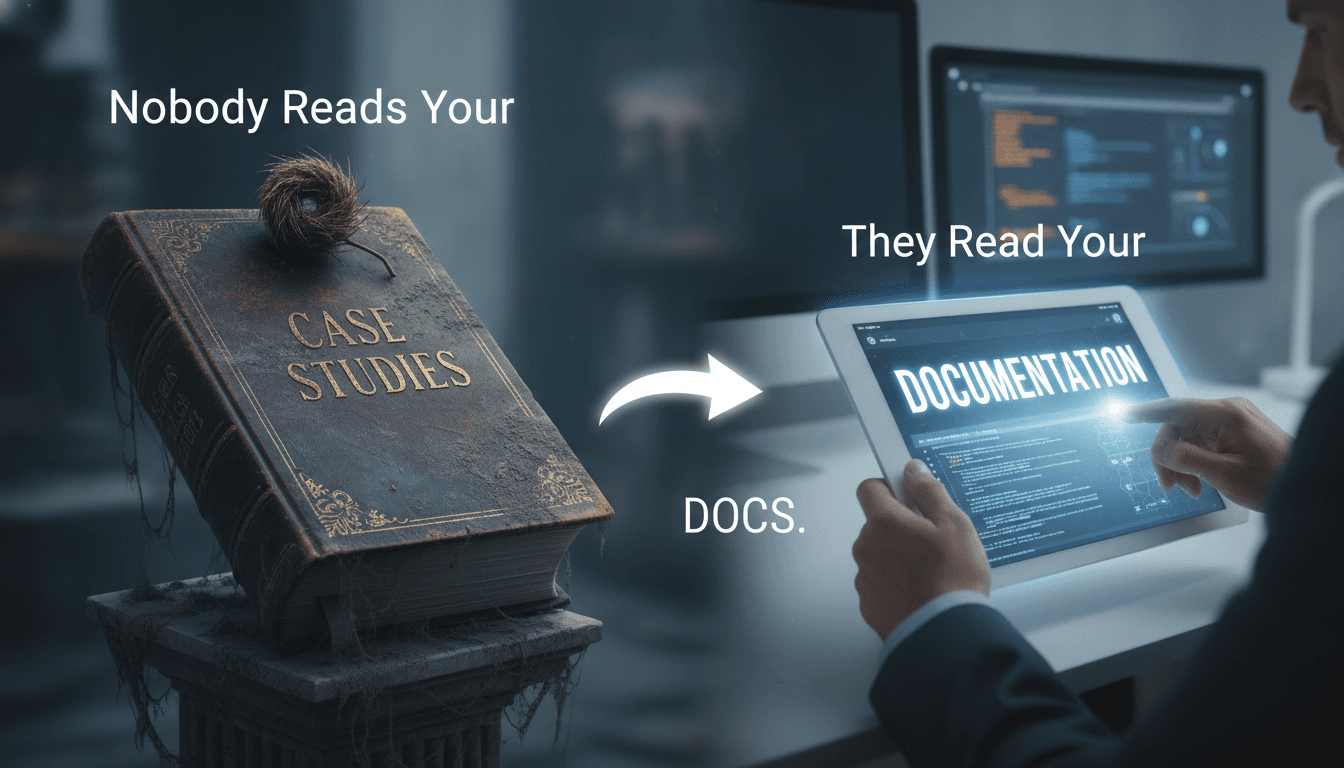
Your documentation is the product demo that never sleeps. Before a prospect books a call, before a lead fills out a contact form, they've already read your docs, your README, your API reference — or they've tried to and given up. Case studies tell them you've done something. Docs tell them how you think.
What Does Your Documentation Actually Signal?
Technical buyers read documentation the way a hiring manager reads code. They're not looking for completeness. They're looking for evidence of how decisions were made.
A well-structured API reference tells them you understand your own system. Clear error messages with actionable descriptions tell them you've operated it under real load. A changelog with honest deprecation notes tells them you can be trusted to communicate bad news. Vague, auto-generated docs from Swagger with no examples and no explanations of edge cases tell them you ship fast and clean up later — or don't.
This matters because the people evaluating your work are technical. A CTO evaluating a custom software vendor isn't moved by a PDF case study with a client logo. They're moved by reading your GraphQL schema and noticing that your pagination follows the Relay spec. That's a signal. It takes thirty seconds to read and it communicates more than three pages of testimonials.
Why Case Studies Fail at the Job They're Supposed to Do
Case studies exist to establish credibility. The problem is that everyone has them, they're always positive, and they're structurally incapable of answering the question a technical buyer is actually asking: Can these people handle our specific problem?
A case study says "we built a payment gateway for a fintech in Southeast Asia." A technical buyer hears: "they want me to believe they can build our thing, based on a description of their last thing."
Documentation answers the real question. If your REST API docs show that you handle idempotency keys on payment endpoints, that you distinguish between 402 and 422 response codes correctly, and that your webhook retry logic follows exponential backoff with jitter — you've just answered the fintech buyer's question without a single sales conversation.
The case study is a claim. The docs are evidence.
/// Not sure where to start?
Get the architecture before you commit
Tell us what you're building and we'll map the technical approach, stack, and rough timeline. No cost, no obligation, no sales call required.
How Should Developer Docs Be Structured to Actually Convert?
The structure that works for documentation that converts technical buyers isn't dramatically different from documentation that converts developers. It's the same thing, because technical buyers are developers — or were, recently enough that they still read like one.
A few structural patterns that consistently work:
Lead with the goal, not the tool. Don't open a section with "This endpoint accepts a POST request." Open with "To initiate a transfer, send a POST to /v1/transfers. The minimum payload is amount, currency, and source_account_id." That framing treats the reader as someone who wants to accomplish something, not someone who needs a lecture.
Show the unhappy path. Most docs show the happy path. Showing what happens when a payment fails, when a webhook isn't acknowledged, when a rate limit is hit — that's what separates documentation written by people who've operated the system from documentation written by people who've only built it.
Version everything. Not just your API version. Your changelog, your migration guides, your deprecation schedule. A buyer who sees that you deprecated a v1 endpoint with a six-month notice and a migration guide trusts you. A buyer who sees a dead endpoint returning 500 with no documentation trusts you less.
One Table Worth More Than a Page of Prose
| Signal | What It Communicates |
|---|---|
| Idempotency keys on mutating endpoints | You've thought about retry behaviour |
| Explicit error codes with descriptions | You've run this in production |
| Webhook retry policy documented | You've debugged event delivery failures |
| SDK with typed responses | You care about the caller's experience |
| Changelog with deprecation timelines | You communicate proactively |
| No examples, only parameter tables | You wrote this for compliance, not use |
What Most Engineering Teams Get Wrong About Docs
The most common failure is treating documentation as a post-ship task. It gets written after the feature is done, by whoever has time, with whatever detail they can reconstruct from memory. The result reads like a police report: technically accurate, emotionally barren, and useless for someone trying to understand intent.
The second failure is writing for the team that built the system. Internal knowledge leaks into docs constantly. You'll see phrases like "use the same credentials as the legacy system" or "see the Confluence page for environment setup" in public-facing references. That tells an evaluator that your external and internal surfaces aren't clearly separated — which is a security signal, not just a quality signal.
The third failure is ignoring search. A developer who lands on your docs page from a Google search for "how to handle webhook failures in [your product]" is already highly qualified. If your docs aren't indexed, structured with proper headings, and written with the vocabulary your users actually search for, you're invisible to the best-qualified inbound traffic you'll ever get.
What Good Looks Like in Practice
Stripe's documentation is the reference standard, and it's been cited so often that it feels cliché. But it's worth being specific about why it works: it opens every section with a goal, every endpoint has a runnable cURL example, error objects are documented with the same rigour as success objects, and the changelog goes back to 2011. That last point is underappreciated. A twelve-year changelog is a trust document.
Twilio's approach to error codes is another specific example. Every error has a URL. The URL leads to a page that explains the error, the likely cause, and the remediation steps. That's not a documentation choice, that's a product decision — it means support volume stays low because users can self-serve on failures.
You don't need Stripe's resources to achieve this. You need a decision: documentation is a first-class deliverable, not a trailing artefact.
Conclusion
If a technical buyer reads your docs and comes away with an accurate picture of how your system behaves under pressure, you've done more sales work than any case study could. The next step is a content audit: open your existing API reference or README, find the first place where you'd be embarrassed to show it to a senior engineer from a company you respect, and fix that section first. Then the next one. It compounds.
FAQ
Does documentation quality actually affect enterprise sales cycles? Yes, measurably. In developer-led growth models, documentation is often the first technical interaction a buyer has with your system. Buyers who can self-evaluate technical quality through documentation require fewer sales-engineering hours and close with higher conviction. Poor docs add friction at the evaluation stage, which lengthens cycles.
What's the minimum viable documentation set for a custom API product? At minimum: an authentication guide, endpoint reference with request/response examples for every method, an error code index with descriptions and remediation notes, a changelog, and a getting-started guide that reaches a working state in under fifteen minutes. Everything else is additive.
Should documentation be written by engineers or technical writers? Both, ideally. Engineers own accuracy; technical writers own clarity and structure. When you only have engineers, the biggest gain comes from requiring runnable examples for every documented behaviour. When you only have writers, require sign-off from the engineer who built the feature before anything ships.
How do you keep docs accurate as the product changes? Treat outdated documentation as a bug. Put doc updates in the same pull request as the code change that necessitates them. If your review process doesn't gate on documentation completeness, docs will always lag. Some teams run a weekly doc audit against a test environment to catch drift early.
Is auto-generated documentation from OpenAPI or Swagger good enough? For a machine-readable contract, yes. For a technical buyer evaluating your system, no. Auto-generated docs show structure; they don't show intent, edge cases, or operational behaviour. Use OpenAPI as the foundation and write prose explanations, examples, and error narratives on top of it.
Have a project in mind? Contact Sodio Technologies to discuss your requirements and explore the right technology solution for your business.
/// Work with us
Talk to the engineers who'd build it
You'll get a technical scope, timeline and cost estimate from the people doing the work, not an account manager. In-house team, no subcontracting, since 2016.