

What Happens to a Codebase When the Client Takes It In House
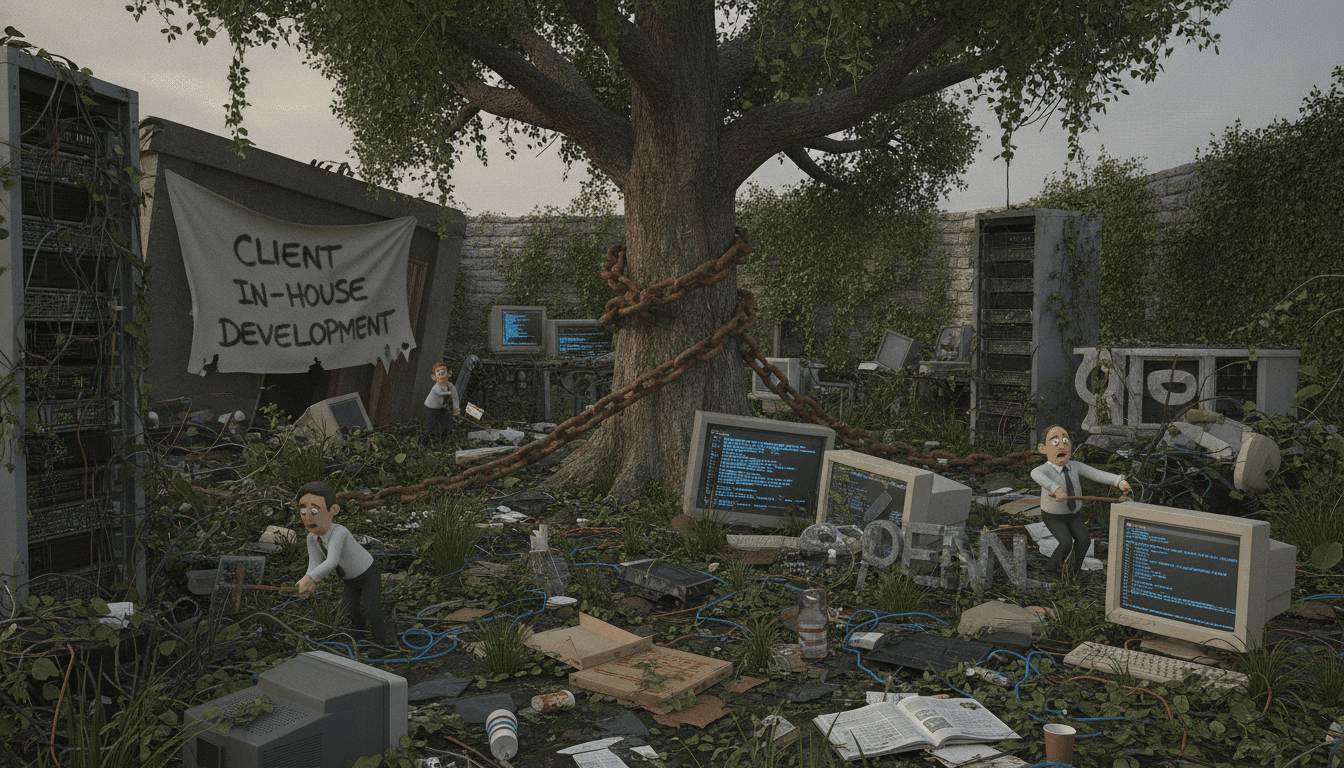
Handing over a codebase is a moment of truth. What looked manageable during the build can surface a backlog of hidden costs the moment your team tries to own it alone.
The First 90 Days Are the Hardest
Most teams underestimate the knowledge transfer problem. Documentation covers what the code does, not why specific decisions were made. The architecture diagram shows the components; it does not explain why you chose PostgreSQL over MongoDB for that particular service, or why the background job queue runs on Sidekiq 6.x rather than something newer.
When the original development team is gone, those decisions become archaeology. A new engineer joins, reads the code, and makes a reasonable guess about intent. Sometimes they're right. Often they're close but not quite. Over twelve to eighteen months, a codebase can drift significantly from its original design principles through a sequence of individually sensible-looking changes.
The fastest way to close that gap is a structured handover, not a two-week documentation sprint at the end of the engagement. Handover should start roughly a quarter before the transition, with the incoming team making real changes under supervision.
What "Documentation" Usually Misses
Most handover packages include a README, an API reference, and maybe an architectural overview. What they almost never include:
- The rejected approaches and why they were ruled out
- The external constraints that shaped decisions (a specific cloud provider's limitations, a client API that behaves unexpectedly, a compliance requirement that never made it into a ticket)
- The parts of the codebase the original team was quietly worried about
- The sequence in which things need to be deployed after a schema migration
None of this is exotic. It just requires someone to sit down and write it honestly, which takes time that is rarely budgeted.
Does Your Team Have the Stack Depth to Maintain It?
This is the question most clients avoid asking directly. The answer matters more than almost anything else.
A team that built a system on Django 4.x, Celery, Redis Streams, and a React 18 frontend needs engineers who are comfortable across all of those. If the incoming team is strong on React but thinner on the Python/Celery layer, incidents in the async processing pipeline will take longer to resolve than they should. That is not a failure of capability in any absolute sense; it is a mismatch between the stack and the team.
Before taking a codebase in-house, map the stack against your team's actual depth. Not familiarity, depth. There is a real difference between an engineer who has used Redis and one who can diagnose a Redis Streams consumer group lag issue under load.
| Stack Layer | Skill Required | Common Gap |
|---|---|---|
| Application logic | Language proficiency | Usually fine |
| Framework internals | Framework-specific debugging | Often thin |
| Infrastructure / IaC | Terraform / Pulumi / CDK | Frequently missing |
| Observability | Grafana, Prometheus, alert tuning | Almost always missing |
| Database | Query optimisation, schema migration safety | Hit-or-miss |
Gaps in the middle three rows are where systems quietly degrade over time. The application runs. The dashboards show green. Then something happens at scale or under an unusual access pattern, and nobody is sure where to look.
/// Not sure where to start?
Get the architecture before you commit
Tell us what you're building and we'll map the technical approach, stack, and rough timeline. No cost, no obligation, no sales call required.
What Actually Breaks After the Handover
Not all breakage is dramatic. Some of it is slow.
Test coverage erosion. The original team wrote tests because they knew the failure modes. The incoming team writes fewer tests, or writes them at the wrong layer, because they are still learning the system. Coverage numbers stay stable. Confidence in those numbers drops.
Dependency staleness. Nobody owns the job of keeping dependencies current. Six months in, you are three minor versions behind on your ORM, eighteen months behind on a cryptographic library, and you did not notice either because nothing broke. This is how security debt accumulates silently.
Observability drift. Dashboards were built to reflect the original team's mental model of the system. When the system changes and the incoming team does not update the dashboards, alerts start firing late or not at all. The observability layer becomes a historical document rather than a live view.
Architectural shortcuts. The incoming team has a deadline. They add a direct database query where there should be a service call, or they skip the message queue for a one-off job. Each shortcut is defensible in isolation. After eighteen months, the system architecture no longer resembles the design, and nobody has a clear picture of what it actually is.
How to Structure the Handover to Avoid the Common Failures
The single highest-leverage thing is pairing, not documentation. Pair the outgoing and incoming engineers on real production issues for at least four to six weeks before the formal transition. That is how tacit knowledge actually transfers.
Beyond that:
- Run a formal threat-modelling session before handover, with both teams in the room. The outgoing team will surface risks they have been quietly managing.
- Audit dependency versions and produce a remediation schedule, not just a list.
- Review alerting thresholds with both teams. Ask the outgoing team to explain why each alert is set where it is.
- Schedule a six-month post-handover review. Not a sales call. A technical review where you look at what the codebase has become relative to what was handed over.
If budget allows, retaining one or two engineers from the original team on a reduced retainer for six months is worth considerably more than the cost. They field the questions that are too specific to answer from documentation.
Should You Have Built It to Be Maintained In-House from the Start?
Honestly, sometimes the answer is no. If your team does not have the depth to own the stack, a custom build hands you an asset you cannot fully maintain. A well-configured SaaS product or a lower-complexity custom solution built on a stack your team already owns may serve you better over a five-year horizon.
This is worth thinking about before a project starts, not after. The technology choices made in the first month of a build have a large effect on the total cost of ownership once the original team is gone. A system built on a framework your team knows well will always be cheaper to maintain than one built on a better-fitting framework your team needs to learn.
If you are already past that decision point, the practical question is: what remediation is realistic before the handover? In some cases, a partial rewrite of the most complex subsystem into a simpler, more maintainable form is the right call. It is not always the wrong choice to simplify a system before handing it over, even if the simpler version is technically less elegant.
Conclusion
Taking a codebase in-house works well when the transition is treated as an engineering problem, not a contract milestone. The risks are known, the mitigations are straightforward, and the costs of skipping them are predictable.
If you are six months from a planned handover, the useful next step is a stack audit against your incoming team's actual skills, followed by a structured pairing plan. If you are further out, that is the right time to influence the technology choices so that the system you receive is one your team can genuinely own.
FAQ
How long should a codebase handover actually take? For a system of meaningful complexity, four to six weeks of active pairing is the minimum. Add time if the incoming team is unfamiliar with the stack. A rushed handover compresses knowledge transfer into documentation, which is a poor substitute for working alongside the engineers who built the system.
What is the biggest hidden cost after taking a codebase in-house? Observability debt. Dashboards and alerts built by the original team reflect their mental model. When the incoming team changes the system without updating observability, you lose the ability to detect failures quickly. Rebuilding that coverage after an incident is significantly more expensive than maintaining it through the transition.
Should we rewrite parts of the codebase before or after handover? Before, if possible. Rewrites done by the original team while the new team watches are far less risky than rewrites done by the new team on a system they are still learning. If simplification is needed, schedule it in the final quarter of the engagement, not after the contract ends.
How do we retain institutional knowledge if the original team is unavailable? Architecture decision records (ADRs) written throughout the project are the most practical tool. Each ADR documents a significant decision, the options considered, and the reasoning. A six-month post-handover retainer for one senior engineer from the original team is a reliable fallback when ADRs are incomplete.
What signals indicate a handover is going poorly? Watch for increasing time-to-resolution on production incidents, a growing list of "we'll fix it later" patches, and test coverage that stays numerically stable while bug reports increase. These patterns typically emerge within three to six months of a poorly managed transition.
Have a project in mind? Contact Sodio Technologies to discuss your requirements and explore the right technology solution for your business.
/// Work with us
Talk to the engineers who'd build it
You'll get a technical scope, timeline and cost estimate from the people doing the work, not an account manager. In-house team, no subcontracting, since 2016.