

Organization Schema and sameAs: Making an Entity Resolvable
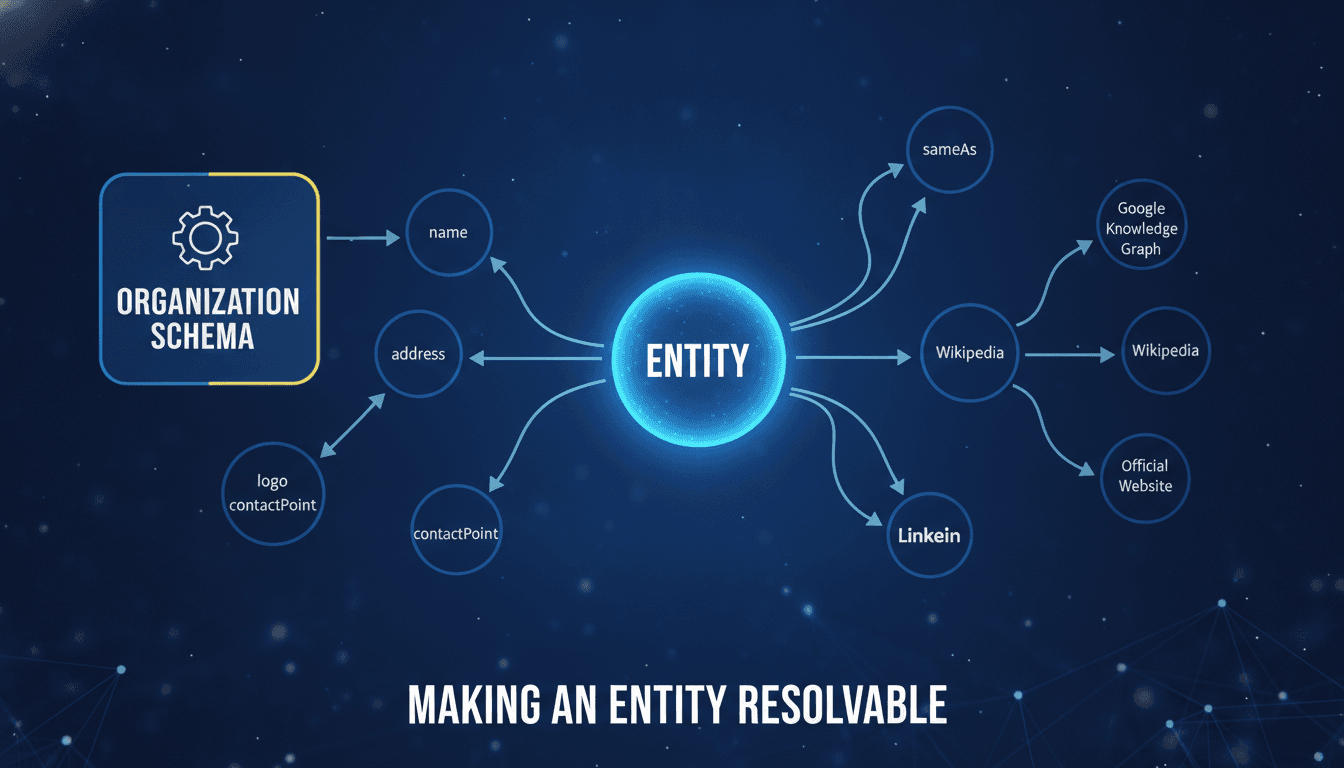
If search engines and AI assistants cannot confidently say "this entity on website A is the same organisation as the entity in my knowledge graph," your structured data is doing half a job. sameAs inside an Organization schema is the fix, and it is simpler than most teams make it.
What Is sameAs Actually Doing?
Google, Bing, and large language models maintain internal knowledge graphs. When they crawl your site, they parse your structured data and try to reconcile what they find with nodes that already exist in those graphs. sameAs is the property that tells them: "the entity described here is identical to the entity at these canonical URIs."
Without it, the crawler has to infer identity from co-occurrence signals, text similarity, and link graph analysis. That inference is noisy. Two organisations with similar names in the same city can remain conflated for months. Explicit sameAs declarations short-circuit that ambiguity.
The property accepts an array of URLs. Each URL should be a stable, dereferenceable identifier for the same real-world entity. A Wikidata QID URL, a Crunchbase profile, a LinkedIn company page — these are all valid targets.
Which URIs Actually Matter?
Not all sameAs targets carry equal weight. Here is how the main options compare:
| URI type | Knowledge graph authority | Dereferenceable | Stability |
|---|---|---|---|
Wikidata (wikidata.org/entity/Q…) |
Very high (feeds Google KG directly) | Yes | Permanent |
| Wikipedia article URL | High | Yes | High (redirect on rename) |
| Google Business Profile | High for local entities | Partial | Medium |
| LinkedIn company page | Medium | Yes | Medium |
| Crunchbase | Medium | Yes | Medium |
| Companies House (UK) | High for legal identity | Yes | Permanent |
| Twitter/X profile | Low | Yes | Low (handle changes) |
| Facebook page | Low | Yes | Low |
| Freebase | Deprecated — do not use | No | Dead |
The rule of thumb: prioritise URIs that are authoritative identifiers in a knowledge base, over profile pages on social platforms. A Wikidata QID is a globally unique, persistent identifier. A Twitter handle is a username that can change.
If your organisation does not have a Wikidata entry, creating one is worth 30 minutes of effort. Wikidata feeds directly into the Google Knowledge Graph. Once your QID exists and your sameAs points to it, you have given Google a ground-truth anchor.
How to Structure the Schema Correctly
The placement of Organization schema matters. Put it in a <script type="application/ld+json"> block in the <head> of your homepage and your "About" page. Do not fragment it across multiple pages with conflicting values.
A minimal but complete example:
{
  "@context": "https://schema.org",
  "@type": "Organization",
  "@id": "https://sodio.tech/#organization",
  "name": "Sodio Technologies",
  "url": "https://sodio.tech",
  "foundingDate": "2016",
  "foundingLocation": {
    "@type": "Place",
    "address": {
      "@type": "PostalAddress",
      "addressLocality": "Bengaluru",
      "addressCountry": "IN"
    }
  },
  "sameAs": [
    "https://www.wikidata.org/entity/QXXXXXXX",
    "https://www.linkedin.com/company/sodio-tech",
    "https://www.crunchbase.com/organization/sodio"
  ]
}
A few things worth noting in that block:
@iduses a fragment URI (/#organization) on your own domain. This makes your site itself a resolvable node in the graph, not just a page.foundingDateandfoundingLocationare not cosmetic. They help disambiguate entities with similar names.- The
sameAsarray should list only URIs you control or that are definitively about your organisation. Do not add URIs speculatively.
/// Not sure where to start?
Get the architecture before you commit
Tell us what you're building and we'll map the technical approach, stack, and rough timeline. No cost, no obligation, no sales call required.
What About LocalBusiness vs Organization?
If you serve customers at a physical location, LocalBusiness (a subtype of Organization) is more appropriate. It accepts openingHoursSpecification, geo, and hasMap, which are signals Google uses for local pack rankings. For a software company operating globally, Organization is the right type. Using LocalBusiness for a remote-first company just to add location fields is not wrong, but it sends mixed signals.
The @id Property and Why It Is Not Optional
Omitting @id means your Organization node has no stable URI. Every crawler visit creates an anonymous blank node. There is no way for external knowledge graphs to link to your entity definition. Set @id once, keep it consistent across every page, and never change it. If you must change it, set up a 301 and update the Wikidata entry.
Does sameAs Actually Affect Rankings?
Directly, no. Google has stated that structured data is not a ranking signal in the traditional sense. What it does affect is entity disambiguation and Knowledge Panel eligibility. Once Google is confident your organisation is a known entity, it may surface a Knowledge Panel in branded searches. That panel shows up before any organic result. For B2B companies where branded search intent is high, this is material.
The indirect effect on rankings is through E-E-A-T (Experience, Expertise, Authoritativeness, Trustworthiness). When your authors are associated with a known organisation entity, and that entity has consistent sameAs signals, authorship markup on your blog posts carries more weight. Articles attributed to a recognised entity rank differently than articles from an anonymous domain.
LLMs trained on web data also use sameAs signals indirectly. When Wikidata and Wikipedia entries link to your site, your organisation is more likely to be represented accurately in model training data. This matters more now that AI overviews and chatbot responses are becoming the first touchpoint for many branded queries.
What Can Go Wrong?
The two most common mistakes:
Contradictory data across pages. If your homepage schema says foundingDate: "2016" and your About page says foundingDate: "2015", you have created conflicting assertions about the same @id. Crawlers average or ignore contradictions. Audit every page that contains Organization schema and make sure the values are identical.
Stale sameAs URIs. LinkedIn company page URLs change when a company rebrands. Crunchbase slugs change. If a URI in your sameAs array returns a 404 or redirects to a different entity, it is worse than not having the URI at all. Set a calendar reminder to validate your sameAs URLs every six months. A simple curl -I in a cron job is sufficient.
Over-claiming. Adding a Wikidata URI that does not exist yet, or that refers to a different organisation with a similar name, is a factual error in your schema. Knowledge graph systems are designed to detect and penalise conflation. Verify every URI before you add it.
Conclusion
Entity resolution is not a one-time task. It requires consistent schema across your site, verified external identifiers, and periodic maintenance of the URIs you claim. Start with three steps: create a Wikidata entry if you do not have one, add a well-formed Organization block with a stable @id to your homepage and About page, and validate every sameAs URI before publishing.
If you want to go further, look at Person schema for your founders and senior authors, link those persons to the Organization entity via the memberOf property, and ensure that the same Wikidata QIDs appear in both your schema and any Wikipedia or Wikidata entries about your team. That creates a coherent, cross-referenced entity graph that search and AI systems can traverse with confidence.
FAQ
What is the minimum viable sameAs implementation?
At minimum, one authoritative URI — ideally a Wikidata QID — in an Organization block with a valid @id. Everything else adds signal but is not strictly required. A single well-chosen authoritative link outperforms five low-quality social profile URLs.
Can sameAs hurt my SEO if I add the wrong URI?
Yes. If a sameAs URI points to an entity that knowledge graphs associate with a different organisation, you may cause conflation. Google may start attributing facts about that entity to yours. Always verify the URI resolves to your entity specifically, not just to a page that mentions your name.
Does sameAs help with Google Knowledge Panels?
Directly contributing to Knowledge Panel eligibility is one of its primary functions. Google uses sameAs signals to match your schema data to existing Knowledge Graph nodes. Without this, panel eligibility depends entirely on passive inference, which is slower and less reliable.
How often should sameAs URIs be audited?
Every six months is a reasonable interval. Social platform URLs are the most volatile; LinkedIn and Crunchbase URLs change on rebranding. Wikidata QID URLs are permanent and do not need checking once validated. Build a simple monitoring script that checks HTTP status codes on all sameAs URLs quarterly.
Should every page on my site include Organization schema?
No. Define it once on your homepage and About page. Including it on every page with slight variations creates conflicting assertions. If you use a CMS or a site-wide schema plugin, make sure it injects an identical block, not a page-specific variant with different field values.
Have a project in mind? Contact Sodio Technologies to discuss your requirements and explore the right technology solution for your business.
/// Work with us
Talk to the engineers who'd build it
You'll get a technical scope, timeline and cost estimate from the people doing the work, not an account manager. In-house team, no subcontracting, since 2016.