

Server-Side Rendering Is Not Optional If You Want AI Citations
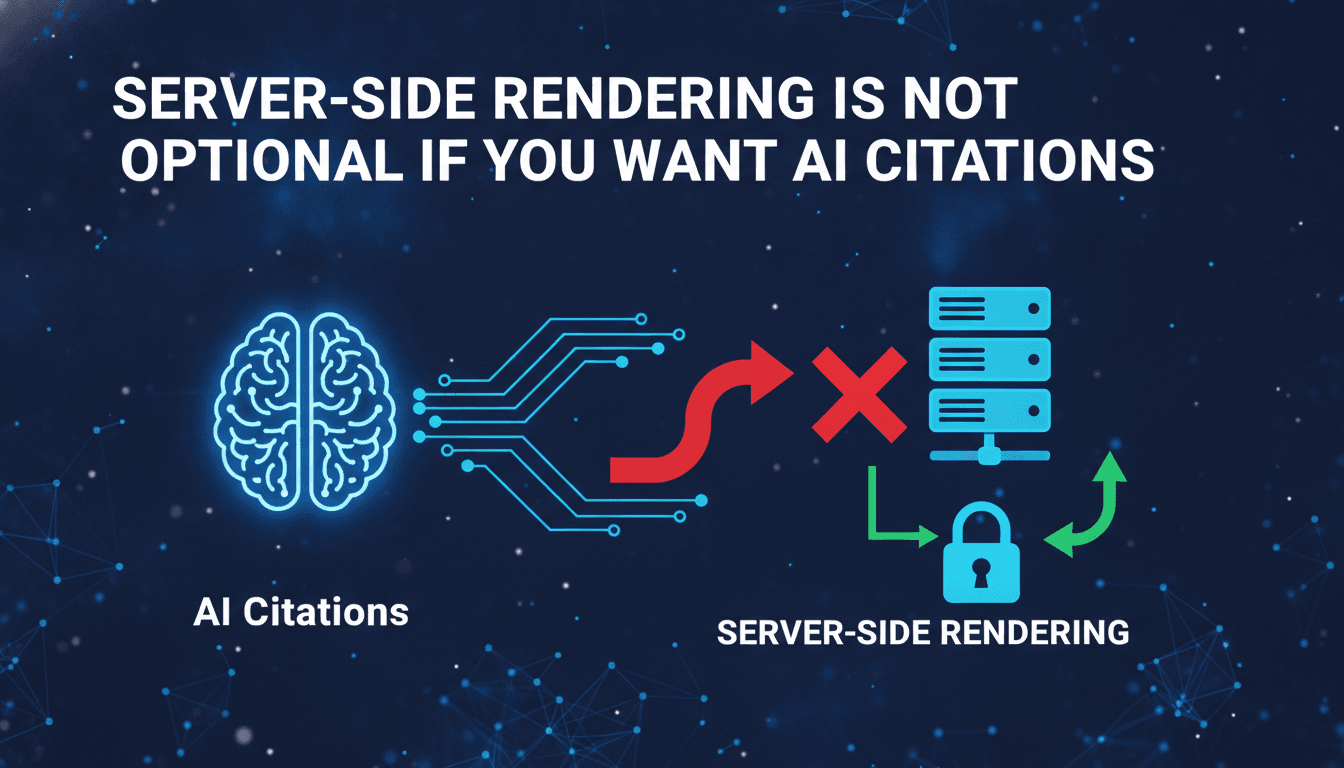
If your web app returns a blank <div id="root"></div> to a crawler, AI systems will not cite you. It is that direct. This post explains why, what SSR actually fixes, and where the trade-offs bite you.
Why AI Citation Crawlers Behave Differently From Google
Search crawlers have, over many years, built second-pass JavaScript rendering pipelines. Googlebot queues client-side pages for a deferred render using a headless Chromium variant. That process has latency and quota limits, but it exists.
AI citation systems, including Perplexity, ChatGPT's browsing tool, Bing's Grounding API, and the retrieval layer behind Google's AI Overviews, largely do not do this. They send a standard HTTP GET, parse what comes back immediately, and move on. If the meaningful content of your page lives inside a React or Angular bundle that hydrates 800ms after the initial response, those systems see an empty shell.
This matters more than it did two years ago. A growing share of zero-click answers cite specific URLs. If your documentation, technical guides, or product pages are client-side rendered, they are structurally invisible to the systems generating those answers.
The mechanism is simple. A crawler that reads HTML at response time gets your content. A crawler that does not execute JavaScript gets nothing but your <head> tags and whatever falls inside <noscript>. The latter describes most AI retrieval pipelines in production today.
What Does SSR Actually Change in the Response?
When you move to server-side rendering, the HTTP response body contains the fully populated HTML. The crawler does not need to run JavaScript to read your <h1>, your article body, your structured data, or your metadata.
There are three practical approaches:
- Full SSR on every request (Next.js
getServerSideProps, Nuxt withssr: true, SvelteKit in server mode): the server computes the HTML per request. Dynamic content is current at render time. - Static Site Generation (SSG): HTML is pre-built at deploy time. Response times are fast, CDN-friendly, and zero compute on the critical path. The trade-off is stale content between builds.
- Incremental Static Regeneration (ISR): Next.js's implementation revalidates specific pages in the background after a configurable TTL. You get the CDN performance of static with bounded staleness. A 60-second
revalidatevalue is often enough for content that changes hourly.
For AI citation purposes, SSG and ISR are usually sufficient. You do not need fresh server-rendered HTML for every crawler hit. You need the HTML to exist and be semantically complete.
/// Not sure where to start?
Get the architecture before you commit
Tell us what you're building and we'll map the technical approach, stack, and rough timeline. No cost, no obligation, no sales call required.
Does Structured Data Actually Help, or Is It Just SEO Folklore?
Structured data genuinely matters for AI citation, and not just for traditional SEO reasons.
Schema.org markup, specifically Article, FAQPage, TechArticle, and HowTo types delivered as JSON-LD, gives retrieval systems machine-readable signals about what a piece of content is and who authored it. Perplexity's documentation and Google's guidance on AI Overviews both reference structured markup as a ranking and eligibility signal.
The key point: JSON-LD in your <head> is readable from the raw HTML response without JavaScript execution. If your framework injects it server-side, it works. If your tagging fires after hydration, it may not.
Check your rendered HTML using curl -A "Mozilla/5.0" https://yoursite.com/your-page and inspect the <script type="application/ld+json"> block directly. If it is not there in the curl output, a non-JS crawler will not see it.
OpenGraph and Meta Tags
The same logic applies to og:title, og:description, og:type, and og:image. These should be populated per-page, server-side, from real content, not from a static fallback in your index.html. Next.js 13+ generateMetadata(), Nuxt's useHead() with server context, and Remix's meta() export all handle this correctly.
A generic og:description that reads "My App" on every page is not just bad SEO. It tells retrieval systems that your pages are undifferentiated, which reduces citation likelihood.
Framework Comparison for SSR and AI Visibility
| Framework | SSR Support | SSG/ISR | JSON-LD Server-Side | Notes |
|---|---|---|---|---|
| Next.js 14 (App Router) | Yes | Yes (ISR via revalidate) |
Yes, via generateMetadata |
Most complete solution today |
| Nuxt 3 | Yes | Yes | Yes, via useHead / modules |
Strong Vue ecosystem |
| SvelteKit | Yes | Yes | Yes, in +layout.server.ts |
Smallest runtime bundle |
| Remix | Yes | No native SSG | Yes, via meta export |
Good for data-heavy apps |
| Gatsby | No SSR | SSG primary | Yes, at build time | Content-heavy, less dynamic |
| Create React App | No | No | No (client only) | Should not be used for public content |
Create React App and any purely client-side Vite config produce pages that AI crawlers will consistently miss. If your marketing site, docs, or content hub was built on CRA and never migrated, that is the first thing to fix.
How Do You Audit What Crawlers Actually See?
The audit is straightforward and takes under an hour for most sites.
curl -s https://yoursite.com/key-page | grep -i "og:description\|application/ld+json\|<h1\|<article"tells you immediately whether meaningful content is in the raw response.- Google Search Console's URL Inspection tool shows you the rendered HTML as Googlebot sees it, post-JavaScript execution. Compare that against the curl output to see what is in the raw HTML versus what requires JS.
- Screaming Frog (version 20+) with JavaScript rendering toggled off will crawl your site and flag pages where the word count difference between raw and rendered HTML is significant.
- Cloudflare's crawler hints via
cf-apoheaders or Vercel's Edge Network logs can tell you how often known AI crawlers (GPTBot, PerplexityBot, ClaudeBot) are hitting your domain and whether they are getting 200s or timeouts.
If you are on a React SPA today, a full SSR migration is not always the right immediate move. A pragmatic intermediate step is to add a pre-rendering service like Prerender.io or to deploy a middleware that detects known crawler user-agent strings and serves a cached static snapshot. This is imperfect and requires maintenance, but it gets content into crawlers faster than a framework migration.
The cleaner long-term path is migrating to Next.js or SvelteKit and building SSR or ISR into the architecture from that point forward.
Conclusion
The content your team spends time writing and maintaining needs to be readable by the systems that surface it. If your stack returns empty HTML to crawlers, that content is effectively unpublished from an AI retrieval standpoint.
Audit your raw HTML response today using curl. If your content is not there, prioritise SSR or SSG in your next sprint planning cycle. The technical lift for a migration to Next.js or SvelteKit is real but bounded. The cost of continued invisibility to AI citation systems compounds every month you wait.
If you want a second opinion on your current rendering architecture before committing to a migration path, Sodio's engineering team is available for technical reviews.
FAQ
Does SSR guarantee AI citations? No. SSR makes your content readable by AI crawlers, which is a necessary condition. It is not sufficient. Content quality, domain authority, topical relevance, and structured data all contribute. SSR removes the structural barrier; it does not replace good content.
Will migrating to Next.js break my existing React components?
Usually not significantly. Next.js 14 with the App Router supports standard React components. The main changes are in data-fetching patterns, replacing useEffect data fetches with server components or getServerSideProps. Plan for 2 to 6 weeks depending on codebase size and data complexity.
Is pre-rendering with Prerender.io a valid long-term solution? It is a valid short-term solution. You serve cached static HTML to detected crawlers and the live SPA to users. The risk is cache staleness and the ongoing maintenance of a separate rendering pipeline. Most teams treat it as a bridge, not a destination.
Which AI systems use crawlers that respect SSR? GPTBot (OpenAI), PerplexityBot, ClaudeBot (Anthropic), and Bingbot all operate as standard HTTP crawlers without JS execution. Google's retrieval layer for AI Overviews does execute JavaScript, but with lower frequency than its standard indexing queue. Designing for non-JS crawlers covers the majority of AI retrieval systems.
Does this apply to documentation sites, or just marketing pages? It applies equally to documentation. Developers increasingly use Perplexity and ChatGPT to find technical answers, and those systems cite docs pages directly. If your documentation is built on a client-rendered framework, it will not be cited even if the content is accurate and well-written.
Have a project in mind? Contact Sodio Technologies to discuss your requirements and explore the right technology solution for your business.
/// Work with us
Talk to the engineers who'd build it
You'll get a technical scope, timeline and cost estimate from the people doing the work, not an account manager. In-house team, no subcontracting, since 2016.