

Smart Grid Management: Ensuring Efficient Energy Distribution
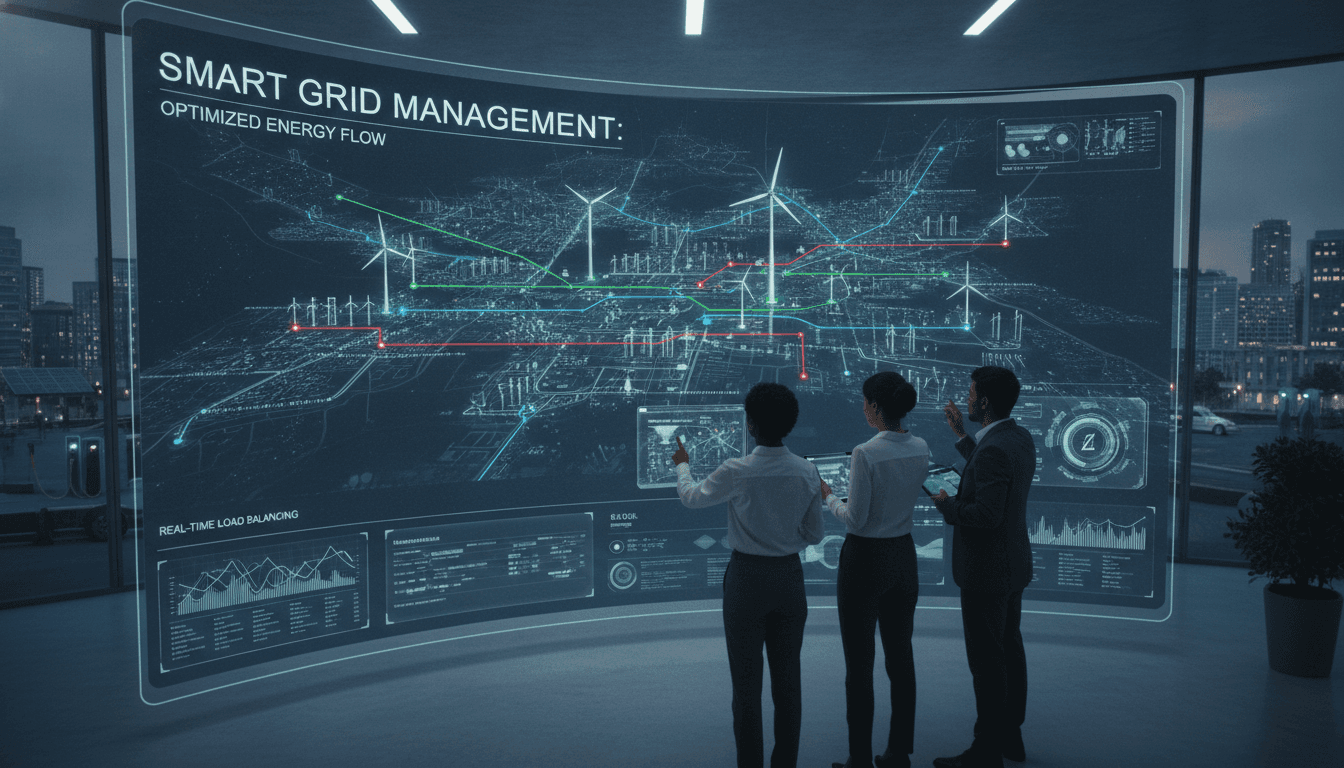
Smart grids are not a future concept. They are running in production across dozens of countries, and the engineering problems they surface are genuinely hard: real-time load balancing across thousands of nodes, bidirectional power flows from distributed generation, sub-second fault isolation, and data volumes that make most enterprise systems look quiet.
This post covers the core architecture decisions you face when building grid management software, the protocols and standards that actually matter, and where things tend to go wrong in practice.
What Does a Smart Grid Management System Actually Do?
A traditional grid operates on a one-directional model: generation plants push power to consumers, and utility operators adjust output manually or with simple SCADA systems. A smart grid flips several assumptions at once.
Power can flow in both directions. A solar installation on a commercial roof can sell surplus back to the grid. An electric vehicle fleet can discharge into the grid during peak demand. This bidirectionality means the management system needs to track both consumption and injection at each node simultaneously.
The system must also respond in near real-time. Grid frequency in most countries sits at 50 Hz (60 Hz in North America and parts of Japan). Significant deviations from that frequency, even by 0.5 Hz sustained for a few seconds, trigger protective equipment. Your control loop latency has a real physical ceiling.
The software stack has to do five things well:
- Collect metering data from AMI (Advanced Metering Infrastructure) endpoints
- Run state estimation to build a consistent picture of the grid topology at any moment
- Execute SCADA or ADMS (Advanced Distribution Management System) control actions
- Run demand forecasting and load dispatch optimisation
- Handle event processing for fault detection and isolation (FDIR)
These are not the same system, and trying to build them as a monolith is a mistake most teams make once.
Which Communication Protocols Should You Standardise On?
This is one of the most consequential decisions in a grid project, and it gets made too early with too little information surprisingly often.
The dominant standards in the space are:
| Protocol | Layer | Primary Use Case | Notes |
|---|---|---|---|
| IEC 61968/61970 (CIM) | Application | Data model interoperability | XML or RDF; used for ADMS integration |
| IEC 61850 | Substation | Protection & control automation | GOOSE messages for sub-4ms trip times |
| DNP3 | Field | SCADA polling to RTUs/IEDs | Widely deployed in older infrastructure |
| DLMS/COSEM | Meter | AMI data collection | Paired with HDLC or TCP/IP transport |
| OpenADR 2.0 | Demand response | DR event signalling to C&I loads | REST-based, reasonably easy to integrate |
IEC 61850 is the right choice for new substation automation. The GOOSE (Generic Object Oriented Substation Event) message type gets protection signals across the station LAN in under 4 milliseconds, which is what breaker trip coordination requires. DNP3 is still everywhere in existing infrastructure, and you will almost certainly need to support it for 10 to 15 years regardless of what you build new.
The CIM (Common Information Model) under IEC 61968/61970 is worth understanding deeply before you design your data model. If your system ever needs to exchange network topology or asset data with another utility system, CIM is the lingua franca. Ignoring it and inventing your own schema creates migration pain later.
How Do You Handle Real-Time State Estimation at Scale?
State estimation is the process of computing the best estimate of the grid's operating state (voltage magnitudes, phase angles, power flows) from a set of noisy, asynchronous measurements. It runs continuously, typically on a cycle of 2 to 30 seconds depending on the grid tier.
The classic algorithm is weighted least squares (WLS) over the power flow equations. At transmission scale this is manageable. At distribution scale with thousands of feeders and load nodes, the computational graph gets large quickly, and the measurement coverage is much thinner than at transmission. Many distribution grids have measurement at 20 to 30% of nodes, not 100%.
Pseudo-measurements fill the gaps. These are estimated values generated from historical load profiles, weather-adjusted demand models, or AMI interval data. The quality of your state estimator depends heavily on how well your pseudo-measurement models are tuned.
/// Not sure where to start?
Get the architecture before you commit
Tell us what you're building and we'll map the technical approach, stack, and rough timeline. No cost, no obligation, no sales call required.
For the real-time processing layer, most production systems run on a time-series database paired with a streaming engine. InfluxDB or TimescaleDB handles the metering data. Apache Kafka or Flink handles the event stream. The state estimator itself typically runs in a C++ or Fortran numerical kernel, with Python orchestration around it. This is an area where reaching for a pure Python stack will cost you when you need to meet control loop latency requirements.
A practical architecture separates the data historian (long-term storage at 15-minute resolution or finer) from the real-time operational datastore (second-resolution, short retention). They serve different query patterns and should not share infrastructure.
Fault Detection, Isolation, and Restoration
FDIR is where grid management software earns its keep. A fault on a distribution feeder needs to be isolated in seconds, not minutes. Modern ADMS systems target service restoration to unaffected sections within 30 to 90 seconds automatically, before most customers even notice a flicker.
The standard approach uses a combination of:
- Fault indicators on the feeder (FCI devices reporting via DNP3 or IEC 61850)
- Topology analysis to identify the faulted section
- Automated switching sequences to isolate the fault and restore adjacent sections through alternate paths
The tricky part is topology management. Real distribution networks have switching operations happening constantly, temporary configurations for maintenance, and sections that are nominally open but available for restoration. Your topology model has to track the live switching state, not just the nominal design-state from the GIS system.
This is also where cybersecurity becomes non-negotiable. IEC 62351 covers security for the IEC 61850 and DNP3 protocols specifically. NERC CIP standards apply to bulk electric system assets in North America. If your system touches protection or control functions, authentication and encryption on the communication layer are not optional.
What's the Right Infrastructure Model: On-Premise, Cloud, or Hybrid?
Most utilities are running hybrid by necessity. The substation automation and real-time SCADA functions stay on-premise or at edge nodes close to the physical equipment. Latency and reliability requirements make a pure cloud architecture impractical for protection-critical functions.
Cloud infrastructure makes sense for the analytics layer: demand forecasting, asset health monitoring, long-term load flow analysis, and reporting. These workloads tolerate higher latency, benefit from elastic compute, and don't need to be co-located with field equipment.
The split roughly follows control plane versus data plane. Keep the control plane on-premise with deterministic connectivity. Move the data plane to cloud where you need scale and flexibility.
Kubernetes works well for the analytics and integration middleware layer. For the real-time control functions, most teams run bare-metal or VMs with real-time OS patches (PREEMPT_RT on Linux, for instance) rather than containers, because container networking jitter is hard to bound tightly enough for sub-100ms control loops.
Conclusion
Smart grid management systems are a class of software where the physical constraints of the grid set hard requirements on your architecture. Latency, topology accuracy, protocol interoperability, and fault response time are not negotiable after the fact.
If you are evaluating a grid management build, start by mapping your actual latency requirements by function. Separate protection-critical from analytics functions early, and choose your communication protocols before you design your data model, not after.
If you want to talk through the architecture for a specific deployment, the engineers at Sodio have worked across AMI integration, ADMS development, and real-time data infrastructure for energy clients. Reach out and we can look at your topology together.
FAQ
What is the difference between SCADA and ADMS in grid management? SCADA (Supervisory Control and Data Acquisition) handles real-time monitoring and manual control of grid equipment. ADMS (Advanced Distribution Management System) adds automation layers on top: state estimation, fault isolation, load flow optimisation, and demand response coordination. Most modern deployments run ADMS with SCADA as a subsystem.
Why is IEC 61850 preferred over DNP3 for new substation installations? IEC 61850 supports GOOSE messaging with sub-4ms delivery, which is required for protection relay coordination. It also standardises the data model, so devices from different vendors interoperate without custom mappings. DNP3 is simpler and more widely supported in legacy field devices, so it remains common for RTU polling outside substations.
How do pseudo-measurements affect state estimation accuracy? Pseudo-measurements are synthetic readings generated from load models where real sensors are absent. They introduce bias if the underlying models are poorly calibrated. In distribution grids with sparse measurement coverage, pseudo-measurement error can degrade state estimator accuracy significantly. Regular model recalibration against AMI interval data helps keep this bounded.
What cybersecurity standards apply to smart grid software? IEC 62351 covers security for IEC 61850, DNP3, and related protocols. NERC CIP applies to bulk electric system assets in North America and mandates specific controls around access management, patch management, and physical security. For distribution-level systems outside NERC CIP scope, IEC 62443 (industrial control system security) is the relevant framework.
When does it make sense to put grid management functions in the cloud? Analytics, forecasting, asset health monitoring, and regulatory reporting workloads are good candidates for cloud deployment. Real-time control, protection automation, and fault isolation functions should stay on-premise or at edge nodes because they require deterministic, low-latency connectivity that public cloud WAN links cannot reliably guarantee.
Have a project in mind? Contact Sodio Technologies to discuss your requirements and explore the right technology solution for your business.
/// Work with us
Talk to the engineers who'd build it
You'll get a technical scope, timeline and cost estimate from the people doing the work, not an account manager. In-house team, no subcontracting, since 2016.