

Video and Music Production Tools: Enhancing Creativity
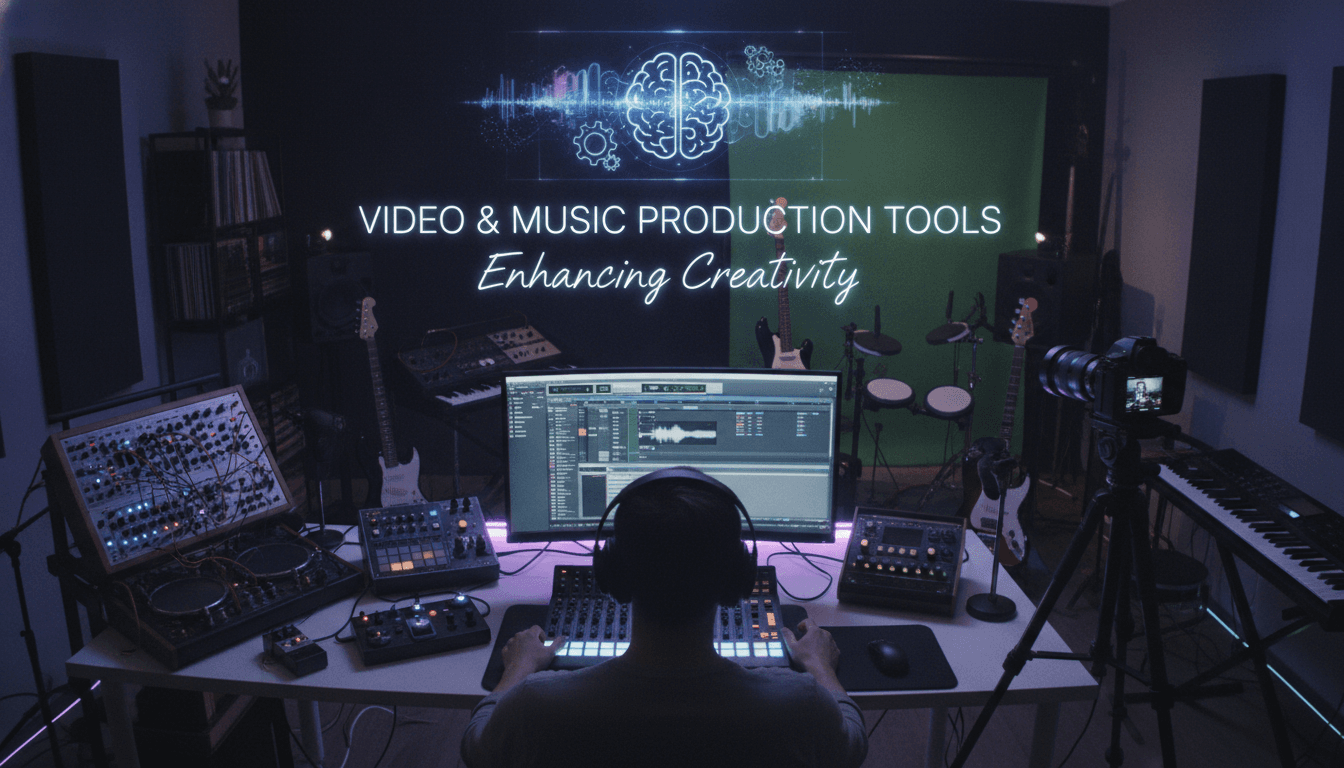
AI, cloud rendering, and specialised APIs are reshaping how production studios build their toolchains. Here is what is actually worth integrating, what is still immature, and where to draw the line between off-the-shelf and custom.
What Has Actually Changed in the Last Three Years
The shift is not in the tools themselves but in how they connect. DAWs like Ableton Live 12 and Logic Pro 10.8 have always had plugin ecosystems, but they were siloed. Similarly, video editors like DaVinci Resolve 18 and Premiere Pro 24 are fully capable standalone tools. What is new is the maturity of the APIs and SDKs sitting around them, and the availability of ML inference at reasonable latency on consumer hardware.
Apple Silicon changed the cost model for on-device inference. An M3 Max running a quantised diffusion model locally is not a toy anymore. It is a legitimate production environment. For audio, models like Meta's MusicGen and Stability AI's Stable Audio Open can run inference in under 10 seconds on that hardware for a 30-second clip. That matters because it removes the round-trip to a cloud API for every iteration.
At the same time, cloud-side rendering has matured. Frame.io's Camera to Cloud protocol, integrated with Resolve and Premiere, means raw footage can be in a remote edit suite within seconds of capture. That is a genuine workflow change, not marketing copy.
What Does "AI-Assisted Production" Actually Mean in Practice?
The term gets used loosely. It covers at least four distinct capabilities, and conflating them leads to poor architectural decisions.
Generative audio produces original stems, loops, or full compositions from a text prompt or MIDI seed. Tools here include Udio, Suno v3, and the open-weight MusicGen-Melody model from Meta. Quality is usable for temp tracks and background music. It is not yet reliable for lead melody or emotionally complex composition without significant human curation.
Audio restoration and correction uses models trained on degraded audio pairs. iZotope RX 11 and Adobe Podcast's Enhance Speech are the production-ready options. RX 11's Dialogue Isolation module runs a spectral neural network that genuinely outperforms traditional spectral editing for voice isolation in noisy environments.
Video generation from text or image prompts is still unreliable for anything beyond short clips under 10 seconds. Runway ML's Gen-3 Alpha and Sora (limited access) produce compelling results in demos. In practice, temporal consistency degrades beyond 6 to 8 seconds without stitching tricks. Do not build a production dependency on these tools yet if output consistency matters.
Intelligent editing assistance covers things like DaVinci Resolve's Magic Mask, Premiere's AI-driven scene cut detection, and Descript's Overdub. These are the most immediately useful because they accelerate mechanical tasks without requiring you to trust the AI on creative decisions.
The distinction matters because the risk profile is different for each. Generative audio can be auditioned and rejected cheaply. Generative video as a structural dependency is a risk most production pipelines cannot absorb yet.
/// Not sure where to start?
Get the architecture before you commit
Tell us what you're building and we'll map the technical approach, stack, and rough timeline. No cost, no obligation, no sales call required.
How Should You Structure a Custom Production Toolchain?
If you are building internal tooling for a studio or a SaaS product for creators, the architecture question is: where does your custom code sit relative to the commercial tools?
The sensible answer for most teams is to treat the professional applications as immovable nodes and build orchestration around them, not replacements. DaVinci Resolve has a full Python scripting API. Ableton Live exposes its session via Max for Live and the AbletonOSC protocol. Logic Pro supports AppleScript and MIDI Remote Scripts. These are your integration points.
| Layer | Tool/API | What you can automate |
|---|---|---|
| Video edit | Resolve Python API | Timeline assembly, colour grade export, marker injection |
| Audio DAW | Ableton AbletonOSC | Session state, clip triggering, parameter automation |
| Asset management | Frame.io API v4 | Upload, review routing, version control |
| AI inference | Replicate, Banana.dev, or self-hosted | Model serving for generative and correction tasks |
| Render farm | ShotGrid + Deadline 10 | Job queuing, distributed rendering, notifications |
Building your own DAW is almost never the right call. The physics simulation in audio engines (Faust, JUCE) and the colour science in video tools took decades to tune. The value you add is in workflow logic, data pipelines, and ML integration, not in reimplementing FFT convolution.
When Self-Hosted Inference Makes Sense
If your pipeline runs inference on more than a few hundred clips per day, self-hosted models on A100 or H100 instances will be cheaper than API calls within a few months. The break-even depends on your volume and the specific model, but as a rough reference, Replicate charges approximately $0.0023 per second of A100 compute. A single A100 instance on AWS (p4d.xlarge equivalent) costs around $3.20 per hour. At sustained throughput, the maths favours self-hosting above roughly 400 inference minutes per day.
The operational cost of running your own model serving infrastructure (monitoring, versioning, scaling) is real. Use managed inference if you are not already running ML infrastructure. The overhead is not worth it below that threshold.
What Are the Real Bottlenecks in Collaborative Production Pipelines?
Storage and transfer, not compute, are usually the first constraint. Uncompressed 4K ProRes 4444 footage runs at approximately 1.2 GB per minute. A feature film shoot can generate 5 TB in a single day. Moving that around a distributed team is not a solved problem even with Frame.io and Aspera.
Object storage with intelligent tiering (S3 Intelligent-Tiering, or Azure Blob with lifecycle policies) handles the economics reasonably well, but access latency for remote editors on hot footage is still a pain point. Edit-ready proxies generated at ingest, typically ProRes Proxy at 1/4 resolution, are the standard answer. Automate proxy generation at upload time; do not leave it as a manual step.
Version control for audio projects is underserved by existing tools. Git does not handle large binary files well without LFS, and even with LFS, merging DAW project files is not possible in any meaningful sense. The practical approach is to version at the session-export level, with named snapshots, rather than trying to apply source control semantics to a .als or .logicx file.
For real-time remote collaboration, Audiomovers LISTENTO and Sonobus provide low-latency audio streaming over standard internet connections. Sonobus targets under 20ms latency on a good connection. That is usable for overdub sessions but marginal for tight rhythmic recording.
Conclusion
The tools that are genuinely production-ready deserve to be integrated properly, via their APIs and scripting interfaces, rather than worked around. The tools that are still maturing, particularly generative video, should be kept at the edges of your pipeline where failures are recoverable.
If you are evaluating whether to build custom tooling or buy, start by mapping the mechanical tasks in your current workflow that consume disproportionate engineer or operator time. Those are the integration points worth investing in. Everything else, the creative tools themselves, should be left to the vendors who have spent years on them.
Pick one integration, instrument it properly, and measure the time saving before building the next one.
FAQ
Is AI-generated music legally safe to use commercially? The legal position depends on jurisdiction and the specific model's training data. As of mid-2024, no major jurisdiction has definitively ruled on AI-generated music copyright. Tools like Udio and Suno have faced litigation in the US. For commercial work, use models with explicit commercial licences and documented training data provenance, such as MusicGen with its CC-BY-NC licence clearly understood and worked around.
Can open-source models match iZotope RX for audio restoration? For broadband noise reduction and basic de-clicking, open-source tools like Demucs v4 and the Facebook Research audio separator are competitive. For dialogue isolation in complex acoustic environments, iZotope RX 11's Dialogue Isolation module still leads. The gap is narrowing but it is real enough to matter in professional post-production contexts.
What is the minimum viable setup for a cloud-based video pipeline? Frame.io Camera to Cloud handles ingest and review. S3 with lifecycle policies handles storage economics. DaVinci Resolve's project server handles multi-seat editing. ShotGrid handles production tracking. You can get a functional collaborative pipeline for a small team for under $2,000 per month in infrastructure and licences.
How do you handle audio stem separation in a production workflow? Demucs v4 (htdemucs_ft model) is the current open-weight standard. It separates a stereo mix into four stems: drums, bass, vocals, and other. Output quality is sufficient for remix and sync work. For forensic separation or mastering-grade output, expect manual cleanup. Run it as a batch process on ingest rather than on demand to avoid blocking editors.
When does it make sense to build a custom plugin rather than use an existing one? When the processing logic is specific to your content type and not covered by existing DSP or ML plugins, and when the volume of content justifies the engineering investment. A custom JUCE plugin or Max for Live device takes two to eight weeks to build properly, depending on complexity. For one-off tasks, scripting existing tools is almost always faster.
Have a project in mind? Contact Sodio Technologies to discuss your requirements and explore the right technology solution for your business.
/// Work with us
Talk to the engineers who'd build it
You'll get a technical scope, timeline and cost estimate from the people doing the work, not an account manager. In-house team, no subcontracting, since 2016.