

How to Make an App Like Splash
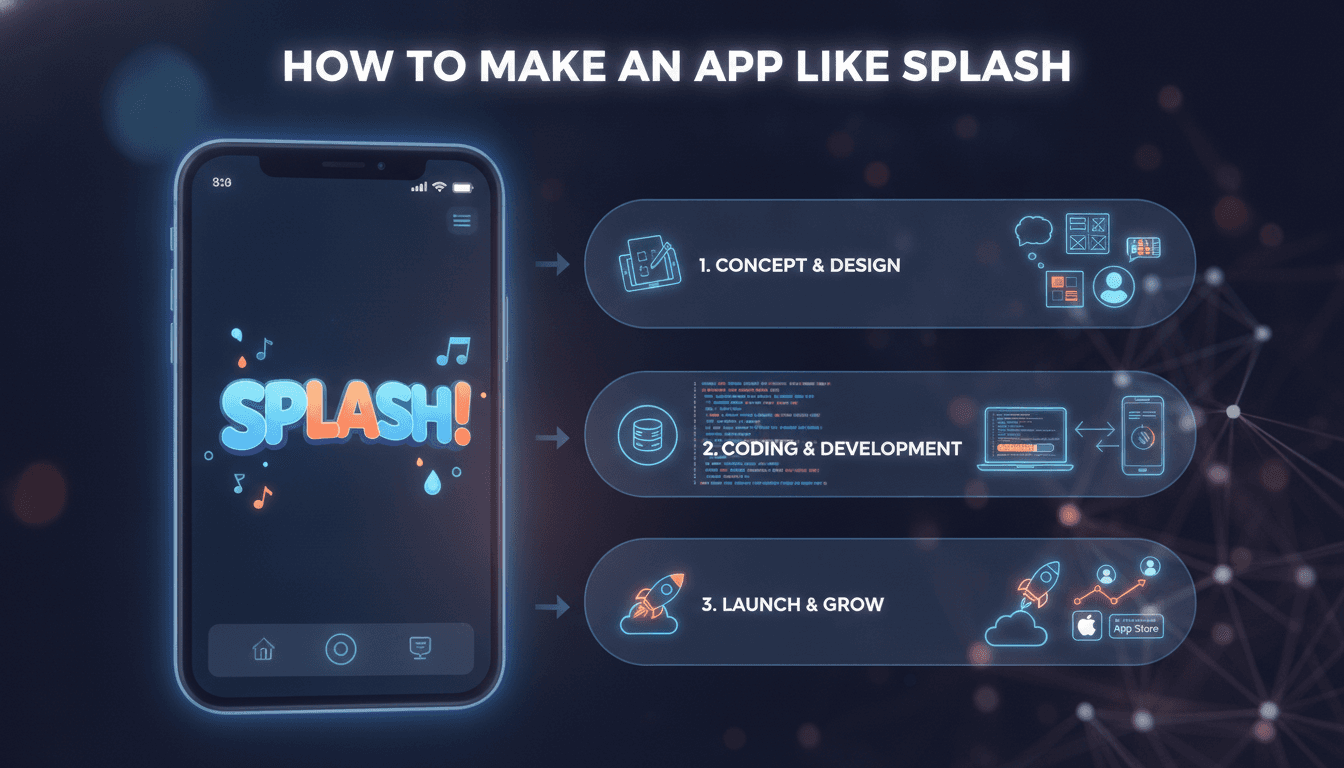
Building a music-focused social app is harder than it looks. Splash sits at the intersection of short-form video, real-time audio processing, and creator monetisation. Each of those is a non-trivial engineering problem on its own. Combined, they demand careful architectural decisions from day one.
This post walks through what it actually takes to build something like Splash: the tech stack, the tricky parts, the cost drivers, and where projects like this tend to go wrong.
What Does Splash Actually Do Under the Hood?
Splash lets users record short vocal performances, apply effects in real time, and share them socially. The surface looks simple. Underneath, you have:
- Real-time audio capture and processing on-device
- Low-latency effects chain (pitch correction, reverb, EQ)
- Video recording synchronised with audio
- A feed algorithm that surfaces relevant content
- Payments and creator payouts
The audio processing layer is where most teams underestimate effort. Mobile microphone input is inconsistent across devices. Android fragmentation across OEMs makes this worse. You are dealing with AudioRecord latency on Android (often 100–200ms without tuning) and AVAudioEngine on iOS. Getting that below 30ms for a usable real-time experience requires native code, not just React Native or Flutter audio plugins.
How Much Does It Cost to Build an App Like Splash?
Cost depends almost entirely on where you invest engineering time. Here is a realistic breakdown for a v1 with core features:
| Feature Area | Estimated Effort (weeks, 2 engineers) |
|---|---|
| Auth, profiles, social graph | 3–4 |
| Audio recording + effects chain | 6–10 |
| Video capture + sync | 3–4 |
| Feed + discovery algorithm | 4–6 |
| Payments / creator payouts | 3–5 |
| Admin panel + moderation tools | 2–3 |
| Infrastructure (CDN, transcoding) | 2–3 |
| Total | 23–35 weeks |
At a mid-market agency rate, that puts you somewhere between $120,000 and $280,000 USD for a cross-platform v1. Those numbers assume a well-scoped brief and no major pivots mid-build. Scope creep on the audio layer is the single biggest budget killer in this category.
If you are building in-house, budget for the fact that real-time audio engineers are hard to hire. Expect to pay a senior iOS/Android audio engineer 30–40% above a standard mobile rate.
/// Not sure where to start?
Get the architecture before you commit
Tell us what you're building and we'll map the technical approach, stack, and rough timeline. No cost, no obligation, no sales call required.
The Audio Processing Architecture
This is the part most posts skip. It is also the part that differentiates a product that feels professional from one that feels like a demo.
On-Device vs. Server-Side Processing
For real-time effects (pitch shift, reverb, auto-tune), you have two choices: process on-device or stream to a server and return processed audio. Server-side processing introduces 80–150ms of round-trip latency on a good 4G connection. That is unusable for real-time vocal performance. Everything that needs to feel live must run on-device.
Post-recording effects (mastering, noise reduction, format conversion) can reasonably run server-side. AWS Lambda or Google Cloud Run work well here with containerised FFmpeg pipelines.
Recommended Stack for On-Device Audio
On iOS, AVAudioEngine with AUAudioUnit gives you a proper graph-based processing chain. You can insert pitch correction via third-party AU extensions or build your own using the Accelerate framework and vDSP for FFT-based processing.
On Android, the Oboe library (maintained by Google) is the right starting point. It selects between AAudio and OpenSL ES based on the device's API level and handles the latency negotiation automatically. Target a buffer size of 128–256 frames. Anything above 512 frames and you will feel it.
For cross-platform parity, some teams use a shared C++ audio engine compiled with CMake for both platforms, with thin native wrappers. This works well when the team has C++ depth. If it does not, you will spend months debugging JNI crashes on Android.
Media Transcoding and Storage
User uploads need to be normalised before storage. Raw audio from different devices varies wildly in sample rate (44.1kHz vs 48kHz), bit depth, and format. Run everything through a transcoding pipeline before writing to object storage. FFmpeg in a Docker container, triggered by an S3/GCS event, is the standard approach. Transcode to AAC at 128kbps for playback, keep the lossless original if your retention policy allows.
For video, transcode to H.264/AAC in an MP4 container. HLS packaging with three bitrate variants (360p, 540p, 1080p) covers most playback conditions without over-serving bandwidth.
Feed Algorithm: What Actually Drives Engagement?
Short-form audio-social apps live and die by feed quality. A chronological feed works at zero scale and nowhere else.
The signals that matter most for a music or vocal content feed are different from those in a general video feed. Completion rate matters more than likes. A 15-second clip played to 90% completion is a stronger signal than one that gets 50 likes but is skipped at 3 seconds. Build your scoring function around this early.
A simple starting model:
- Completion rate: weight 0.5
- Re-plays: weight 0.2
- Shares: weight 0.2
- Profile follows triggered: weight 0.1
Run this as a lightweight scoring job in PostgreSQL or BigQuery on a rolling 48-hour window. You do not need a recommendation engine on day one. A well-tuned scoring function beats a poorly trained ML model at early scale.
When you hit around 50,000 daily active users, move to a two-tower retrieval model (candidate generation + ranking). At that point, tools like Google's TFX or Meta's Pytorch-based recommendation systems are worth the investment.
Payments and Creator Monetisation
Splash uses a tipping and virtual gifting model. If you are replicating this, Stripe Connect is the fastest path to compliant marketplace payments in most jurisdictions. Stripe handles KYC for payees, which removes significant legal surface area from your side.
Be aware that both Apple and Google take a 30% platform cut on in-app purchases (reduced to 15% for subscriptions after year one under the Small Business Programme). If virtual gifts are bought via in-app purchase, that cut applies before the creator sees anything. Some apps route purchases through the web to avoid this, which introduces friction but changes the unit economics significantly.
If your creator payouts involve international transfers, look at Wise Platform or Airwallex as alternatives to Stripe for non-US-centric creator bases. The fees on international payouts through Stripe can erode creator earnings materially.
Conclusion
The path to building an app like Splash is well-defined, but it is not short. Get the audio stack right first. Everything else, the feed, the social graph, the payments, can be iterated on after launch. A product with mediocre discovery but great audio feels better to users than the reverse.
If you are scoping this out, the first decision to make is whether your team has native audio engineering depth. If it does not, that gap needs to be filled before build starts, not during it.
Talk to us at Sodio if you want a technical scoping session. We have built systems in this space and can give you an honest read on effort before you commit budget.
FAQ
How long does it take to build an app like Splash? A cross-platform v1 with core audio features, social feed, and payments typically takes 23–35 engineer-weeks. Timeline depends heavily on how much custom audio processing is required and whether the team has prior native audio experience. Plan for 6–9 months from brief to a production-ready release.
What is the hardest technical part of building a music social app? Real-time audio processing with low latency on Android. iOS is relatively controlled, but Android's hardware fragmentation means latency varies significantly across devices. Getting consistent sub-30ms end-to-end latency requires using Oboe, careful buffer tuning, and testing on a wide device matrix early.
Can you build this with React Native or Flutter? For the social and UI layers, yes. For the real-time audio processing layer, no. You will need native modules written in Swift/Kotlin or a shared C++ engine. Trying to do real-time audio entirely in Dart or JavaScript will not produce a usable result.
How do creator payouts work technically? Stripe Connect is the standard for marketplace payouts in most regions. It handles KYC, tax form collection (W-9/W-8BEN), and transfer scheduling. For international-heavy creator bases, Wise Platform or Airwallex offer better rates on cross-border transfers.
What does a scalable media storage setup look like for this kind of app? Store raw uploads in S3 or GCS, trigger a transcoding pipeline via event notification, and write processed assets to a CDN-backed bucket. Use CloudFront or Cloudflare for delivery. Pre-signed URLs for upload avoids routing large media files through your application servers.
Have a project in mind? Contact Sodio Technologies to discuss your requirements and explore the right technology solution for your business.
/// Work with us
Talk to the engineers who'd build it
You'll get a technical scope, timeline and cost estimate from the people doing the work, not an account manager. In-house team, no subcontracting, since 2016.