

What Dedicated Developers Cost and What Changes at Each Seniority
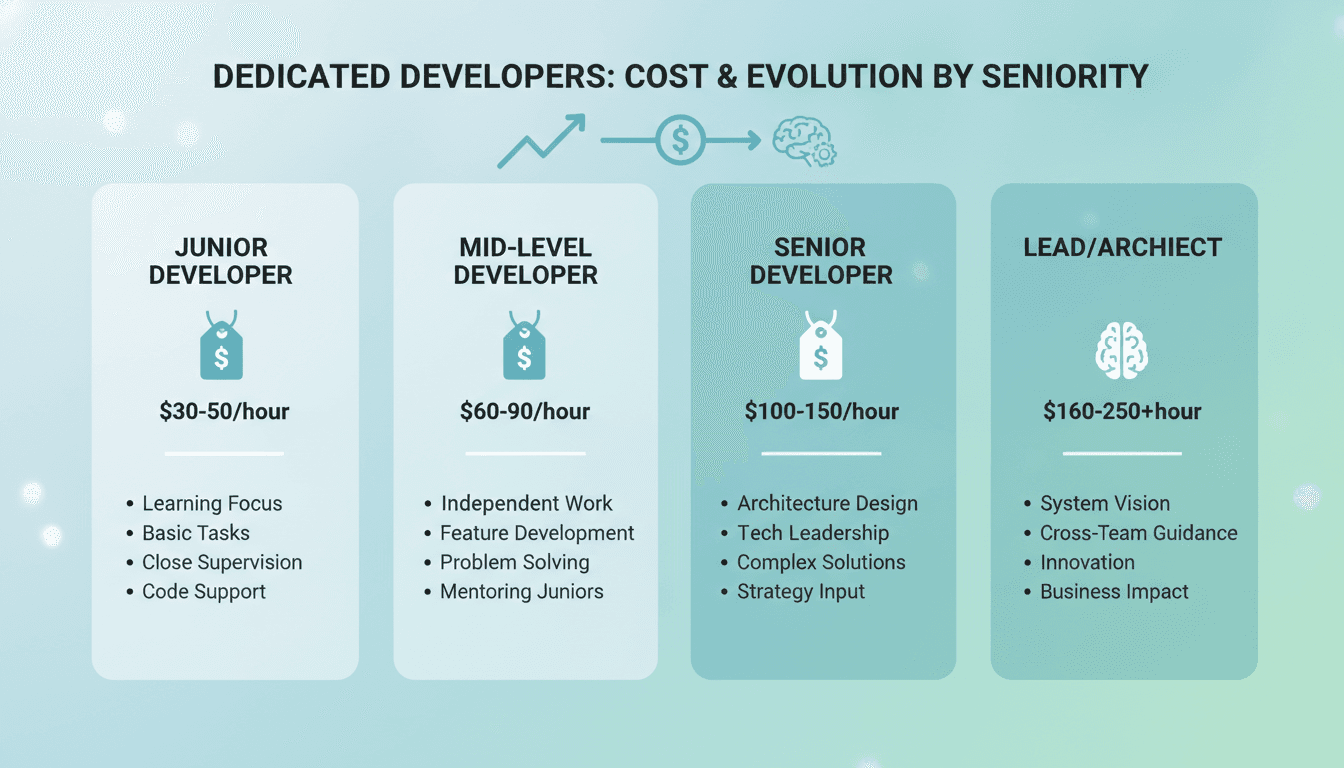
A practical breakdown of what you actually pay for at each seniority level when hiring dedicated developers, and where the real cost differences show up in your system's quality and delivery speed.
The Numbers First
Rates for dedicated developers vary widely depending on geography, engagement model, and how the contract is structured. Here is a representative range for engineers hired through a dedicated model (full-time equivalent, monthly):
| Seniority | India (USD/month) | Eastern Europe (USD/month) | Latin America (USD/month) |
|---|---|---|---|
| Junior (0–2 yrs) | 800–1,400 | 1,500–2,500 | 1,200–2,000 |
| Mid-level (2–5 yrs) | 1,800–3,000 | 3,000–4,500 | 2,500–4,000 |
| Senior (5–10 yrs) | 3,500–6,000 | 5,000–8,000 | 4,500–7,000 |
| Lead / Staff (10+ yrs) | 6,000–10,000 | 8,000–14,000 | 7,000–12,000 |
These are market rates as of 2024–2025. They do not include the vendor's margin if you are going through an agency, which typically runs 20–40% on top depending on the contract structure.
The range within each band is real. A senior engineer at the lower end of a band usually means a narrower specialisation or a smaller portfolio of shipped systems. At the upper end, you are paying for breadth: someone who has debugged production issues at 3 a.m., made architectural calls they later had to live with, and learned from both.
What Actually Changes Between Junior and Senior?
The obvious answer is speed. A senior engineer writes code faster. That is true but not the most important difference.
The more significant gap is in decision surface. Junior engineers solve the problem in front of them. Senior engineers question whether that is the right problem. A junior developer handed a requirement to add a new microservice will build it. A senior engineer will ask whether the service boundary makes sense, whether it duplicates logic already in another service, and whether the communication pattern chosen will cause latency issues at scale. That conversation does not show up in a ticket, but it shows up six months later in your architecture.
Concretely, here is where seniority pays:
- Code review quality. Senior engineers catch security issues, not just style violations. They spot places where error handling is missing or where a retry loop will cause a thundering herd under load.
- Estimation accuracy. Mid-level and senior engineers have shipped enough to know what they do not know. Their estimates include buffer for integration, edge cases, and testing. Junior estimates tend to cover the happy path.
- Onboarding cost. A junior developer typically needs 4–8 weeks before they are net-positive contributors on an unfamiliar codebase. A senior engineer is usually productive within 1–2 weeks and often identifies pre-existing problems in week one.
- Incident response. When a service goes down, you want someone who can read a flamegraph, correlate logs across services, and form a hypothesis quickly. This is pattern recognition built from having seen failures before.
How Should You Structure a Team Across Seniority Levels?
A team of all senior engineers is expensive and often dysfunctional. Senior engineers need problems worth solving. If your backlog is mostly CRUD work and feature flags, a team heavy on juniors with one senior to review and guide is more cost-effective and keeps your senior from getting bored.
A pattern that works well in practice:
- 1 lead or staff engineer owning architecture and technical direction
- 2–3 senior engineers for system-critical work and mentoring
- 3–5 mid-level engineers as the core delivery layer
- 1–2 juniors on well-defined, bounded tasks with clear acceptance criteria
This is not a universal ratio. A fintech building a payment reconciliation engine needs more seniors than an e-commerce team adding product filters. The deciding factor is how much ambiguity is in the work. Ambiguity is expensive when it is handled by people who have not seen it before.
/// Not sure where to start?
Get the architecture before you commit
Tell us what you're building and we'll map the technical approach, stack, and rough timeline. No cost, no obligation, no sales call required.
What Does "Dedicated" Actually Cost Beyond the Day Rate?
The rate you negotiate is not the total cost. There are consistent add-ons worth accounting for:
Infrastructure and tooling. If the developer is working on your systems, factor in their share of Datadog, GitHub, Jira, and whatever CI/CD environment you are running. This is rarely more than USD 200–400 per developer per month, but it adds up.
Onboarding and context transfer. Your internal team will spend time getting an external developer up to speed. For a senior engineer, budget 20–30 hours of internal time in the first month. For a junior, budget 40–60 hours spread across the first two months.
Management overhead. A dedicated developer is not a fully autonomous unit. Someone needs to write clear requirements, review outputs, and handle blockers. If you do not have that capacity internally, a dedicated developer underperforms relative to their cost.
Notice and transition periods. Most dedicated contracts carry a 30–90 day notice clause. If a developer leaves mid-project, you have knowledge transfer cost on top of replacement recruiting. Good vendors absorb some of this risk by having bench capacity, but not all do.
Is a Dedicated Model the Right Choice at All?
Not always. If your requirement is well-scoped, has a fixed deliverable, and is unlikely to evolve, a fixed-price project contract is usually cheaper. You pay for output, not time.
Dedicated models make sense when:
- The work is ongoing and the scope will shift as you learn
- You need someone embedded enough to make judgment calls without waiting for a requirements doc
- You are building internal capability and want a developer who will eventually transfer knowledge to your permanent team
- The domain is complex enough that ramp-up cost is a significant fraction of the total engagement
Where dedicated models go wrong: when there is no internal technical owner to set direction. A dedicated senior engineer without a clear product owner or technical lead on your side will default to building what they think you want, which is rarely exactly what you need.
Conclusion
The rate card matters, but the category you hire into matters more. Paying USD 5,000 a month for a senior engineer who prevents two weeks of rework every quarter is cheaper than paying USD 1,500 for a junior who needs constant supervision and ships code that accumulates debt.
Before you open a job requisition or send an RFP, get specific about what decisions you need the developer to make autonomously and what decisions you will make for them. That answer tells you where on the seniority curve you actually need to be.
If you want to talk through what a team structure would look like for your specific build, reach out to Sodio. We can look at your requirements and tell you honestly what mix makes sense.
FAQ
Does a higher day rate always mean better output? Not reliably. Rate reflects experience and geography, not fit. A USD 8,000/month senior with no domain experience in your problem area may deliver less value in the first quarter than a USD 4,000/month mid-level who has shipped something similar before. Domain familiarity compresses ramp-up time significantly.
How long does it typically take to replace a dedicated developer who leaves? Realistically, 4–8 weeks from the point you start recruiting, depending on seniority and specialisation. Senior engineers in high-demand stacks like Rust, Go, or Solidity take longer. Build your contracts to include a 30-day notice period and document critical decisions continuously, not just at handoff.
What is the difference between a dedicated developer and staff augmentation? Largely contractual framing. In both cases you are getting a developer embedded in your team. The distinction is that dedicated models usually imply longer engagements with some degree of exclusivity, while staff augmentation is more transactional. Day-to-day, the working arrangement is often identical.
Should you hire junior developers if you do not have senior engineers internally? Rarely a good idea. Junior developers need direction, code review, and feedback loops. Without a senior to provide those, they learn slowly and ship code that creates problems you may not notice until it is expensive to fix. If your internal team is all junior, the first hire should be a senior.
Is the cost difference between Eastern Europe and India as large as the rate tables suggest? The gap has narrowed. Rates in India have risen sharply since 2020, particularly in Bengaluru and Hyderabad. For senior and staff-level engineers, the difference is often 15–25%, not 50%. Time zone overlap and communication style are frequently more decisive than cost when choosing between the two regions.
Have a project in mind? Contact Sodio Technologies to discuss your requirements and explore the right technology solution for your business.
/// Work with us
Talk to the engineers who'd build it
You'll get a technical scope, timeline and cost estimate from the people doing the work, not an account manager. In-house team, no subcontracting, since 2016.