

Hire In House or Use an Agency for Your First Engineering Team
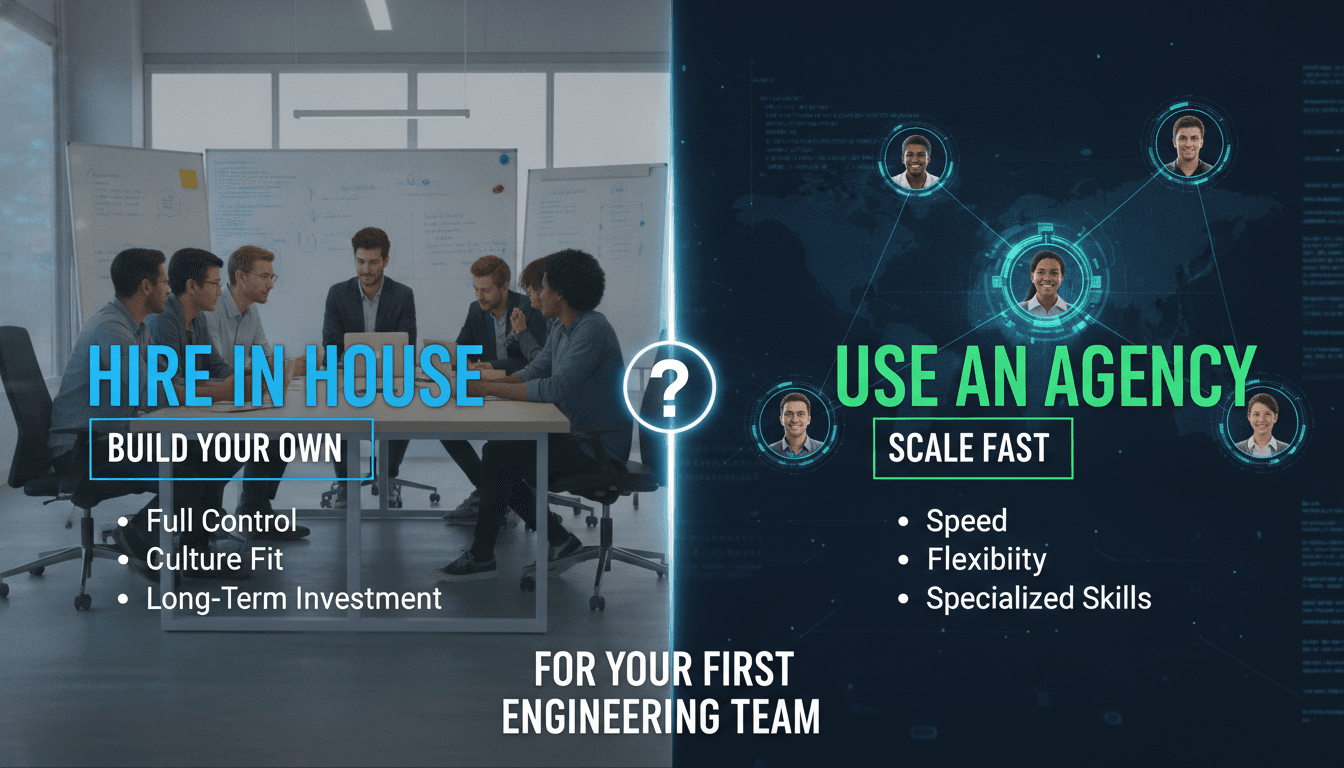
Building your first engineering team is one of the highest-stakes decisions you'll make as a technical founder or CTO. Get it wrong and you're looking at 12–18 months of lost time, a codebase that needs a rewrite, and a hiring process that consumes everyone's attention at exactly the wrong moment.
This post lays out the real trade-offs between hiring in-house and working with an agency for that first team. Not a checklist. Not a pitch. Just an honest look at what each path costs you, where each one breaks down, and how to decide.
What "First Engineering Team" Actually Means
There's a difference between your first hire and your first team. A single senior engineer is a hire. A team capable of shipping a product end-to-end, handling code review, managing infrastructure, and covering for each other's absences, that's a team. In practice, that's four to seven people with complementary skills.
Getting to that point in-house, including recruiting, interviewing, onboarding, and getting them to baseline productivity, takes most companies six to nine months in a competitive hiring market. Agencies can have engineers on a call with you within a week.
That gap matters enormously depending on where you are in your product lifecycle.
What Does Each Model Actually Cost?
Cost is the first thing people ask about, and it's also the most misunderstood comparison.
| Cost factor | In-house | Agency |
|---|---|---|
| Time to first productive engineer | 3–6 months | 1–2 weeks |
| Fully-loaded annual cost per mid-level engineer (Bengaluru) | ₹35–55 lakh | ₹40–70 lakh billed, no overhead |
| Recruitment cost (retained search) | 8–12% of first-year salary | Zero |
| Benefits, equipment, office space | Significant fixed cost | Included in rate |
| Severance and legal risk on exit | Real and often underestimated | Minimal |
| Knowledge retained after engagement ends | Stays with company | Leaves with team |
The agency looks more expensive per engineer-hour on a spreadsheet. It almost always is. The question is whether you're comparing the right things. A ₹50 lakh agency engagement that ships in four months is cheaper than six months of recruiting plus onboarding plus the opportunity cost of not shipping.
Sunk cost is the trap. Once you've hired four engineers and they're six months in, the psychological cost of changing course is enormous, even if the team isn't working.
When Does Hiring In-House Make More Sense?
In-house wins when your engineering problem is genuinely long-term, domain-specific, and hard to specify up front.
If you're building something where institutional knowledge is a competitive moat, medical imaging models, high-frequency trading systems, hardware-software integration, then the learning curve an agency goes through on each engagement is a real cost you bear. Engineers who've spent two years in your domain are materially faster than engineers who are smart and experienced but new to it.
In-house also wins when you need full control over team culture from day one. This matters more than people admit. If you have a specific way you want code reviewed, a particular approach to incident response, a strong opinion about documentation standards, it's genuinely easier to instil those habits when you're hiring directly.
When the in-house path breaks down
The failure mode I see most often: a company with a six-month runway starts hiring engineers because they believe it signals seriousness to investors. They spend four months recruiting, two months onboarding, and then the runway runs out before the product ships. Speed matters.
In-house also struggles when your first version needs to span multiple disciplines quickly. Frontend in React 18, backend in Python with FastAPI, infrastructure on AWS with Terraform, mobile on React Native, you can't hire all of those simultaneously without a serious budget and a serious recruiter.
Is an Agency the Right Call for an MVP?
For most Series A companies building a first product, yes. With caveats.
The right agency brings senior engineers who have built the same class of system before, which means you're not paying for them to learn the architectural patterns. At Sodio, for instance, when we take on a fintech build, we're not figuring out how KYC flows work at the code level for the first time. That experience compresses timelines in ways that are hard to quantify but very easy to feel.
The caveat is that agency work requires a technically literate counterpart on your side. If no one in your company can read a pull request, challenge architectural decisions, or define acceptance criteria precisely, you'll get exactly what you asked for, which is rarely what you needed.
/// Not sure where to start?
Get the architecture before you commit
Tell us what you're building and we'll map the technical approach, stack, and rough timeline. No cost, no obligation, no sales call required.
Agencies are also not a good fit if your product is in a domain that requires long regulatory approval cycles, where the cost of context-switching between their projects and yours is higher than the value of speed. Clinical trial software, for example, or anything touching SEBI-regulated instruments in depth.
What to look for in an agency
Four things that actually matter:
- Do they show you the engineers who will work on your project before you sign? If not, you're hiring a brand, not a team.
- Can they point to systems they've built that are still running in production, two or more years later?
- Do they push back on your spec? An agency that just executes is dangerous. You want one that questions your assumptions.
- What's the handover process? Code, documentation, deployment runbooks, monitoring setup. Get this in writing.
How Do You Structure the Transition If You Start With an Agency?
Starting with an agency and planning to build in-house later is a legitimate strategy, but only if you design for the transition from the beginning.
That means: insisting on code that follows patterns your future in-house engineers can read (not framework-specific abstractions only the agency knows), requiring thorough documentation as a deliverable rather than an afterthought, and ideally having at least one of your own engineers embedded in the project from month two.
The worst outcome is a codebase that only the agency fully understands. It creates a dependency that's expensive to break and gives the agency significant negotiating leverage at renewal time. Push for an architecture decision record (ADR) log from day one. It's a simple document format and it pays enormous dividends when your in-house team eventually takes over.
Budget six to eight weeks for a structured handover, not a Friday afternoon knowledge dump.
Making the Decision
There's no formula that spits out the right answer, but the questions that matter most are:
- How much runway do you have, and how much of it are you willing to spend on recruiting before shipping?
- Is there a person internally who can act as a technical product owner and challenge agency output?
- Does your competitive advantage depend on domain-specific engineering knowledge that needs to accumulate over years?
- What does your first version actually need to do? A proof-of-concept and a production-ready multi-tenant SaaS are very different scopes.
If you're pre-product, underfunded, or time-constrained, the agency path is almost always faster and cheaper when you account for total cost. If you're post-product-market-fit and engineering is a core long-term differentiator, in-house is worth the pain.
Conclusion
The decision isn't permanent. Most companies start with an agency, build the product, raise, and then hire in-house with a working system as the foundation. That's a sensible sequence.
The next step is practical: map out your actual runway in months, estimate time-to-hire for each role you'd need, and compare that against the time an agency would need to deliver your first version. Put numbers on it. That exercise usually makes the right call obvious.
If you'd like a second opinion on that estimate, or want to understand what a structured agency engagement looks like for your specific stack, get in touch.
FAQ
Can I use an agency for the MVP and then hire in-house to maintain it? Yes, and it's one of the most common sequences. The critical requirement is that the agency hands over code, documentation, and runbooks that your future in-house team can work with independently. If you don't contractually require this, it often doesn't happen.
How long does it typically take to hire a full engineering team in-house? For a team of four to six engineers in a competitive market like Bengaluru or Pune, expect six to nine months from first job post to full team at baseline productivity. Senior roles with specialist skills, like ML engineers or security-focused backend engineers, often take longer.
What's the biggest risk of going with an agency? Knowledge dependency. If the agency owns all the architectural context and your team can't maintain the system without them, you've created a vendor lock-in problem that's expensive to unwind. Mitigate this with embedded engineers on your side and mandatory documentation deliverables.
Does it make sense to hire one in-house engineer alongside an agency? Often yes. That person becomes your technical liaison, reviews agency output, makes decisions about scope trade-offs, and absorbs the context the agency builds up. Without that, you lose institutional knowledge every time the agency rotates engineers onto your project.
What should a handover from an agency to an in-house team include? At minimum: a README that covers local setup, staging and production deployment procedures, a list of all third-party services and their credentials locations, architecture decision records for major choices, and a runbook for the five most common operational issues. Anything less and you're guessing.
Have a project in mind? Contact Sodio Technologies to discuss your requirements and explore the right technology solution for your business.
/// Work with us
Talk to the engineers who'd build it
You'll get a technical scope, timeline and cost estimate from the people doing the work, not an account manager. In-house team, no subcontracting, since 2016.