

 WEARABLES & IOT
Wearable and IoT App Development
Companion apps, device management backends, BLE connectivity and on-device AI for wearables and connected devices. Built for unstable networks and constrained hardware.

TRUSTED BY TEAMS






Sodio builds wearable and IoT applications: companion apps for Wear OS and watchOS, BLE device connectivity, device management backends, time-series data pipelines and on-device AI.
Wearable engineering is constrained in ways general mobile development is not. Bluetooth connections drop, so sync must be idempotent and buffered on both sides.
Battery budget limits how often anything can run. Sensor data arrives noisy and needs fusion before it means anything. We design for those constraints rather than discovering them in testing.
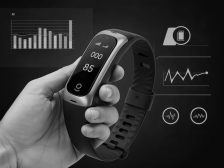
/// WHAT MAKES WEARABLE AND IOT ENGINEERING DIFFERENT
Why Connected Devices Break Normal Assumptions
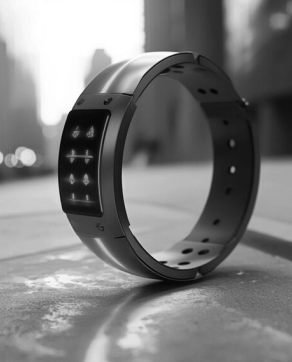
Normal Application Assumptions Do Not Apply
Mobile and web applications assume a stable network, adequate power and clean input.
Connected Devices Require a Different Architecture
Connected devices give you none of those, and most wearable projects fail because the architecture assumed otherwise.
Connectivity Is Unreliable
Connectivity is the first constraint. Bluetooth drops when the user walks into another room. Sync has to be idempotent so a repeated transfer does not duplicate a week of data, buffered on both device and phone, and resilient to a reconnection mid-transfer. An application that feels unreliable is usually one that assumed the connection would hold.
Battery Defines the Engineering Budget
Power is the second. Every background wake, every radio transmission and every model inference costs battery, and users judge a wearable on how long it lasts. That budget shapes how often you sync, how much you compute on-device and how much you send to the cloud.
Sensor Data Requires Interpretation
The third is the data itself. Raw accelerometer, PPG and gyroscope output is noisy and largely meaningless until it is fused, filtered and interpreted. That work — sensor fusion and signal processing — is where the engineering difficulty actually sits, and it is rarely what gets discussed in a proposal.
/// WEARABLE & IOT SOLUTIONS
Wearable and IoT Development Services

IoT Application Development

Custom IoT Development

IoT Software Development

Wearable App Development

Hire Wearable App Developers

Smartwatch App Development

BLE & Device Connectivity

Wearable SDK & API Integration

IoT Data Analytics

5G & Connected Devices

AR & Smart Glasses Apps

Industrial & Safety Wearables

///AI FOR CONNECTED DEVICES
AI for Wearables and Connected Devices
The useful AI in a wearable runs close to the sensor, not in a data centre. These are the use cases where latency, battery and data ownership decide the architecture.
On-Device & Edge AI (TinyML)
Models that run on the device itself. No cloud round-trip, lower battery cost, and sensor data that never leaves the hardware.

Sensor Fusion & Signal Processing
Combining accelerometer, gyroscope, PPG, ECG, GPS and environmental inputs into one reliable signal. The hard part of wearable engineering.
Fall Detection & Safety AI
Motion models that distinguish a genuine fall from a dropped device, with escalation paths for elder care and industrial safety.

Predictive Device Maintenance
Fleet-level models for battery degradation, sync failure and device attrition, so replacements happen before failures do.
Models that run on the device itself. No cloud round-trip, lower battery cost, and sensor data that never leaves the hardware.
Learn MoreCombining accelerometer, gyroscope, PPG, ECG, GPS and environmental inputs into one reliable signal. The hard part of wearable engineering.
Learn MoreMotion models that distinguish a genuine fall from a dropped device, with escalation paths for elder care and industrial safety.
Learn MoreFleet-level models for battery degradation, sync failure and device attrition, so replacements happen before failures do.
Learn More///PLATFORMS & PROTOCOLS
Platforms, Protocols and SDKs We Work With


/// HOW WE WORK
How We Work on Connected Device Projects
Device and data audit
We establish what the hardware actually exposes: the BLE profile, sampling rates, battery budget, firmware update path and what the sensors genuinely measure rather than what the datasheet claims.
Free solution architecture
Sync strategy, data pipeline, on-device versus cloud split, platform choice and a costed delivery plan. Yours to keep whether or not you build with us.
MVP in 30 days
A working MVP against real hardware, not a simulator. Where the device is still in development or the BLE profile is undocumented, we say so before starting.
Production build in 90 days
Core build with device management, OTA pipeline, monitoring and agreed integrations. Fleet-scale deployments are phased rather than launched in one release.
///FEATURED CASES
Future-Proof Software for Your Business
At Sodio, we deliver mobile apps, web apps, blockchain (DApps), AI integrations, SaaS platforms, and custom software development. Our innovative solutions are scalable, secure, and user-friendly, designed to drive growth and efficiency, keeping your business ahead in the competitive landscape. Trust Sodio for your digital transformation needs.
Jiffycharge
Developed JiffyCharge, an IoT-powered, on-demand power bank rental platform engineered for seamless portable charging access.
Jiffycharge
Developed JiffyCharge, an IoT-powered, on-demand power bank rental platform engineered for seamless portable charging access.
/// FAQ
Frequently Asked Questions
We build the application layer, the backend and the integration with the device — companion apps, sync pipelines, device management, cloud services and the AI that runs on or alongside the hardware. We work alongside firmware teams rather than replacing them. If your project needs firmware written from scratch, we will tell you that during discovery rather than after.
Apple Watch and watchOS, Wear OS, Apple HealthKit, Google Health Connect, Fitbit Web API, Garmin Connect, Polar, and proprietary SDKs from device manufacturers. For custom hardware we work directly against the BLE GATT profile the device exposes. Which of these apply depends on your device and target market.
You design for failure rather than trying to prevent it. That means local buffering on both device and phone, idempotent sync so repeated transfers do not duplicate a week of data, background reconnection with sensible backoff, and a user interface that stays useful when the device is out of range. Most wearable apps that feel broken are apps that assumed a stable connection.
Often yes, and it is usually the better choice. On-device inference removes network latency, cuts the battery cost of constant uploads, and means raw sensor data never leaves the hardware — which matters commercially as much as it does for privacy. The constraint is model size and compute budget. We assess whether your use case fits on-device, hybrid or cloud during the solution architecture.
For a defined scope we target a working MVP in 30 days and a core production build in 90. Wearable projects extend when hardware is still changing, when device certification is involved, or when the BLE profile is undocumented and has to be reverse-engineered. We flag which of these apply before starting rather than after.
Both. For device manufacturers the work is usually the companion app, device management backend, SDK and on-device intelligence. For software companies it is more often integration with wearables and IoT devices they do not build themselves. The engineering discipline is shared; the ownership boundary differs.
/// RELATED INDUSTRIES & SERVICES
Related Industries and Services
Internal linking. Routes visitors to the correct page where scope overlaps.
/// GET STARTED
Start with a Device
Tell us what the hardware does, what it measures and where the data needs to go. We will prepare a free solution architecture covering sync strategy, the on-device versus cloud split and delivery phases, so you can judge the approach before committing to a build.