

 Logistics
Logistics Software Development
Transport, warehouse, fleet and last-mile systems for carriers, 3PLs and shippers, built for depots with poor signal, gloved hands and trading partners who implement EDI differently.

TRUSTED BY TEAMS






Sodio builds logistics software development covering transportation management, warehouse management, fleet, consignment tracking, last-mile delivery, freight forwarding and cold chain, plus logistics AI for route optimisation, ETA prediction and warehouse slotting.
Logistics software fails in predictable places: connectivity in depots and on the road, trading partners who implement EDI inconsistently, and multi-leg consignments where several carriers each hold a partial truth about where something is.

/// WHAT MAKES LOGISTICS SOFTWARE DIFFERENT
Built for Depots, Not for Desks
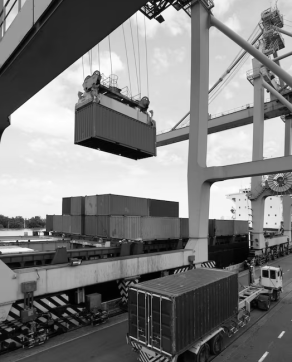
Harsh Environments
Logistics software runs in places nobody designs software for. A trailer yard at five in the morning, a warehouse aisle with no signal, a cab with one hand free. Systems built for a desk do not survive there, and the people using them will work around anything that slows them down.
Connectivity
Connectivity is the first constraint. Offline-first capture, queued syncing that survives a mid-transfer drop, and idempotent uploads so a retry does not create a second delivery record. Most driver apps that get abandoned assumed coverage.
EDI Integration
EDI is the second, and ignoring it is not an option. It remains the backbone of carrier, customer and customs messaging, and trading partners implement the same transaction sets inconsistently. That means a mapping layer and per-partner testing rather than a single integration, and it is usually underestimated in scope.
Multi-Leg Consignments
Multi-leg consignments are the hardest modelling problem. A shipment changes hands several times, each carrier holding its own reference, milestones and data quality. The system has to reconcile that into one view the customer can read, while preserving each carrier's record for settlement and dispute.
Unforgiving Metrics
And the metrics are unforgiving. Cost per drop, drops per shift, on-time delivery, dock turnaround — every operator reports them weekly, which means software either moves them or it does not.
/// LOGISTICS SOLUTIONS
Logistics Software We Build

Logistics Software Development

Transportation Management Systems

Logistics Management Software

Custom Logistics Software

Warehouse Management Systems

Fleet Management

Logistics App Development

Logistics Tracking Software

Last-Mile Delivery Platforms

Freight Forwarding & Customs

Yard & Dock Management

Cold Chain Logistics

///SHARED WITH ADJACENT INDUSTRIES
EV and Supply Chain Operations

EV Fleet Management
Charger management, energy usage, range planning and EV-specific fleet operations
Supply Chain Visibility
Multi-tier supplier visibility, traceability and network-level planning
Charger management, energy usage, range planning and EV-specific fleet operations
Learn MoreMulti-tier supplier visibility, traceability and network-level planning
Learn More///AI FOR LOGISTICS OPERATIONS
AI for Logistics Operations
Logistics is the easiest sector in which to prove AI value, because every operator already reports the numbers these models move: cost per drop, drops per shift, on-time rate, dock turnaround, pick path length.
Route Optimisation
Multi-stop routing against time windows, vehicle constraints and real traffic. The largest single cost lever in the sector.

ETA Prediction & Delay Alerts
Arrival prediction from live position, traffic and historical performance, with alerts before the customer calls.
Warehouse Slotting Optimisation
Product placement that shortens pick paths. Labour is the largest warehouse cost line and slotting is the lever nobody markets.

Demand & Capacity Forecasting
Matching fleet, labour and warehouse capacity to forecast volume rather than last year's pattern.

Freight Rate Prediction
Spot rate forecasting by lane and mode, so procurement decisions are timed rather than reactive.

Document Processing for Customs
Bills of lading, customs declarations, commercial invoices and proof of delivery extracted into structured data.

Fleet Predictive Maintenance
Component failure prediction from telematics, so vehicles come off the road on your schedule rather than mid-route.
Multi-stop routing against time windows, vehicle constraints and real traffic. The largest single cost lever in the sector.
Learn MoreArrival prediction from live position, traffic and historical performance, with alerts before the customer calls.
Learn MoreProduct placement that shortens pick paths. Labour is the largest warehouse cost line and slotting is the lever nobody markets.
Learn MoreMatching fleet, labour and warehouse capacity to forecast volume rather than last year's pattern.
Learn MoreSpot rate forecasting by lane and mode, so procurement decisions are timed rather than reactive.
Learn MoreBills of lading, customs declarations, commercial invoices and proof of delivery extracted into structured data.
Learn MoreComponent failure prediction from telematics, so vehicles come off the road on your schedule rather than mid-route.
Learn More///SYSTEMS AND STANDARDS
Systems and Standards We Work With


/// HOW WE WORK
How We Work on Logistics Projects
Operational walkthrough
We follow a consignment and a shift rather than reading a spec. Where the current process breaks, what the depot signal is actually like, and which trading partners send what in which format.
Free solution architecture
Integration map per system and partner, offline strategy, data ownership per field, optimisation approach and a costed delivery plan. Yours to keep whether or not you build with us.
MVP in 30 days
One flow end to end with real data — a consignment booked, moved, delivered and settled. Enough to expose the edge cases that a spec never contains.
Production build in 90 days
Full build with integrations, EDI partner onboarding and monitoring. Depot rollouts are phased site by site with training and a rollback path.
///FEATURED CASES
Future-Proof Software for Your Business
At Sodio, we deliver mobile apps, web apps, blockchain (DApps), AI integrations, SaaS platforms, and custom software development. Our innovative solutions are scalable, secure, and user-friendly, designed to drive growth and efficiency, keeping your business ahead in the competitive landscape. Trust Sodio for your digital transformation needs.
Jiffy
Developed JiffyCharge, an IoT-powered, on-demand power bank rental platform engineered for seamless portable charging access.
TATA Steel
An enterprise sales management platform for TATA Steel to optimize order fulfillment, track multi-tier distribution networks, and streamline B2B sales workflows.
Jiffy
Developed JiffyCharge, an IoT-powered, on-demand power bank rental platform engineered for seamless portable charging access.
TATA Steel
An enterprise sales management platform for TATA Steel to optimize order fulfillment, track multi-tier distribution networks, and streamline B2B sales workflows.
/// FAQ
Frequently Asked Questions
Usually. Most modern platforms expose APIs or event streams, and the established ones support EDI. Older or heavily customised installations often mean scheduled file exchange or database extraction instead. The harder question is which system owns each data field once two systems disagree about where a consignment is — we establish that during discovery, because it is where logistics integrations fail later.
Yes. EDI remains the backbone of carrier, customer and customs messaging, and any system that ignores it will not survive contact with a real network. We build against the common transaction sets and handle the practical reality that trading partners implement them inconsistently, which means a mapping layer and per-partner testing rather than one integration.
It depends on how routes are planned today. Where planning is manual or fixed, the gains are usually substantial — fewer miles, more drops per shift, better time-window compliance. Where a mature optimiser already runs, improvements are incremental and come from better constraint modelling rather than a different algorithm. We measure against your current cost per drop before and after rather than quoting a percentage from someone else's case study.
It should not, and designing for it is the difference between an app drivers use and one they work around. That means offline-first data capture, queued syncing that survives a mid-transfer drop, idempotent uploads so a retry does not duplicate a delivery, and an interface that stays usable with no connection. Most driver apps that get abandoned assumed coverage.
Yes, and it is one of the harder modelling problems in logistics. A consignment can change hands several times, each leg with its own reference, milestones and data quality. The system has to reconcile that into one view the customer can read while preserving each carrier's record for settlement and dispute resolution.
For a defined scope we target a working MVP in 30 days and a core production build in 90. Logistics extends when carrier or customs integrations, EDI partner onboarding or a phased depot rollout are involved. We flag which apply during the free solution architecture rather than after work begins.
/// RELATED SERVICES
Related Industries and Services
Services that complement logistics software development.
/// GET STARTED
Start With One Consignment
Tell us how a consignment moves through your network today and which systems touch it. We will prepare a free solution architecture covering integrations, offline strategy, optimisation approach and delivery phases, so you can judge the approach before committing.