

How to Make an App Like 10% Happier
How to Make an App Like 10% Happier
Meditation and mindfulness apps have moved from niche wellness tools to mainstream mental health companions. 10% Happier stands out in a crowded market because it does something clever: it speaks to skeptics. Instead of leaning on incense-and-crystals aesthetics, it offers plainspoken, science-backed mindfulness taught by world-class teachers — and that positioning helped it build a loyal, paying audience.
If you're planning to build a meditation app of your own, this guide walks through what makes 10% Happier work, the features you'll need, the tech stack that can support it, and what it realistically costs to bring to market.
Why the Meditation App Market Is Still Worth Entering
The mental wellness category continues to grow, driven by burnout, remote work stress, sleep problems, and a generation that's far more comfortable talking about anxiety than the one before it.
But the market isn't saturated so much as it is generic. Most meditation apps look and sound alike. The winners differentiate on:
- Voice and tone — 10% Happier's "meditation for fidgety skeptics" angle is a masterclass in this
- Teacher credibility — named, respected instructors rather than anonymous narrators
- Niche audiences — new parents, athletes, teens, healthcare workers, people in recovery
- Habit mechanics — the app that actually gets used daily wins retention
There is still plenty of room for a well-positioned entrant. The trick is picking a lane before you write a line of code.
Deconstructing 10% Happier
Before building, it's worth understanding the product architecture underneath the polish.
Core Product Pillars
1. Guided meditation courses Multi-day structured programs (e.g., "Basics," "Sleep," "Anxiety") that progress in difficulty and theme. This is the backbone — it gives users a path rather than a library to get lost in.
2. Single meditations Standalone sessions filtered by duration, topic, and teacher for users who want something quick.
3. Teacher-led content library Real, recognizable mindfulness teachers with bios and distinct styles. Users develop preferences and follow specific voices.
4. Podcast and talk content Interviews and conversations that build trust and act as a top-of-funnel acquisition channel.
5. Sleep content Sleep meditations, soundscapes, and bedtime stories — consistently one of the highest-engagement categories in wellness apps.
6. Progress tracking and streaks Minutes meditated, sessions completed, streak counters, and milestone badges.
7. Coaching and community Access to real human coaches for premium tiers, plus challenges that create social accountability.
Must-Have Features for Your MVP
Don't build everything. Build the smallest version that can prove people will return.
User Onboarding
A short, conversational intake flow that asks:
- What brings you here? (stress, sleep, focus, anxiety)
- How much experience do you have with meditation?
- How many minutes per day can you commit?
- When should we remind you?
Use these answers to generate a personalized starting plan. This single feature dramatically improves day-one activation.
Audio Player
This is your most important screen. It needs:
- Background playback with lock screen and notification controls
- Offline download for saved sessions
- Adjustable ambient background sound and volume mixing
- Resume-where-you-left-off behavior
- Bluetooth, AirPlay, and CarPlay/Android Auto support
- Bell/interval chimes for unguided timer sessions
Audio reliability is non-negotiable. A meditation app that stutters or drops playback mid-session breaks the entire value proposition.
Content Discovery
- Browse by goal, duration, teacher, and mood
- Search with filters
- Curated collections and "daily" recommendation
- Favorites and personal playlists
Habit and Progress Layer
- Daily streaks with a forgiving "streak freeze" mechanic
- Total minutes and sessions meditated
- Weekly and monthly insight summaries
- Milestone achievements
- Smart reminders based on when the user actually meditates, not just when they said they would
Subscription and Paywall
- Free trial (7–14 days) with full access
- Monthly, annual, and lifetime options
- Clear value framing at the paywall moment
- Family plans and gifting
- Promo codes and partner/employer access
Notifications
Gentle, not nagging. Encourage with contextual nudges — "You usually meditate around now" beats "Don't break your streak!" for long-term retention.
Features That Differentiate
Once the MVP is validated, these are the additions that create defensibility:
| Feature | Why It Matters |
|---|---|
| Live sessions and events | Creates urgency and community |
| 1:1 or group coaching | Premium revenue and deep retention |
| Mood check-ins | Emotional data that powers personalization |
| Wearable integration | HRV, sleep, and stress data from Apple Watch / Fitbit / Oura |
| Corporate/B2B portal | Enterprise wellness budgets are large and sticky |
| Multi-language content | Unlocks international growth |
| Widgets and complications | Reduces friction to open the app |
| AI-personalized plans | Adaptive recommendations based on behavior and mood |
| Offline-first library | Essential for travel and commuting |
| Social challenges | Friend-based accountability groups |
Recommended Tech Stack
Mobile Frontend
- Flutter or React Native for a shared codebase across iOS and Android — ideal when the UI is content-driven and you want speed to market
- Swift (SwiftUI) and Kotlin (Jetpack Compose) if you need deep native audio control, advanced widgets, watchOS apps, and best-in-class performance
For a meditation app specifically, cross-platform is very viable — but budget extra time for native audio modules and background playback edge cases.
Backend
- Node.js (NestJS) or Python (Django/FastAPI) for APIs
- PostgreSQL for user, subscription, and progress data
- Redis for caching, sessions, and streak counters
- Microservices or modular monolith depending on team size — start modular, split later
Audio Delivery
- Amazon S3 or Google Cloud Storage for asset storage
- CloudFront or Cloudflare CDN for low-latency global delivery
- HLS adaptive streaming for quality that adjusts to connection strength
- Signed URLs to prevent content piracy
Content Management
A headless CMS (Strapi, Contentful, or Sanity) so your content and editorial team can publish courses, teachers, and metadata without engineering involvement. This is a bigger deal than it sounds — content velocity is your competitive advantage.
Subscriptions and Analytics
- RevenueCat or Adapty for cross-platform subscription management
- Stripe for web purchases and B2B billing
- Amplitude or Mixpanel for product analytics
- Firebase / OneSignal for push notifications
- Braze or Customer.io for lifecycle messaging
Infrastructure
- AWS or GCP with containerized deployments
- CI/CD via GitHub Actions or GitLab CI
- Sentry for crash and error monitoring
UI/UX Principles That Matter Here
Meditation apps live or die on feel. Some hard-won guidelines:
Calm over clever. Generous whitespace, soft palettes, restrained motion. Every animation should feel like an exhale.
Reduce decisions. A user in a stressed state should be able to start meditating in two taps. Put a single, obvious primary action on the home screen.
Respect the session. During playback, strip the interface down. No badges, no upsells, no notifications.
Design for darkness. Many sessions happen in bed with the lights off. Dark mode isn't optional, and neither is a dimmed player screen.
Celebrate quietly. Acknowledge streaks and milestones without gamified confetti that undermines the tone.
Accessibility is core. Large text support, high-contrast modes, VoiceOver/TalkBack labels, and transcripts or captions for spoken content.
Content Strategy: The Real Moat
Here's the uncomfortable truth — the software is the easy part. 10% Happier's advantage is its content and the teachers behind it.
Plan for:
- Teacher partnerships. Identify and contract credible instructors early. Negotiate whether you're paying flat fees, royalties, or equity.
- Production quality. Studio-grade audio recording, editing, and mastering. Poor audio quality instantly destroys credibility.
- A content calendar. Users churn when the library feels stale. Commit to a regular release cadence before launch.
- Licensing clarity. Music, soundscapes, and background tracks all need proper rights.
- Scientific grounding. If you claim evidence-based benefits, cite real research and be careful with medical claims. Wellness marketing has regulatory boundaries.
Monetization Models
Freemium subscription is the default and for good reason. A limited free tier plus a paid subscription converts well when the free content genuinely delivers value.
Other options worth layering in:
- B2B / employer wellness programs — often the highest-margin revenue in this category
- Insurance and healthcare partnerships
- One-time course purchases for users allergic to subscriptions
- Premium coaching tiers
- Gift subscriptions — strong seasonal revenue spikes
- Educational and nonprofit licensing
Avoid ads. Interruption is fundamentally incompatible with mindfulness, and users will punish you for it.
Development Roadmap
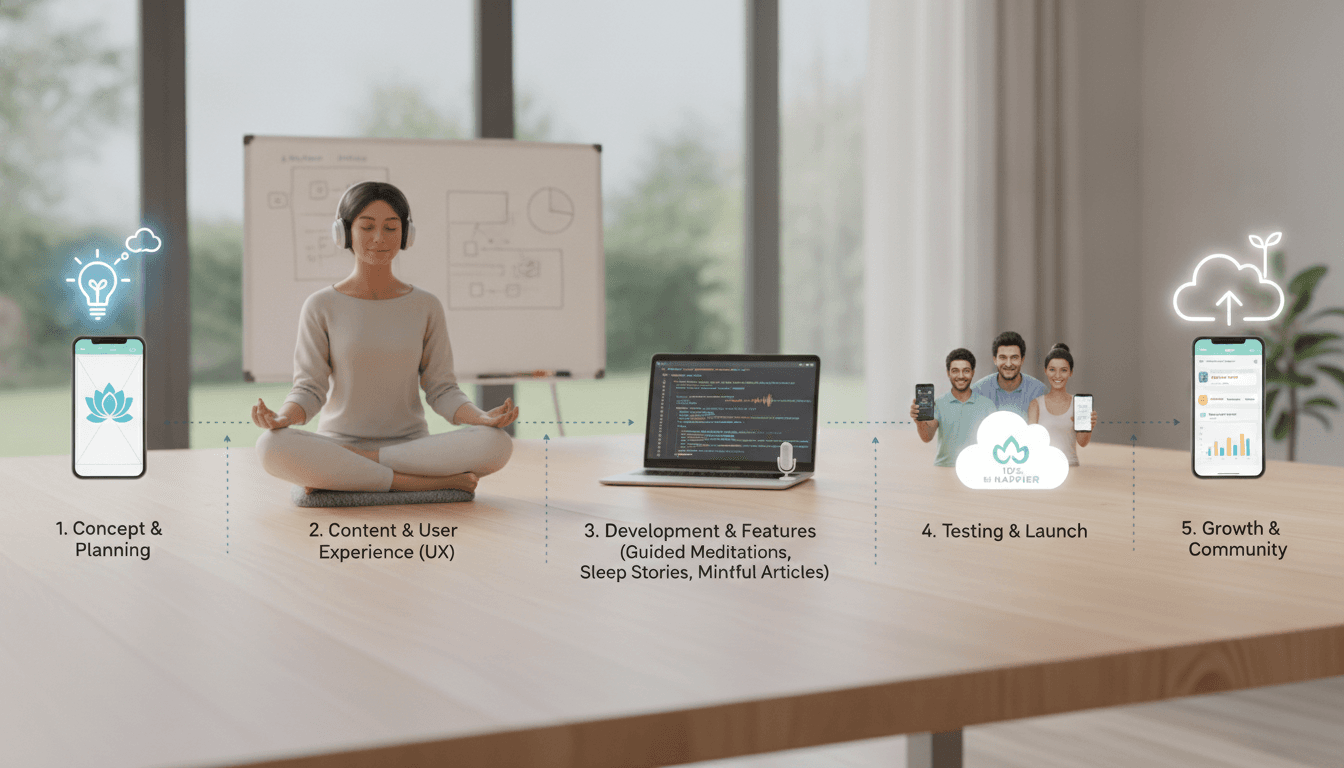
Phase 1 — Discovery (2–4 weeks) Market and competitor research, audience definition, feature prioritization, content strategy, technical architecture.
Phase 2 — Design (4–6 weeks) Information architecture, wireframes, design system, high-fidelity screens, prototype testing with real users.
Phase 3 — MVP Build (12–16 weeks) Core app, audio engine, CMS integration, subscriptions, analytics, onboarding, progress tracking.
Phase 4 — Content Production (parallel) Record and master an initial library — aim for at least 40–60 sessions and 3–5 structured courses at launch.
Phase 5 — Beta and QA (3–4 weeks) TestFlight and Play Console beta, audio testing across devices, performance tuning, store compliance review.
Phase 6 — Launch and Iterate App Store optimization, paid acquisition testing, retention cohort analysis, and a continuous content pipeline.
Cost Expectations
Ranges vary widely by region and team composition, but broadly:
| Scope | Estimated Range |
|---|---|
| Lean MVP (one platform, core features) | $40,000 – $70,000 |
| Cross-platform MVP with CMS and subscriptions | $70,000 – $120,000 |
| Full-featured app with coaching, wearables, B2B | $150,000 – $300,000+ |
| Content production (initial library) | $15,000 – $60,000 |
| Ongoing (hosting, CDN, tools, content) | $3,000 – $15,000/month |
Budget for the content and the marketing, not just the build. Many meditation apps fail not because the app was bad, but because nobody knew it existed and the library never grew.
Metrics to Watch
- Day 1 / Day 7 / Day 30 retention — the single best predictor of success
- Trial-to-paid conversion rate
- Sessions per active user per week
- Average session completion rate — are people finishing meditations?
- Streak length distribution
- Subscription churn and LTV
- Content engagement by course and teacher
Common Pitfalls to Avoid
Building a library, not a path. Users don't want 500 options; they want to know what to do today.
Underinvesting in audio engineering. Background playback bugs, download failures, and interrupted sessions are the top complaints in this category.
Copying the leaders' positioning. Calm and Headspace already own "general mindfulness." Find a specific audience you can serve better than anyone.
Launching with thin content. An empty library feels abandoned. Front-load production.
Aggressive paywalls too early. Let users feel a benefit before you ask for money. In wellness, trust is the conversion mechanism.
Final Thoughts
Making an app like 10% Happier is less about replicating a feature list and more about replicating a relationship. The technology — audio streaming, subscriptions, progress tracking — is well-understood and entirely achievable. What separates the apps people keep from the ones they delete after a week is clarity of voice, quality of content, and thoughtfulness of the habit loop.
Start narrow. Pick an audience whose stress you understand deeply. Build a flawless audio experience around a small, excellent content library. Then grow the library relentlessly.
If you're ready to scope your meditation or mental wellness app, our team can help you move from concept to validated product — including architecture, design, development, and go-to-market planning. Let's talk about what you're building.
Have a project in mind? Contact Sodio Technologies to discuss your requirements and explore the right technology solution for your business.
/// Work with us
Talk to the engineers who'd build it
You'll get a technical scope, timeline and cost estimate from the people doing the work, not an account manager. In-house team, no subcontracting, since 2016.