

How to Make an App Like The Mindfulness App
How to Make an App Like The Mindfulness App
Mental wellness has moved from a niche interest to a mainstream daily habit. Apps like The Mindfulness App, Headspace, and Calm have shown that guided meditation, breathing exercises, and sleep support can build genuinely loyal user bases — and sustainable subscription revenue.
If you're considering building your own meditation and mindfulness platform, this guide walks through the features, technology, timeline, and costs involved.
Related reading: How to Make an App Like MyLife Meditation.
Why the Mindfulness Market Is Worth Entering
The global meditation app market continues to grow at double-digit rates, driven by rising awareness of burnout, anxiety, and sleep disorders. A few factors make this category particularly attractive for founders:
- High retention potential. Mindfulness is a daily habit, not an occasional utility. Well-designed apps see strong streak-based engagement.
- Proven monetisation. Subscriptions are the norm, and users already expect to pay for premium content.
- Content scalability. Once your platform exists, adding new meditations, courses, and instructors is relatively low-cost.
- B2B expansion. Corporate wellness programs represent a lucrative secondary revenue stream.
That said, the space is competitive. Differentiation — whether through niche audiences, unique content, or smarter personalisation — matters enormously.
Core Features of a Mindfulness App
1. Onboarding and Goal Setting
First impressions determine whether a user ever returns. A strong onboarding flow asks a handful of questions — Why are you here? Stress? Sleep? Focus? — and immediately delivers a personalised starting recommendation.
Keep it short. Five screens maximum before the user experiences their first meditation.
2. Guided Meditation Library
The heart of the product. Your library should be organised by:
- Category (stress, sleep, anxiety, focus, relationships)
- Duration (3, 5, 10, 20, 30 minutes)
- Instructor or voice
- Difficulty or experience level
Robust search and filtering are essential once the catalogue passes a few dozen sessions.
3. Timed and Unguided Meditation
Experienced practitioners often want silence with interval bells. Offer a customisable timer with ambient background sounds, warm-up periods, and ending chimes.
4. Sleep Content
Sleep stories, soundscapes, and wind-down routines are among the most-used features in the category. They also drive evening engagement, which pairs nicely with morning meditation habits.
5. Breathing Exercises
Animated breathing guides (box breathing, 4-7-8, coherent breathing) are cheap to build and highly effective for acute stress relief. They make great free-tier content.
We cover a closely related subject in How to Make an App Like Headspace.
6. Progress Tracking and Streaks
Users need to see their commitment paying off:
- Total minutes meditated
- Current and longest streak
- Sessions completed
- Mood check-ins over time
- Milestone badges
Handle streaks gently. Harsh streak resets cause churn in a wellness context — consider "streak freezes" or forgiving weekly goals instead of rigid daily ones.
7. Reminders and Notifications
Smart, non-nagging reminders drive habit formation. Let users pick their preferred time and tone, and use behavioural data to suggest the moments they're most likely to practise.
8. Offline Downloads
Meditation often happens on planes, commutes, or in areas with poor signal. Offline playback is close to a baseline expectation in this category.
9. Courses and Programs
Multi-day structured programs ("7 Days to Better Sleep", "21-Day Anxiety Reset") create narrative momentum and give users a reason to return tomorrow.
10. Subscription and Paywall
Free trials, monthly plans, annual plans, and lifetime options. The paywall placement and copy will have an outsized effect on revenue — plan to test it continuously.
Advanced Features That Differentiate
Once the fundamentals are in place, consider:
- AI-powered personalisation — recommending sessions based on mood logs, time of day, and completion history.
- Wearable integration — pulling heart rate and HRV from Apple Watch, Fitbit, or Wear OS to measure real physiological impact.
- Mood journaling — lightweight check-ins before and after sessions that generate meaningful insight dashboards.
- Live sessions — scheduled group meditations that create community and urgency.
- Community features — groups, challenges, and shared milestones (handled carefully, since mindfulness users value calm over social noise).
- Multi-language support — a genuine growth lever in this category.
- Corporate dashboards — aggregated, anonymised wellness reporting for B2B clients.
Designing for Calm
UI/UX carries more weight here than in almost any other app category. Your interface is part of the therapeutic experience.
For a closer look at a related topic, read our guide on How to Make an App Like 10% Happier.
Principles to follow:
- Minimalism. Generous whitespace, few elements per screen, no visual clutter.
- Soft palettes. Muted blues, greens, warm neutrals. Avoid high-saturation alerts.
- Dark mode by default at night. Sleep users are in bed with the lights off.
- Smooth, slow animations. Transitions should feel like breathing, not snapping.
- Typography with room to breathe. Larger line height, readable sizes.
- No aggressive gamification. Guilt-driven mechanics work against the product's purpose.
Accessibility matters too: captions for spoken content, adjustable text sizes, and screen-reader-friendly navigation broaden your reach considerably.
Technology Stack
Mobile Front End
- Cross-platform: Flutter or React Native — faster to market, one codebase, ideal for content-driven apps.
- Native: Swift (iOS) and Kotlin (Android) — better for deep wearable, widget, and background audio integration.
For most mindfulness apps, cross-platform is the pragmatic choice, with native modules added where audio and health integrations demand it.
Backend
- Languages/frameworks: Node.js, Python (Django/FastAPI), or Go
- Architecture: Microservices or a well-structured monolith, depending on scale
- Database: PostgreSQL for relational data, Redis for caching and session state
Audio Delivery
This is the critical infrastructure piece. You'll need:
- Cloud storage (AWS S3, Google Cloud Storage)
- A CDN (CloudFront, Cloudflare) for low-latency global delivery
- Adaptive bitrate streaming for variable network conditions
- Background audio handling with lock-screen controls on both platforms
- Secure, expiring URLs to protect premium content
Supporting Services
- Auth: Firebase Auth, Auth0, or a custom OAuth implementation
- Payments: Apple In-App Purchase and Google Play Billing (mandatory for digital content), plus Stripe for web subscriptions
- Analytics: Mixpanel or Amplitude for behavioural data; Firebase for basics
- Push: Firebase Cloud Messaging or OneSignal
- CMS: A headless CMS so your content team can publish sessions without engineering support
That last point is underrated. Build content operations tooling early, or your developers will become a bottleneck.
Content: The Real Product
Your app is a delivery mechanism. The content is what users pay for.
Options for building a library:
- Hire instructors and produce in-house. Highest quality control and brand consistency; highest cost.
- License existing content. Faster to launch, but less differentiated.
- Creator marketplace. Instructors publish and earn revenue share; scales well but requires moderation and quality gates.
Budget for professional audio production — recording, editing, mastering, and royalty-free background music. Poor audio quality is immediately disqualifying in this category.
Plan for roughly 50–100 sessions at launch as a credible minimum, with a consistent publishing cadence afterwards.
Monetisation Models
- Freemium subscription. A meaningful free tier plus a premium library. The dominant model.
- Free trial to paid. Seven-day trials converting to annual plans typically outperform monthly-first funnels.
- Lifetime access. Useful for cash flow and for users resistant to subscriptions.
- B2B licensing. Per-seat corporate wellness packages, often the highest-margin channel.
- In-app purchases. Individual courses or instructor packs sold à la carte.
Annual plans are the goal. They dramatically improve lifetime value and reduce churn management overhead.
Privacy, Security, and Compliance
Mindfulness apps collect sensitive data — mood logs, sleep patterns, sometimes health metrics.
- Encrypt data in transit and at rest
- Comply with GDPR, CCPA, and regional equivalents
- Understand when HIPAA applies (generally if you integrate with clinical providers)
- Follow Apple HealthKit and Google Health Connect data policies strictly
- Write a genuinely clear privacy policy — trust is your brand
- Never sell or share mental health data with advertisers
Be careful with medical claims too. Positioning your app as treatment for a clinical condition can trigger regulatory scrutiny in many jurisdictions.
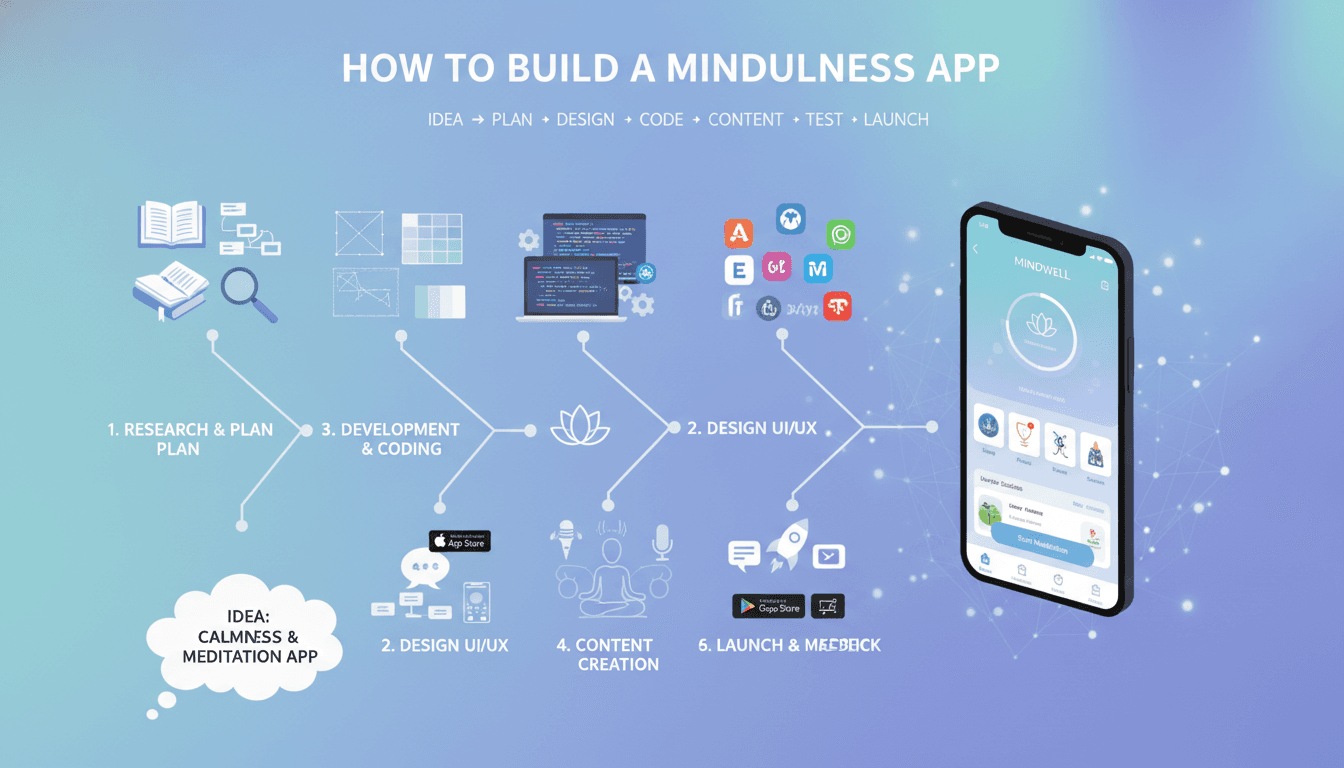
Development Timeline
A realistic phased approach:
Phase 1 — Discovery and Design (4–6 weeks) Market research, feature scoping, wireframes, UI design system, prototype.
Phase 2 — MVP Development (12–16 weeks) Core library, audio playback, offline downloads, basic tracking, subscriptions, onboarding.
Phase 3 — Testing and Launch (4–6 weeks) QA across devices, beta program, app store submission, analytics instrumentation.
Phase 4 — Iteration (ongoing) Personalisation, wearables, courses, community, localisation.
Total to a credible MVP: roughly five to seven months.
Cost Estimates
Costs vary widely by region and team composition, but typical ranges look like this:
- Simple MVP (single platform, basic library, subscriptions): $40,000 – $70,000
- Full-featured cross-platform app (personalisation, offline, tracking, courses): $80,000 – $150,000
- Enterprise-grade platform (AI recommendations, wearables, B2B dashboards, multi-language): $150,000 – $300,000+
Add content production ($10,000 – $50,000 depending on volume), plus ongoing cloud, CDN, and maintenance costs of roughly 15–20% of initial build per year.
Common Pitfalls to Avoid
- Launching with too little content. Users churn fast when the library feels thin.
- Copying Calm or Headspace exactly. Without differentiation you're competing on marketing spend against companies with far bigger budgets.
- Neglecting audio engineering. Buffering, playback bugs, and interrupted background audio destroy the experience.
- Over-notifying. Nothing undermines a calm brand faster than nagging push messages.
- Ignoring the first session. If a user doesn't complete a meditation in their first visit, they probably won't come back.
- Underestimating content operations. Publishing, tagging, and localising content is an ongoing job, not a one-off.
Finding Your Angle
The most successful new entrants aren't general-purpose meditation apps — they're focused. Consider niching around:
- Mindfulness for children and families
- Faith-based or culturally specific practice
- Meditation for athletes or performance contexts
- Support for specific conditions (with appropriate care around claims)
- Workplace and corporate wellness
- Regional language markets underserved by the major players
A smaller, well-served audience will almost always outperform a broad, undifferentiated launch.
Final Thoughts
Building an app like The Mindfulness App is technically achievable for most competent development teams — the stack is well-understood and the feature set is mature. The real challenges are content quality, thoughtful design, and finding an audience that isn't already committed to an incumbent.
Start with a focused MVP, invest disproportionately in the first-session experience, and treat content as a product line rather than an afterthought. Get those three things right and you have a genuine shot in a growing market.
If you're ready to explore building your own mindfulness platform, the next step is a discovery session to define scope, audience, and differentiation before a single line of code is written.
Have a project in mind? Contact Sodio Technologies to discuss your requirements and explore the right technology solution for your business.
/// Work with us
Talk to the engineers who'd build it
You'll get a technical scope, timeline and cost estimate from the people doing the work, not an account manager. In-house team, no subcontracting, since 2016.