

How to Make an App Like Airbnb
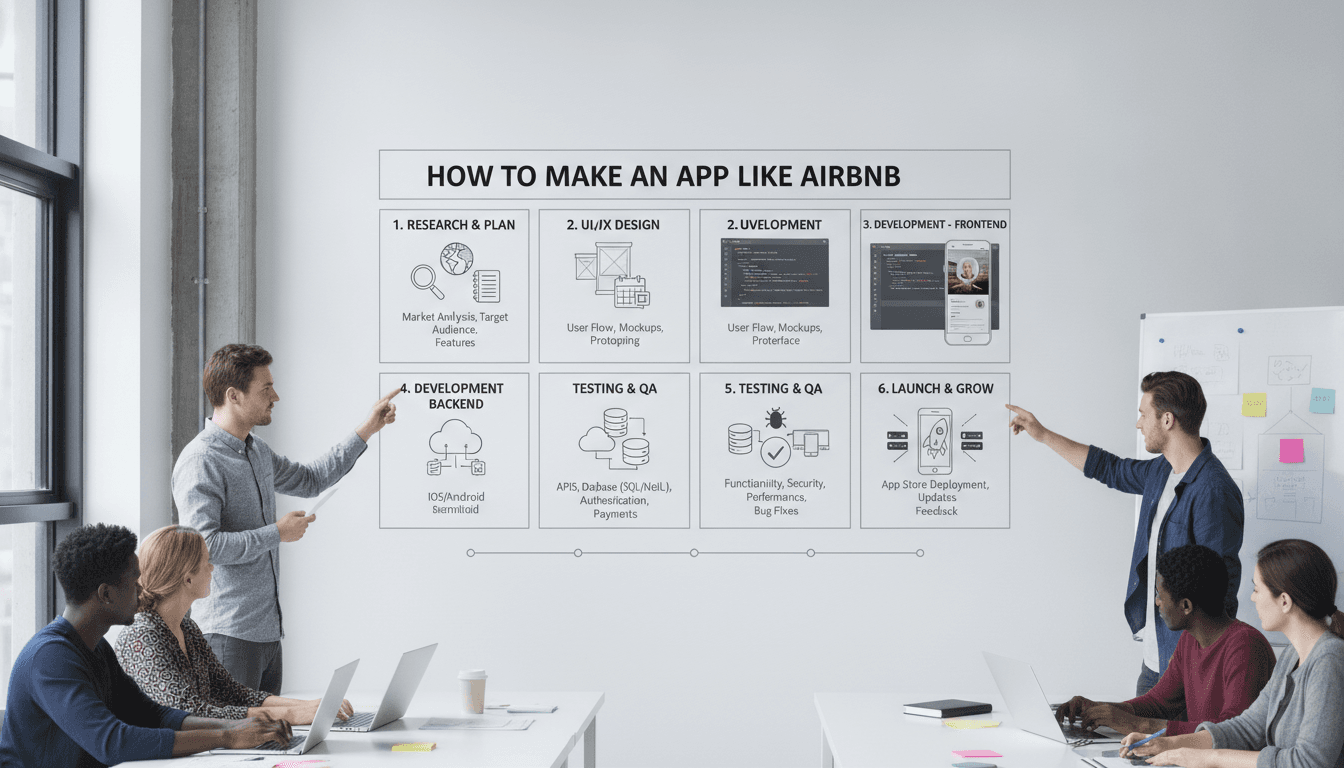
Building a rental marketplace is one of the more complex product engineering challenges out there. Two-sided marketplaces have non-trivial state management, trust and safety requirements, payment complexity, and search problems that only reveal themselves once you're past the prototype stage. This post breaks down what it actually takes to build something at Airbnb's level of sophistication.
What Does the Architecture of a Rental Marketplace Actually Look Like?
Start with the core entities: Users, Listings, Bookings, Payments, Reviews, and Messages. Every other feature hangs off these six.
The common mistake is treating this as a CRUD app early on and then bolting on complexity. Booking state alone — pending, confirmed, cancelled_by_host, cancelled_by_guest, completed, disputed — demands a proper finite state machine from day one. Use a library like XState on the frontend or a server-side state machine backed by a database-level status column with strict transition guards.
Data Model Decisions That Matter
Listings need versioning. If a host edits their pricing mid-booking, the booking must reference the price and rules at the time of confirmation, not the current listing state. This is often implemented with a listing_snapshots table that freezes the relevant fields at booking creation.
Availability is the other landmine. A naive boolean is_available column breaks immediately once you introduce multi-night stays, blocked dates, and time zones. Use an interval-based model: store unavailability as date ranges (PostgreSQL's daterange type with exclusion constraints is well-suited here), and query availability by checking for non-overlapping intervals.
Calendar sync via iCal (RFC 5545) is expected by hosts managing multiple platforms. Build this from week one, not as an afterthought.
Search and Discovery
Airbnb's search is powered by a combination of Elasticsearch for full-text and faceted filtering, and a custom geo-search layer. For a new build, you can get far with PostGIS on PostgreSQL for geo-queries and Elasticsearch 8.x for everything else. The key is separating your search index from your transactional database early — trying to run complex geo-filtered, availability-checked, price-sorted queries against a single Postgres instance under load is asking for trouble.
How Do You Handle Payments in a Two-Sided Marketplace?
This is where most teams underestimate the scope. You're not just collecting money. You're holding it in escrow, splitting it between platform and host, handling refunds based on cancellation policies, and dealing with international currencies and tax compliance.
Stripe Connect is the standard choice and for good reason. It handles KYC for hosts (Express or Custom accounts), supports destination charges and on-behalf-of charges, and provides a reasonable framework for managing payouts. The critical decision is which charge type to use:
| Charge Type | Who owns the payment | Payout control | Complexity |
|---|---|---|---|
| Direct Charge | Connected account | Lower | Low |
| Destination Charge | Platform | Medium | Medium |
| Separate Charges + Transfers | Platform | Full | High |
For a marketplace where the platform needs to control refund logic and hold funds until check-in, Destination Charges or Separate Charges + Transfers are the right choice. This gives you the ability to hold the host payout until 24 hours after check-in, which is standard practice and reduces fraud significantly.
Tax is its own problem. If you're operating in the EU, Stripe Tax handles VAT calculation. If you're targeting the US, some jurisdictions require the platform to remit Occupancy Tax directly. This is a legal and technical problem combined, and you'll need a tax counsel alongside your engineering decisions.
/// Not sure where to start?
Get the architecture before you commit
Tell us what you're building and we'll map the technical approach, stack, and rough timeline. No cost, no obligation, no sales call required.
What Does the Trust and Safety Layer Require?
Airbnb spends heavily here because a single high-profile incident destroys marketplace trust. The technical components fall into a few categories.
Identity verification: Integrate a provider like Onfido or Jumio for document verification. Don't build your own OCR pipeline. These providers handle liveness detection, document authenticity checks, and regional ID types across 195 countries. Budget around $1–3 per verification depending on volume and tier.
Risk scoring: Every booking should produce a risk signal. Build a lightweight scoring model using signals like: account age, number of previous bookings, IP/device mismatch, velocity (multiple bookings in a short window), and whether the guest's payment method is newly added. A simple logistic regression model or even a rules engine is enough to start. Don't over-engineer this with neural networks until you have sufficient labelled data from real fraud cases.
Review integrity: Two-way simultaneous reveal for reviews (both parties submit, neither sees the other's review until both have submitted or the window closes) is the standard approach. It's first described in the academic literature on reputation systems and Airbnb uses it. Implement it with a reviews table that stores the review body encrypted or hidden behind a status flag, and a background job that reveals reviews after the 14-day window closes or both parties submit.
Messaging, Notifications, and Real-Time Concerns
The booking flow relies heavily on host response rates. Airbnb's Superhost criteria include a 90% response rate within 24 hours. Your notification system directly affects host behaviour and therefore supply-side health.
Use a multi-channel notification approach: push (FCM for Android, APNs for iOS), email (SendGrid or Postmark), and in-app. The in-app messaging system is worth building on WebSockets (Socket.IO or native WebSocket with a Redis pub/sub backend) rather than polling. Long-polling is an acceptable interim solution but adds unnecessary load at scale.
Thread-based messaging with read receipts, typing indicators, and image attachments requires more infrastructure than it first appears. Keep message storage in a dedicated service or at minimum a separate table, and think about archival strategy from the start. Active conversations get queried frequently; old ones rarely do.
Mobile: Native vs Cross-Platform
Airbnb famously tried React Native in 2016–2018 and then moved back to native. That's a specific data point worth understanding rather than ignoring. Their problems were largely around animation performance, bridging complexity for native modules, and the difficulty of keeping parity across a large engineering organisation.
For a new build in 2024, Flutter is a stronger cross-platform candidate than React Native for a travel/rental app, primarily because of its own rendering engine (Impeller), which gives you more predictable performance on complex animations like map interactions and image carousels. You avoid the JavaScript bridge entirely.
That said, if your team has strong iOS and Android engineers, native gives you the fastest path to polished interactions, best-in-class camera integration (important for listing photo uploads), and no framework overhead. The honest trade-off: cross-platform gets you to market faster with one codebase; native gives you better ceiling for UX quality at the cost of two codebases and two teams.
For the web app, Next.js 14 with the App Router is the current sensible default. Server-side rendering matters for listing pages (SEO is a major acquisition channel for rental marketplaces) and React Server Components reduce the client bundle meaningfully.
Conclusion
Building at Airbnb's scale is a multi-year, multi-team effort. But the foundations — a well-modelled availability system, a properly wired payment split with escrow, a defensible trust and safety layer, and a real-time messaging system — are achievable with a focused team in the 8–12 month range for a solid v1.
The next step is scoping which of these systems is your biggest unknown. Most teams underestimate availability and payments. Do a two-day spike on your availability model before writing a line of feature code. It will surface the edge cases early enough to design around them.
FAQ
How much does it cost to build an app like Airbnb? A production-ready v1 with core booking, payments, search, messaging, and mobile apps typically runs between $150,000 and $500,000 depending on team location, whether you use cross-platform or native mobile, and the scope of trust and safety features. These figures assume a team of 4–6 engineers over 9–12 months.
How long does it take to build a rental marketplace app? A focused team can ship a testable v1 in 6–9 months. A fully featured product with verified identity, calendar sync, multi-currency payouts, and native mobile apps is closer to 12–18 months. Timeline is almost always determined by payment integration complexity and regulatory requirements, not by feature count.
Do I need a separate backend for mobile and web? No. A well-designed REST or GraphQL API serves both. The only exception is if your mobile app needs offline-first capability — in that case, you'll need a local sync layer (something like Realm or SQLite with a conflict resolution strategy) that your web app won't require.
How does availability sync with external platforms like VRBO or Booking.com? Using iCal (RFC 5545) for basic sync is the standard. Your platform exports a calendar feed per listing, and external platforms poll it on their schedule (typically every few hours). For tighter, near-real-time sync, the Channel Manager API from providers like Cloudbeds or Rentals United offers programmatic two-way availability and rate management.
What database should I use for a rental marketplace?
PostgreSQL is the right default. It handles relational booking data, supports daterange types with exclusion constraints for availability, and PostGIS adds geospatial search. Add Elasticsearch for full-text and faceted search on listings. Redis for caching, session management, and pub/sub for real-time messaging. Avoid premature microservice splits — start with a well-structured monolith on Postgres and split when you have a genuine scaling bottleneck to solve.
Have a project in mind? Contact Sodio Technologies to discuss your requirements and explore the right technology solution for your business.
/// Work with us
Talk to the engineers who'd build it
You'll get a technical scope, timeline and cost estimate from the people doing the work, not an account manager. In-house team, no subcontracting, since 2016.