

How to Make an App Like Rover
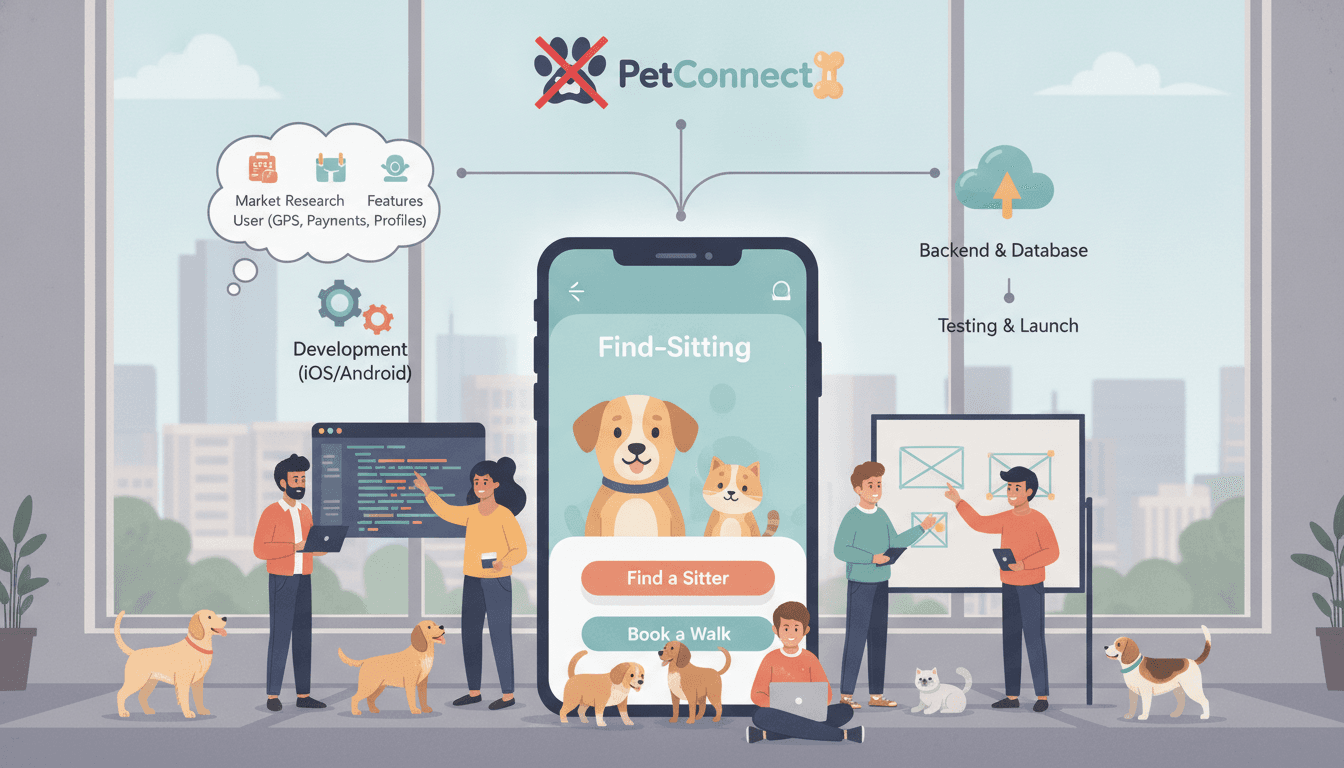
Building a pet services marketplace from scratch is more involved than it looks. Rover's core loop — list a sitter, search by location, book, pay, review — sounds simple, but the engineering underneath it involves real-time availability, background verification, dynamic pricing, two-sided trust, and payment flows with escrow semantics. This post walks through the architecture decisions you'll actually face.
What Does an App Like Rover Actually Do, Technically?
Before writing a line of code, map the service surface. Rover covers dog walking, boarding, drop-in visits, house sitting, and day care. Each service type has a different booking model.
To explore this further, see How to Make an App Like DogVacay.
Dog walking and drop-in visits are time-boxed, often GPS-tracked, and need proof-of-service (photo updates, map routes). Boarding is a multi-day stay with check-in/check-out semantics closer to a hotel than a taxi. Day care is recurring. These aren't the same data model — conflating them early creates pain later.
The platform is two-sided: pet owners and sitters. Each side has a distinct onboarding flow, trust requirement, and notification pattern. Design your user model to support multiple roles per account from day one, because many sitters are also owners.
If this is relevant to your project, check out How to Make an App Like Wag!.
The Core Entities
Your data model starts with these:
- User (with role flags: owner, sitter, or both)
- Pet (species, breed, age, medical notes, vaccination records)
- Listing (sitter profile, services offered, capacity, rates, availability calendar)
- Booking (service type, dates, status machine, linked pets)
- Review (bidirectional: owner reviews sitter, sitter reviews owner)
- Payment (transaction, escrow status, payout schedule)
Availability is the hardest entity to get right. Sitters set recurring schedules with exceptions, block dates, and cap simultaneous bookings per service type. Use an interval-based model, not a flat calendar table — querying a flat table for overlapping bookings at scale gets expensive fast.
What Tech Stack Should You Use?
There's no single right answer, but here's what maps well to this problem:
| Layer | Recommended choice | Why |
|---|---|---|
| Mobile | React Native or Flutter | Single codebase, good map/camera/notification support |
| Backend API | Node.js (Fastify) or Python (FastAPI) | Both handle async I/O well; FastAPI is easier to document |
| Database | PostgreSQL with PostGIS | Geospatial queries are central; PostGIS handles them natively |
| Search | Elasticsearch or Typesense | Faceted search on service type, price, rating, distance |
| Real-time | Socket.IO or Ably | In-app messaging between owner and sitter |
| Payments | Stripe Connect | Marketplace payouts with platform fee splits |
| Maps | Google Maps Platform or Mapbox | Route tracking for walks; Mapbox is cheaper at scale |
| Push notifications | Firebase Cloud Messaging | Cross-platform, reliable, free up to large volumes |
| Background checks | Checkr API | Automated criminal/identity checks for sitters |
PostGIS deserves emphasis. Location search is not just "find sitters near me" — it's "find sitters within 5 km who offer boarding, have capacity on these dates, and accept large dogs." That's a geospatial join with availability and filter predicates. PostGIS handles this well; a standard lat/lon column with application-side filtering does not.
How Does the Booking and Payment Flow Work?
This is where most teams underestimate complexity.
Rover holds payment at booking time and releases it to the sitter 48 hours after the service ends. That's escrow behaviour. Stripe Connect handles the mechanics: you collect from the owner via a PaymentIntent, hold funds in your platform account, and trigger a Transfer to the sitter's connected account after the release window.
Your booking state machine needs at least these states: requested, accepted, confirmed (payment captured), in_progress, completed, disputed, cancelled, refunded. Transitions between states must be atomic — use database transactions, not application-level logic, to prevent double-transitions under concurrent requests.
Cancellation policy is a product decision with engineering implications. If you support tiered refunds (full refund if cancelled 7+ days out, 50% if 2-7 days, none inside 48 hours), the payout trigger logic branches significantly. Build this as a configurable policy object, not hardcoded conditionals.
Platform fee: Rover charges owners a service fee (roughly 5-7% of the booking subtotal) and takes a 20% cut from sitters. Model this as two separate line items on every transaction, both visible in your ledger.
/// Not sure where to start?
Get the architecture before you commit
Tell us what you're building and we'll map the technical approach, stack, and rough timeline. No cost, no obligation, no sales call required.
GPS Tracking and Proof-of-Service
Dog walking is the highest-anxiety service for owners. Real-time GPS tracking during a walk, with a shareable map link, directly affects retention.
On mobile, use the background location API on both iOS (Core Location with allowsBackgroundLocationUpdates) and Android (WorkManager with a foreground service). Publish location updates to a backend via WebSocket or MQTT every 10-15 seconds. Store the route as a PostGIS LineString — this lets you calculate distance walked server-side and display the route on a map after the fact.
Photo updates during a visit require handling image uploads to S3 (or equivalent object storage), generating thumbnails, and pushing a notification to the owner. Use presigned upload URLs so mobile clients write directly to S3; don't proxy large files through your API server.
GPS spoofing is a real concern. Cross-check reported location against booking address at service start. Flag anomalies for manual review rather than auto-rejecting, because GPS accuracy in dense urban areas is genuinely poor.
Trust, Verification, and Safety
Two-sided trust is what makes or breaks a pet services marketplace. Owners are handing over a family member. The trust mechanisms have to be real, not cosmetic.
Sitter verification via Checkr covers identity and criminal background. The Checkr API returns a status (clear, consider, suspended) with a webhook. Map consider cases to a manual review queue — don't auto-approve or auto-reject.
Vaccination records for pets are owner-uploaded documents. Store them in S3 with access scoped to the booking's sitter. Don't expose raw S3 URLs; use presigned URLs with short TTLs (15 minutes is enough).
Reviews need anti-gaming measures. Delay display until both sides have submitted, or 14 days have passed, whichever comes first. This prevents retaliatory reviews and is how Airbnb has handled the same problem since 2013.
You may also find our article on How to Make an App Like Airbnb useful.
Insurance integration is worth considering. Rover provides its own insurance product. If you're building a competitor, you'll either need to partner with a pet insurance provider or direct users to their own cover. This is a legal and product question as much as an engineering one.
Conclusion
The core challenge in building a Rover-style app is not the UI — it's the intersection of real-time location, async payment flows with escrow semantics, two-sided verification, and a booking state machine that has to be correct under concurrency. Get those four things right and the rest follows.
If you're scoping this out, start with the data model and the payment flow. Those are the decisions that are hardest to reverse. Everything else — feature set, UI, notification copy — can change cheaply.
If you want a technical review of your architecture before you start building, reach out to the team at Sodio. We've built marketplace backends and know where the edge cases hide.
FAQ
How long does it take to build an app like Rover? An MVP covering search, booking, and payments typically takes 4-6 months with a team of four to five engineers. Full feature parity with Rover — including GPS tracking, in-app chat, background checks, and a review system — is closer to 12 months. Timeline depends heavily on how much of the infrastructure (auth, notifications, storage) you buy versus build.
What does it cost to build a pet services marketplace app? A realistic MVP budget runs from $80,000 to $150,000 depending on team location and whether you're using managed services. GPS tracking, Checkr integration, and Stripe Connect add complexity that pushes toward the higher end. Factor in ongoing infrastructure costs of $500-$2,000 per month once live, scaling with user volume.
How do you handle payments in a two-sided marketplace? Stripe Connect is the standard choice. You collect from the customer, hold funds on your platform account, and transfer to the service provider after any applicable hold period. The platform fee is deducted before transfer. This model handles tax reporting obligations on the provider side and supports refunds and disputes without custom ledger logic.
Do you need a separate backend for real-time features like GPS tracking? Not necessarily a separate service, but you need a persistent connection layer. WebSockets over your existing API server work at small scale. At higher load, a dedicated MQTT broker (like HiveMQ or AWS IoT Core) or a managed real-time service (Ably, Pusher) is more operationally stable and easier to scale independently of your REST API.
What's the biggest technical mistake teams make building marketplace apps? Modelling availability as a simple calendar table. Once you add recurring schedules, exceptions, service-type capacity limits, and timezone handling, flat-table availability queries become slow and incorrect. Use an interval model from day one and write thorough overlap-detection tests before you go live.
Have a project in mind? Contact Sodio Technologies to discuss your requirements and explore the right technology solution for your business.
/// Work with us
Talk to the engineers who'd build it
You'll get a technical scope, timeline and cost estimate from the people doing the work, not an account manager. In-house team, no subcontracting, since 2016.