

How to Make an App Like BabyCenter
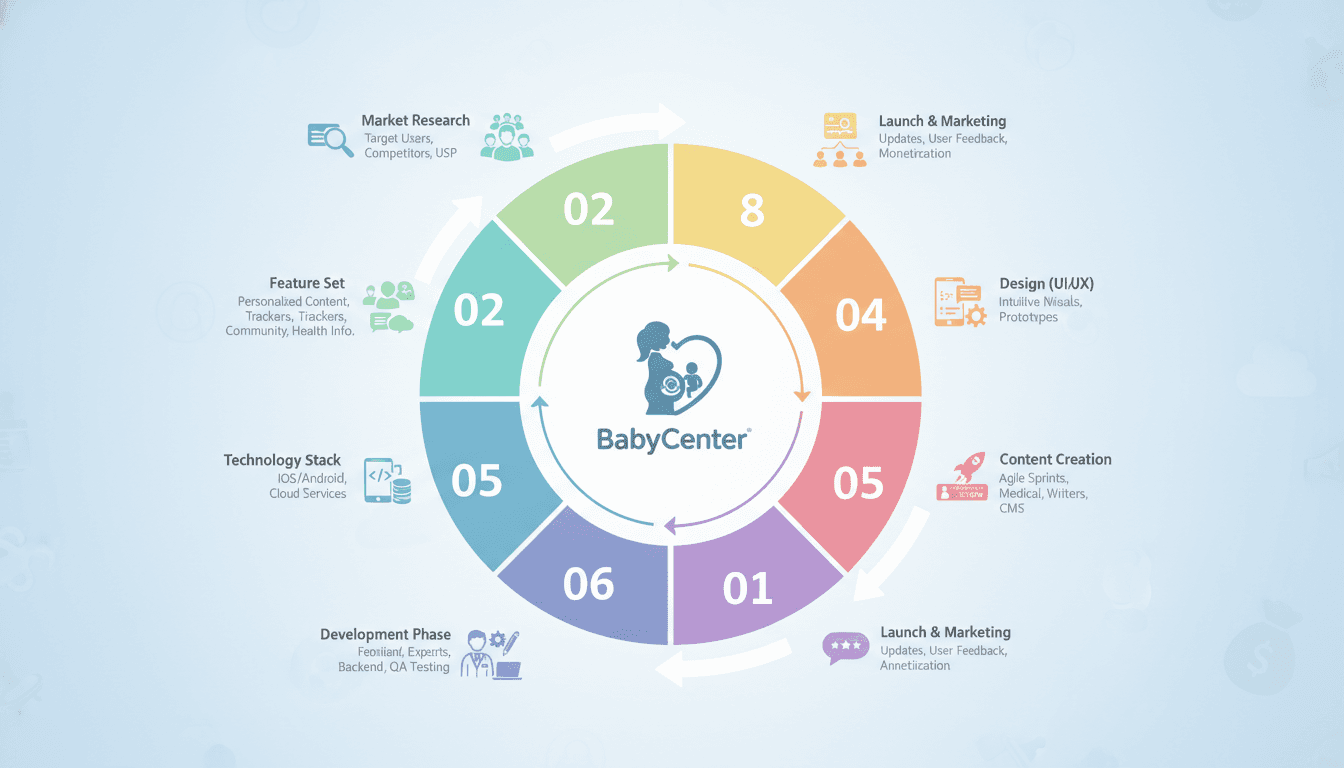
A practical breakdown of the architecture, features, and cost decisions behind building a parenting platform — from content delivery and community moderation to personalisation engines and compliance requirements.
What Does BabyCenter Actually Do, Technically?
Before scoping a build, it helps to be precise about what BabyCenter is under the hood. It is not simply a content site. It combines a content management system, a personalisation engine, a community forum with moderation tooling, a week-by-week pregnancy tracker, push notification infrastructure, and a health information layer that carries regulatory weight in most markets.
We cover a closely related subject in How to Make an App Like Kinedu.
The mobile apps (iOS and Android) account for a significant share of engagement. BabyCenter reports over 100 million users across 9 languages and 9 countries. That scale shapes every architectural decision. You are not building a blog with a due-date calculator. You are building a system that needs to serve personalised, medically-adjacent content reliably to parents at some of the most stressful moments of their lives.
Core Feature Surface
The minimum viable feature set for a comparable platform includes:
- User onboarding with due date or child's birthday as the personalisation anchor
- Week-by-week content delivery (articles, videos, trackers)
- Community forums with nested threads, upvoting, and reported-content queues
- Push notifications triggered by gestational or child age milestones
- User profile and child profile management
- Search with health-topic indexing
- A content management system for editorial teams
Optional but high-value additions include symptom checkers, product recommendation feeds, expert Q&A, and integration with wearables or EHR systems.
You may also find our article on How to Make an App Like The New York Times useful.
What Tech Stack Should You Use?
This depends on your team, your timeline, and how much traffic you expect at launch versus 18 months post-launch.
Backend
A Node.js or Python (FastAPI) backend works well for the API layer. If you expect write-heavy community features from day one, consider separating the forum service early. Monorepos with modular services are easier to maintain at this stage than full microservices, unless you have the engineering headcount to justify the operational overhead.
For the database layer, PostgreSQL handles user profiles, child profiles, and relational content data well. For the forum and activity feed, a combination of PostgreSQL and Redis (for caching and pub/sub) is a reasonable starting point. At BabyCenter's scale, Elasticsearch becomes necessary for content search. You can defer it, but plan for the migration.
Object storage (AWS S3 or GCS) for images and videos is non-negotiable. Media delivery should go through a CDN. CloudFront or Fastly are the standard choices. Video content specifically benefits from transcoding pipelines; AWS Elastic Transcoder or MediaConvert handles this without building custom infrastructure.
Mobile
Flutter is a strong choice if you want a single codebase for iOS and Android with near-native performance. React Native is the other credible option, and the ecosystem is more mature for certain third-party integrations. If your content is mostly article-based, a well-built progressive web app can cover a large portion of the use case and reduces your maintenance surface significantly.
We cover a closely related subject in How to Make an App Like The Bump.
Push notifications at scale should go through Firebase Cloud Messaging regardless of your mobile framework. The milestone-based trigger system (send a push when a user hits week 20 of pregnancy) is a scheduled job problem. A queue-based approach with BullMQ or AWS SQS, triggered by a daily cron that evaluates user timelines, is reliable and auditable.
Content Management
Contentful, Sanity, or Strapi are all viable headless CMS options. The editorial team will care more about the authoring experience than your engineers will. Strapi gives you self-hosted control; Contentful and Sanity are managed and faster to get running. Health content often requires version-controlled review workflows, which Contentful and Sanity handle better out of the box.
How Do You Handle Medically-Adjacent Content Without Becoming a Medical Device?
This is the question most product teams underestimate.
Health content that offers personalised guidance can attract regulatory scrutiny in some markets. In the EU, the Medical Device Regulation (MDR 2017/745) has a software annex (Annex VIII) that can classify symptom-checking features as Class I or higher medical devices depending on how they are framed. In the US, the FDA's digital health policy draws a line between general wellness apps and software as a medical device (SaMD).
BabyCenter stays on the right side of this line by framing content as editorial and community-sourced rather than diagnostic. Your legal and compliance review should happen before you write a line of feature code, not after.
Practically, this means:
- All health content should be reviewed by a qualified medical professional and have a visible review date
- Symptom-related features should direct users to healthcare providers rather than offering conclusions
- Data handling for health-adjacent inputs (menstrual cycles, symptoms, medications) may trigger HIPAA (US) or GDPR health data provisions (EU) even if you are not a covered entity
/// Not sure where to start?
Get the architecture before you commit
Tell us what you're building and we'll map the technical approach, stack, and rough timeline. No cost, no obligation, no sales call required.
What Does Community Moderation Actually Require at Scale?
Community forums are the stickiest feature on a parenting platform and the most expensive to run safely.
At low scale, a flagging system with a small human moderation team is workable. As you grow, you need automated pre-moderation. The standard approach combines a classifier model (fine-tuned on your content categories) with a confidence threshold. Posts above the threshold publish immediately. Posts below go to a human queue. Posts that hit specific keyword patterns (self-harm, spam, doxxing) are held automatically regardless of classifier score.
OpenAI's Moderation API is a fast way to get baseline content classification running without training your own model. It costs fractions of a cent per call and handles most obvious cases. You will still need a human moderation team. The classifier reduces queue volume, it does not replace judgement.
For a parenting platform specifically, you will encounter grief (pregnancy loss, infant illness), relationship distress, and occasionally safeguarding issues. Your moderation policy and escalation paths for these need to be defined before launch, not discovered in production.
How Much Does It Cost to Build?
Rough figures, assuming a mid-tier engineering team and no shortcuts on compliance or performance:
| Phase | Scope | Estimated Cost |
|---|---|---|
| MVP (6 months) | Onboarding, tracker, articles, basic push | $80,000–$130,000 |
| Community features | Forums, moderation tooling, reporting | $40,000–$70,000 |
| Personalisation engine | ML-based content recommendations | $30,000–$60,000 |
| CMS and editorial tools | Headless CMS, review workflows | $20,000–$40,000 |
| Total (12–18 months) | Full platform to BabyCenter parity | $180,000–$320,000 |
These numbers assume you are not building in AI-powered symptom checking, EHR integration, or multi-language localisation from day one. Each of those adds $30,000–$80,000 depending on depth.
Ongoing infrastructure costs for a platform at moderate scale (50,000–200,000 monthly active users) typically run $3,000–$8,000 per month on AWS or GCP, depending on your media delivery volume.
Conclusion
The core of a BabyCenter-style platform is straightforward to scope once you separate the content and tracking layer from the community layer and accept that health-adjacent content carries compliance obligations that require legal input, not just product decisions.
Start with the personalisation anchor (due date or child's birthday), build a solid content delivery pipeline, and defer the community features until you have users who want to talk to each other. The push notification infrastructure and milestone trigger system should be built early because retrofitting it is expensive.
If you are at the stage of scoping a build or reviewing an existing spec, Sodio can do a technical review of your architecture and flag the decisions that tend to become expensive later.
FAQ
How long does it take to build an app like BabyCenter? A credible MVP with onboarding, week-by-week content delivery, and push notifications takes roughly 5 to 7 months with a focused team. Adding community forums and moderation infrastructure extends the timeline to 12 to 18 months. Trying to compress that without cutting features meaningfully increases the risk of compliance and performance problems later.
Do I need a separate iOS and Android app, or will a PWA do? For a content-heavy parenting platform, a progressive web app covers the majority of use cases and is significantly cheaper to maintain. Native apps become necessary when you need offline access, deep push notification control, or device sensor integration (camera for milestones, for example). Many platforms launch PWA-first and build native apps once they have validated retention.
What are the GDPR implications of collecting pregnancy and child health data? Under GDPR, health data is a special category (Article 9) and requires explicit consent, a documented lawful basis, and stricter access controls. Child data collected from users under 16 requires parental consent in most EU member states. You should conduct a Data Protection Impact Assessment before launch and appoint a Data Protection Officer if you are processing health data at scale.
Can I use AI for content personalisation without building a recommendation model from scratch? Yes. For early-stage platforms, collaborative filtering using existing libraries (Surprise, LightFM) or managed services like AWS Personalize is faster than training a custom model. The personalisation anchor (gestational week or child age) means rule-based sequencing already covers a large share of the content relevance problem before you introduce ML at all.
What is the biggest mistake teams make when building parenting platforms? Underestimating the moderation and safety infrastructure. Community forums on parenting platforms attract users in genuine distress. Teams that launch without a moderation policy, a human review queue, and defined escalation paths for safeguarding situations end up handling crises reactively. The tooling is not expensive. The planning just has to happen before the platform has users, not after.
Have a project in mind? Contact Sodio Technologies to discuss your requirements and explore the right technology solution for your business.
/// Work with us
Talk to the engineers who'd build it
You'll get a technical scope, timeline and cost estimate from the people doing the work, not an account manager. In-house team, no subcontracting, since 2016.