

How to Make an App Like Kinedu
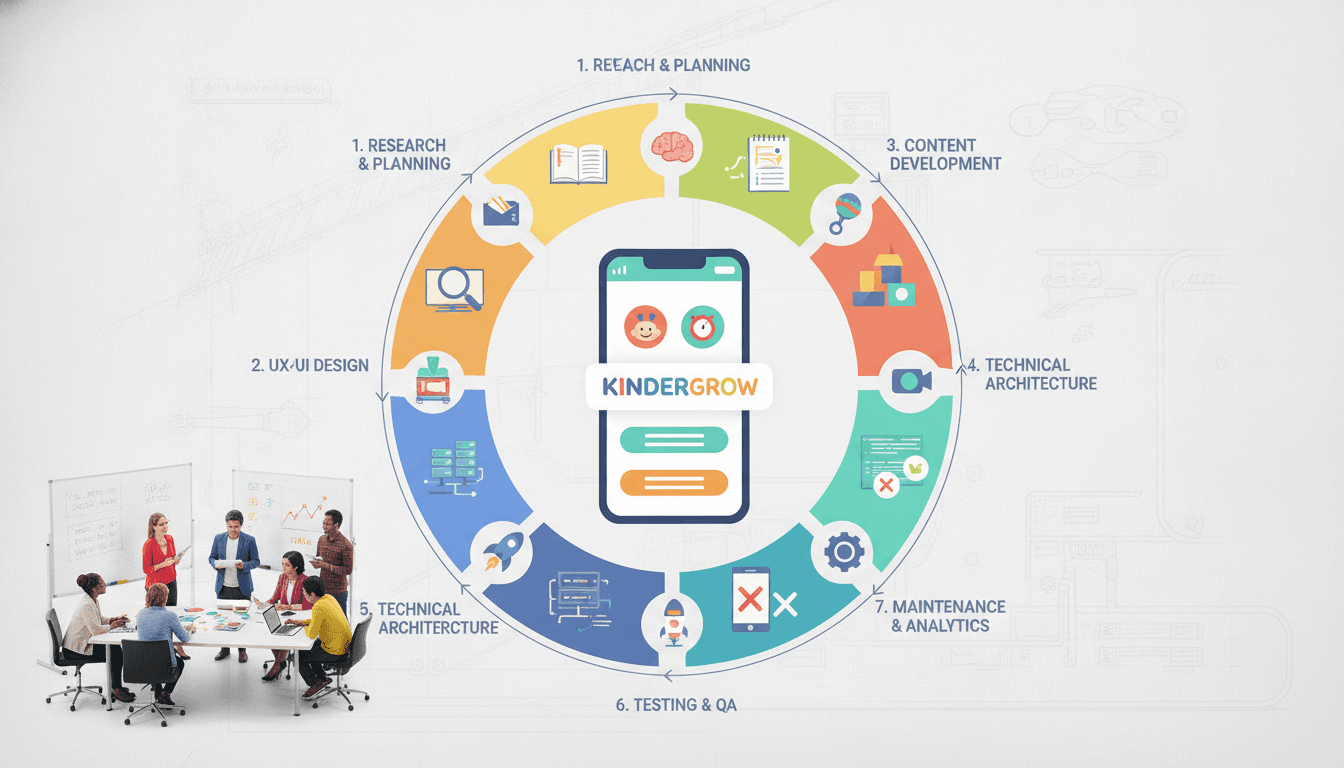
Building a child development app like Kinedu means handling a domain where personalisation, content delivery, and clinical credibility all have to work together. This post walks through the architecture, data models, and product decisions you'll face — from activity recommendation engines to multilingual content pipelines.
What Does Kinedu Actually Do Under the Hood?
Kinedu tracks a child's developmental milestones across four domains: cognitive, linguistic, social-emotional, and fine/gross motor. Parents log completed activities; the app adjusts recommendations based on the child's age (in weeks, not years) and performance signals.
You may also find our article on How to Make an App Like BabyCenter useful.
The core loop is:
- Onboarding captures date of birth, gestational age if premature, and sometimes a paediatrician assessment.
- The app computes a developmental age, not a calendar age.
- Activities are surfaced from a content library tagged against developmental domains and difficulty levels.
- Parent feedback (completed, skipped, too hard, loved it) updates a preference model.
That last step is where the engineering gets interesting. Kinedu has reported over 3 million families on the platform. At that scale, a naive rule-based recommendation system breaks down quickly.
How Do You Model Child Development Data?
Age in Weeks, Not Years
The first architectural decision is your time axis. A child who is 6 months old born at 28 weeks gestation has a corrected age closer to 3 months. Your schema needs to store both chronological_age_days and corrected_age_days and surface the right one in every recommendation query. Miss this and you'll surface activities that are developmentally inappropriate, which erodes trust fast.
Milestone Graphs
Developmental milestones are not a flat list. They have dependencies: a child typically needs to achieve head control before sitting unsupported. Model this as a directed acyclic graph (DAG), not a table. Each node is a milestone; edges represent prerequisites. PostgreSQL with a recursive CTE handles traversal fine up to a few thousand nodes. If your milestone graph grows significantly or you need graph analytics, Neo4j is worth evaluating.
Activity Metadata Schema
Each activity needs at minimum:
- Developmental domain (multi-label, not single)
- Target age range in weeks (lower and upper bound)
- Difficulty score (float, calibrated against your milestone graph)
- Required materials (affects filterability)
- Estimated duration in minutes
- Media assets (video, illustration, PDF)
- Localisation keys
The localisation keys matter more than most teams expect. Kinedu operates in Spanish, English, and Portuguese, and cultural appropriateness of activities varies significantly. "Activity content" is not just translation; it's adaptation.
What Does the Recommendation Engine Look Like?
A rule-based baseline is the right starting point. Filter activities by corrected age range and developmental domain. Rank by a simple score that weights recency of parent engagement and domain balance. This ships in weeks and gives you data to train something better.
From there, a collaborative filtering model (matrix factorisation, or a shallow neural approach like a two-tower model in TensorFlow Recommenders) improves quality once you have enough engagement data. The cold-start problem is real: new children have no history, so your rule-based layer stays in production as the fallback.
To explore this further, see How to Make an App Like Fabulous.
A few implementation notes:
- Store every recommendation event with a timestamp, the model version that generated it, and the outcome. You'll need this for A/B testing and model evaluation.
- Personalisation signals degrade as the child ages. An 8-week-old's pattern tells you almost nothing useful 12 weeks later. Build explicit age-based model expiry.
- Parents often use the app with multiple children. Keep profiles strictly isolated at the data layer to prevent cross-contamination of recommendation signals.
/// Not sure where to start?
Get the architecture before you commit
Tell us what you're building and we'll map the technical approach, stack, and rough timeline. No cost, no obligation, no sales call required.
Content Pipeline and Clinical Credibility
Kinedu partners with clinical advisors to validate activity content. This isn't just marketing; it affects product architecture. You need a content review workflow baked into your CMS, not bolted on after launch.
Build a content state machine: draft → clinical_review → approved → published → deprecated. Each transition logs the reviewer, timestamp, and any flags raised. If you're using Contentful or Sanity as your headless CMS, model this as a custom workflow field. If you're building a custom CMS (generally not worth it at early stage), the same state machine applies.
Video is your heaviest asset class. Kinedu uses short instructional videos, typically under 3 minutes. Store originals in S3 or GCS, transcode to HLS with multiple bitrates using AWS Elemental MediaConvert or FFmpeg on your own infra, and deliver via CloudFront or a CDN of your choice. Cache aggressively; these assets don't change.
Accessibility matters here more than in most app categories. Parents often watch videos one-handed while holding an infant. Design for that: large tap targets, auto-play previews, captions on by default.
For a closer look at a related topic, read our guide on How to Make an App Like Cozi Family Organizer.
Mobile Architecture: What Stack Makes Sense?
Kinedu is available on iOS and Android. The question of native versus cross-platform depends on how much you want to invest in platform-specific UX polish.
| Approach | Pros | Cons |
|---|---|---|
| Flutter | Single codebase, fast iteration, good performance | Limited access to some native APIs, smaller talent pool |
| React Native | Large community, good OSS ecosystem | Bridge overhead, more platform-specific workarounds |
| Native (Swift + Kotlin) | Best performance, full platform API access | Two codebases, higher engineering cost |
For a child development app, Flutter is a reasonable default. The UI is not performance-critical in the way a game or video editor is. The animations and illustrated content that characterise this category render well in Flutter. Where you'll feel friction is in video playback and push notification handling, both of which have mature plugins but occasionally require native module work.
Offline support is non-negotiable. Parents in lower-connectivity markets make up a significant portion of this demographic, particularly in Latin America. Download activities for offline use, queue completion events locally, and sync on reconnect. WorkManager on Android and BGTaskScheduler on iOS handle background sync.
Monetisation, Analytics, and Compliance
Kinedu uses a freemium model: a free tier with limited activities and a subscription (around $9.99/month or $79.99/year at their last published pricing) for full access. Implement this with RevenueCat rather than building your own subscription logic against StoreKit and Google Play Billing directly. The cross-platform receipt validation and webhook handling alone justify the 1% revenue cut.
On analytics: Mixpanel or Amplitude for product events, not just Firebase. You need funnel analysis at the milestone-completion level, not just screen views.
COPPA and GDPR-K compliance is not optional. Your app processes data about children under 13. In the US, COPPA requires verifiable parental consent before collecting any personal data from a child. In the EU, GDPR Article 8 sets the age of digital consent at 16 (lower in some member states). The practical implication is that you're collecting data about children but from parents, so consent flows and data deletion requests must be scoped to the parent account and cascade to all associated child profiles. Get legal advice specific to your target markets before launch, not after.
Conclusion
Building in this space is tractable if you're disciplined about the data model early, particularly the age calculation and milestone graph. The recommendation engine doesn't need to be sophisticated at launch; the content pipeline and clinical credibility are harder problems to retrofit than the ML. Plan for offline-first from the start rather than treating it as a later optimisation.
If you're evaluating whether to build this in-house or with a specialist team, the decision usually comes down to whether you have product designers and clinical content advisors in-house already. The engineering is the easier part to hire for.
FAQ
How long does it take to build an app like Kinedu? A credible MVP with onboarding, a static activity library, basic recommendations, and iOS and Android apps typically takes 6 to 9 months with a team of 5 to 7 engineers. Full-featured parity with a mature product like Kinedu, including personalisation, video content, and multilingual support, is closer to 18 to 24 months of iterative development.
What's the biggest technical risk in building a child development app? The age calculation and corrected-age handling. Getting this wrong means surfacing developmentally inappropriate content, which parents notice immediately. It's a data modelling problem, not a hard algorithmic one, but it needs to be right in the schema from day one. Retrofitting it into an existing data model is painful.
Do you need machine learning for recommendations from the start? No. A rule-based system filtered by corrected age and developmental domain, ranked by engagement recency and domain balance, is a reasonable v1. You need enough engagement data before collaborative filtering adds meaningful value. Most teams underestimate how long it takes to accumulate that signal.
How do you handle COPPA compliance for a children's app? You collect data from parents, not children directly. All consent flows target the parent account. Parental consent must be verifiable, which typically means email confirmation plus a payment-based verification step. Data deletion requests must cascade from the parent account to all associated child profiles. Review the FTC's COPPA guidance and get jurisdiction-specific legal advice before launch.
What CMS should you use for activity content? Contentful and Sanity are both reasonable choices. Contentful has better out-of-the-box localisation tooling. Sanity gives you more flexibility in the content model and the GROQ query language is well-suited to structured content like activity metadata. Avoid building a custom CMS unless you have very specific workflow requirements that neither platform can meet.
Have a project in mind? Contact Sodio Technologies to discuss your requirements and explore the right technology solution for your business.
/// Work with us
Talk to the engineers who'd build it
You'll get a technical scope, timeline and cost estimate from the people doing the work, not an account manager. In-house team, no subcontracting, since 2016.