

How to Make an App Like The Bump
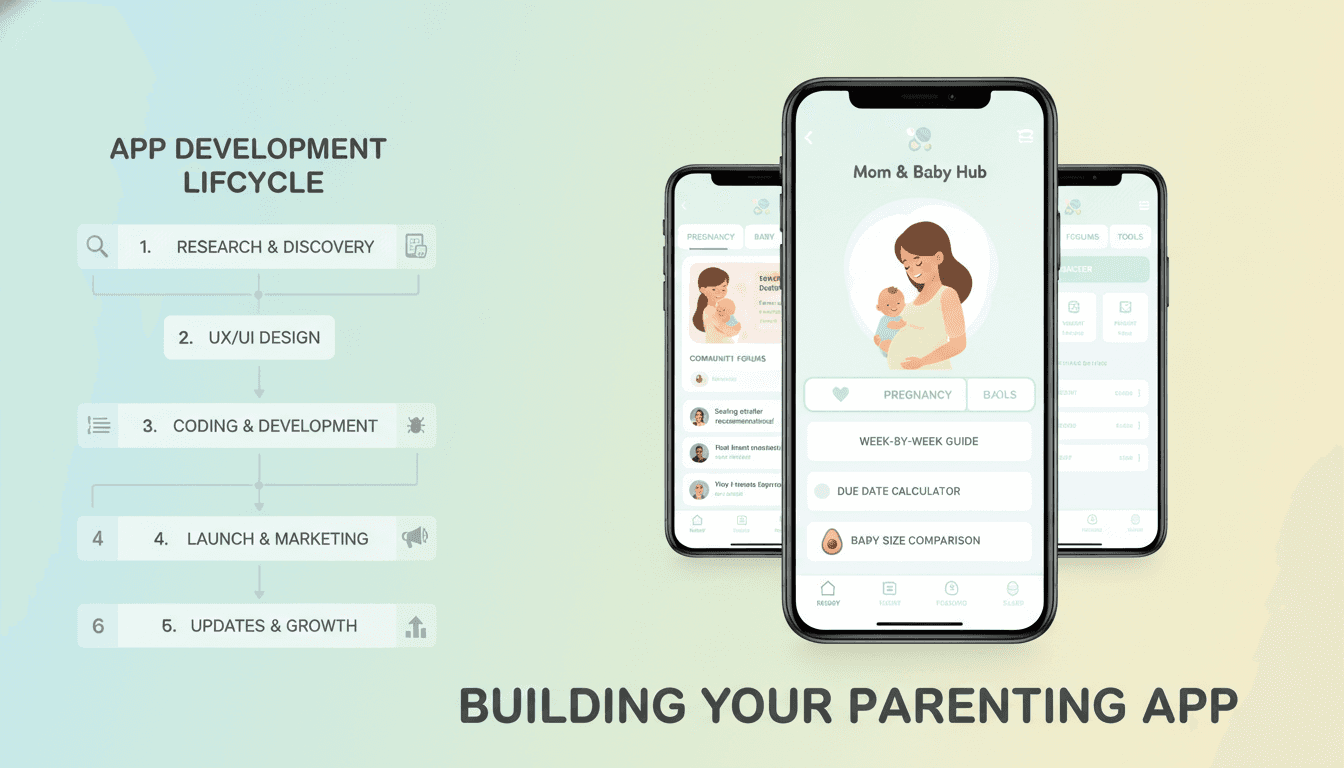
Building a pregnancy and parenting app that people actually use every day is harder than it looks. The Bump gets roughly 9 million unique visitors a month and holds a 4.8-star rating on iOS. That number is not accidental — it comes from a specific set of product and engineering decisions. This post breaks down what those decisions are, what they cost, and where the real complexity sits.
What Does an App Like The Bump Actually Do?
Before writing a single line of code, you need to be honest about feature scope. The Bump is not a simple content app. It combines:
- Week-by-week pregnancy tracking tied to the user's due date
- Community forums segmented by birth month and topic
- A hospital and doctor finder backed by location data
- A baby names database with filtering by origin, meaning, and popularity
- A registry builder integrated with third-party retailers
- Push notifications tied to gestational milestones
- Personalised content feeds based on trimester and user profile
Each of these is a product in itself. Teams underestimate this constantly. The registry feature alone requires OAuth integrations with retailers like Amazon and Buy Buy Baby, webhook handling for inventory changes, and a data model that handles shared wishlists across multiple users.
If this is relevant to your project, check out How to Make an App Like Glow Baby.
Start with a prioritised MVP. Pregnancy tracking, milestone notifications, and a content feed are the core loop. Ship those first. The community and registry features can follow in subsequent releases.
What Tech Stack Should You Build On?
The right answer depends on your team, your timeline, and your distribution goals.
Frontend
React Native is the practical choice for a consumer app targeting both iOS and Android from a single codebase. You will lose some native performance on highly animated screens, but for a content and community app, the trade-off is acceptable. Flutter is a legitimate alternative if your team has Dart experience — its rendering engine gives you more control over custom UI components like the week-by-week fetal size visualisations that apps like The Bump rely on.
Related reading: How to Make an App Like BabyCenter.
If you are building iOS-only first, Swift with UIKit or SwiftUI gives you the smoothest experience, but you are then writing a separate Android app later. Most teams cannot afford that.
Backend
Node.js with Express or Fastify works well for the API layer. If your team is Python-heavy, FastAPI is an equally valid choice — it handles async I/O cleanly and the automatic OpenAPI schema generation saves time during integration. The Bump-style apps are read-heavy with bursty write patterns (forum posts, registry updates), so your database choice matters.
PostgreSQL handles the relational data — user profiles, pregnancy data, registry items. For the community forum feed and notifications, Redis works as a caching and queue layer. If your forum scales to hundreds of thousands of concurrent users, consider separating the community feature onto a dedicated service with a document store like MongoDB, where the flexible schema fits threaded discussions better.
You may also find our article on How to Make an App Like Flo useful.
Infrastructure
AWS or GCP both work. The decision usually comes down to your team's existing knowledge. Use managed services where you can: RDS for Postgres, ElastiCache for Redis, S3 for media. Containerise with Docker from day one and use ECS or GKE for orchestration. Do not wait until you need to scale to set this up — retrofitting containers onto a tightly coupled monolith is painful.
How Do You Handle Sensitive Health Data?
This is where many teams get into trouble late in the build.
Pregnancy data is not technically classified as PHI under HIPAA in the same way that clinical records are, but it is deeply personal and subject to increasing regulatory scrutiny, particularly in the US post-2022. Your privacy posture needs to be decided before you build, not bolted on afterwards.
At minimum:
- Encrypt data at rest (AES-256) and in transit (TLS 1.3)
- Store the minimum data necessary — do not collect gestational age in weeks if a due date alone serves the same function
- Give users a clear data deletion flow that actually works end-to-end
- Keep health-related data out of your analytics pipelines unless you have explicit, informed consent
If you plan to sell or share anonymised data with third parties, get legal counsel involved early. Several US states have passed reproductive privacy laws since 2022, and the compliance picture is still shifting. Building a configurable data-sharing consent layer from the start is cheaper than retrofitting one.
/// Not sure where to start?
Get the architecture before you commit
Tell us what you're building and we'll map the technical approach, stack, and rough timeline. No cost, no obligation, no sales call required.
Community Features: Where Apps Like This Live or Die
The Bump's community forums are arguably its most defensible feature. Content can be replicated. A community with years of posts, relationships, and trust cannot.
Building a forum product is underestimated as an engineering problem. You need:
- A moderation system with both automated flagging (for spam and sensitive content) and human review queues
- A reporting mechanism that produces actionable signals, not noise
- Real-time updates for active threads, which means WebSockets or Server-Sent Events
- A search index — Elasticsearch or Typesense both work well here; Typesense is easier to self-host and cheaper at lower scale
- A notification system that does not spam users into disabling notifications entirely
The push notification problem is worth calling out separately. Apps in this category typically see notification opt-out rates above 40% if the messaging is poorly tuned. Segment users by trimester and engagement level. Use Firebase Cloud Messaging for delivery and track open rates per notification type. Kill any notification type that consistently underperforms.
The community also needs trust signals from day one. That means a verified badge system for medical professionals who participate, clear community guidelines written in plain language, and a graduated moderation system where newer accounts have posting limits until they establish a history.
How Much Does It Cost to Build?
This depends heavily on team composition and geography, but here are realistic ranges for a well-specified MVP covering tracking, content, and basic community features.
| Component | Estimated Dev Time | Notes |
|---|---|---|
| React Native app (iOS + Android) | 10–14 weeks | Single team, 2 developers |
| Backend API + database | 8–12 weeks | Overlaps with frontend |
| CMS integration | 2–3 weeks | Contentful or Sanity |
| Push notifications | 1–2 weeks | FCM + APNs setup |
| Basic community forum | 6–10 weeks | Moderation tools add time |
| Admin dashboard | 3–4 weeks | Often underscoped |
A four-person team (two frontend, one backend, one QA) working in parallel can realistically ship an MVP in five to six months. That is assuming product scope is locked before development starts — scope creep in consumer apps is the single biggest schedule risk.
Budget for App Store and Play Store review cycles. Apple's review averages two days, but rejections for health-adjacent apps are common and can add weeks. Test your app categorisation and metadata against Apple's health and fitness guidelines before submission.
Conclusion
The core challenge in building an app like The Bump is not the technology. It is the combination of sensitive data handling, community trust, and personalised content delivery that has to work together from day one. Each of those requires deliberate decisions before the first sprint starts.
If you are at the stage of validating the concept, build the tracking and milestone notification loop first. Get users into a habit. Community and registry features have value only when there is an existing user base to anchor them.
If you want to talk through the architecture for a specific feature set or get a realistic scope estimate, reach out to the team at Sodio.
FAQ
How long does it take to build a pregnancy tracking app? A focused MVP covering tracking, milestone notifications, and a basic content feed takes roughly five to six months with a four-person team. Adding community features and a registry builder extends that by three to four months. Timeline depends heavily on how stable the product spec is before development begins.
Do I need to comply with HIPAA to build a pregnancy app? Not necessarily in the strict clinical sense, but pregnancy data is sensitive under several state-level privacy laws passed after 2022. You should treat it as protected data regardless — encrypt at rest and in transit, give users genuine deletion controls, and get legal review before sharing any data with third parties.
What database should I use for a community forum at scale? PostgreSQL handles user data and relational content well. For threaded community discussions with high read volume, MongoDB's flexible schema is a better fit. Use Redis for caching hot threads and managing notification queues. The right choice depends on expected concurrent users in the first twelve months.
How do I keep push notification opt-out rates low? Segment notifications by trimester and user engagement level. Send milestone updates only when they are genuinely relevant to the user's week of pregnancy. Track open rates per notification type using Firebase Cloud Messaging analytics and suppress any notification category with consistently low open rates.
Should I build the app natively or use a cross-platform framework? React Native is the right call for most teams building a consumer app for both iOS and Android. You get about 85–90% code reuse and acceptable performance for content-heavy apps. Go native only if you need deep device integrations or have a single-platform strategy for launch.
Have a project in mind? Contact Sodio Technologies to discuss your requirements and explore the right technology solution for your business.
/// Work with us
Talk to the engineers who'd build it
You'll get a technical scope, timeline and cost estimate from the people doing the work, not an account manager. In-house team, no subcontracting, since 2016.