

How to Make an App Like Bumble
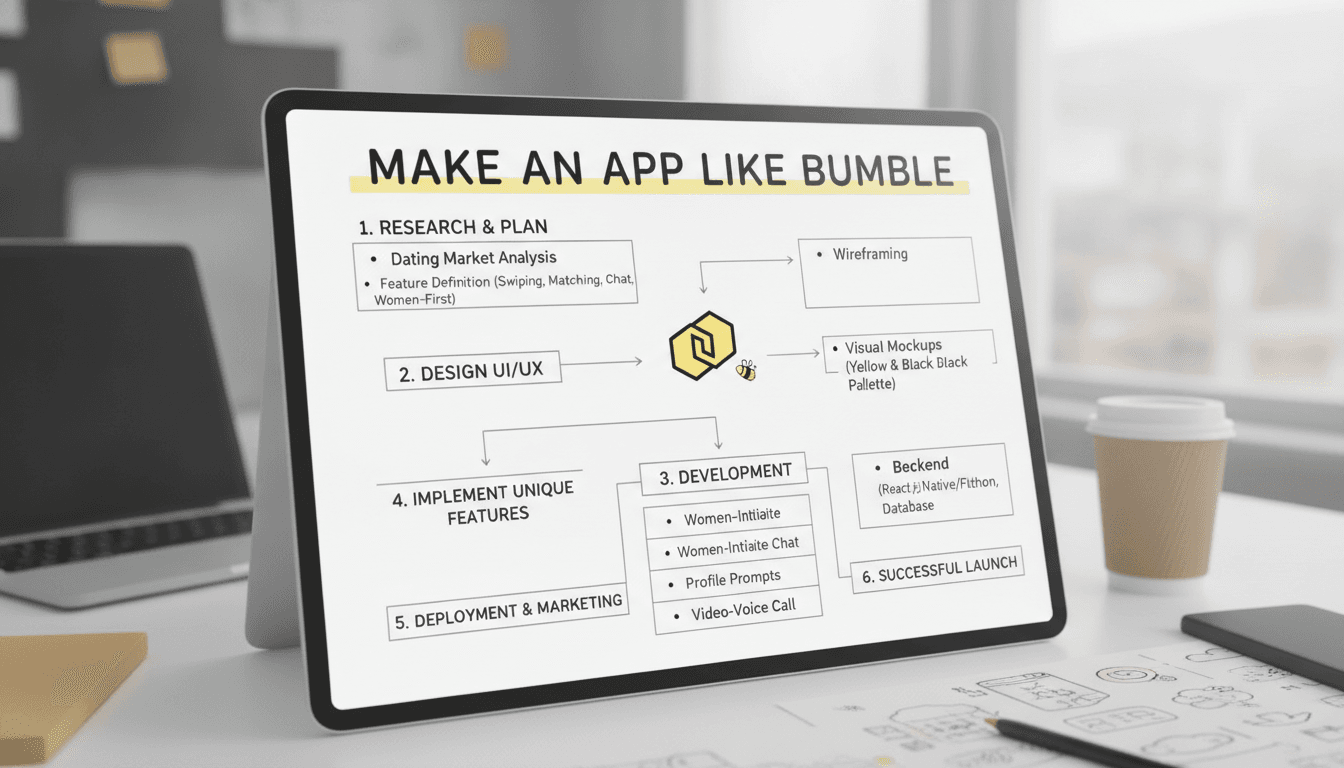
Building a dating app that competes with Bumble means solving hard engineering problems across real-time messaging, matching algorithms, media handling, and trust systems — all at the same time. This post breaks down exactly how that works.
What Does It Actually Take to Build a Dating App at Bumble's Scale?
Bumble had over 50 million registered users as of 2023. It processes billions of swipe events, runs geolocation queries continuously, and enforces a "women message first" flow at the application layer, not just the UI layer. That last bit matters more than people think — it means the business rule is encoded in your state machine, not bolted on as a frontend check.
The core technical surface of an app like Bumble includes:
- A matching engine with real-time swipe processing
- A bidirectional chat system with 24-hour expiry logic
- A media pipeline for profile photos and video verification
- A geolocation index that can query "users within X km" at low latency
- A trust and safety layer covering AI-based content moderation and ID verification
- A subscription and payments system (Bumble Boost and Bumble Premium are significant revenue drivers)
You don't need all of this on day one. But you need to architect as though you will.
How Should You Design the Matching Engine?
The swipe-and-match model looks simple. It is not.
Every swipe is an event. At Bumble's scale, that's tens of thousands of events per second during peak hours. You need an event-driven architecture, not a request-response one. Kafka or AWS Kinesis are the standard choices here. Kafka gives you more control; Kinesis is faster to get production-ready if you're already on AWS.
The Matching Algorithm
Matching is fundamentally a filtering problem. The basic pass filters on age range, distance, and gender preference. After that, you rank candidates.
Bumble uses a proprietary scoring model. For a new build, a good starting point is a collaborative filtering model trained on historical match and conversation data. Before you have enough data for that, simple weighted scoring on profile completeness, activity recency, and mutual connection signals gets you further than you'd expect.
Geolocation indexing is where most teams under-invest early. A PostGIS extension on PostgreSQL handles sub-second radius queries well up to a few million active users. Beyond that, you're looking at a dedicated geospatial index like Elasticsearch's geo_distance queries or a purpose-built solution like what Tinder built internally with their Geomatch service.
The Women-Message-First Rule
This is a business rule that touches your data model. A match between two users needs a state: matched, initiated, expired, active. The transition from matched to initiated is only available to one user (the woman in a heterosexual match). Your backend enforces this, not your frontend. Any client can be tampered with.
What Does the Real-Time Chat Architecture Look Like?
Dating app chat has specific constraints that general-purpose messaging systems don't handle well by default.
The 24-hour expiry window is one. When a match is made, a countdown starts. If neither user initiates (or the required user doesn't), the conversation disappears. This means your message queue and your conversation state need to be time-aware. Redis with TTL-based key expiry is a practical solution for managing match expiry at scale, with a scheduled job sweeping expired states and writing final status to your primary database.
For the chat transport layer, WebSockets over a managed service like AWS API Gateway WebSocket or Ably is a reasonable starting point. Rolling your own WebSocket infrastructure is work you don't need in early stages. As you scale, you'll want to look at a dedicated messaging infrastructure layer, potentially backed by Cassandra for message storage given its write performance and time-series retrieval patterns.
Read receipts, typing indicators, and online presence are separate concerns from message delivery. Presence is best handled through a pub/sub layer, again Redis Pub/Sub or a managed alternative like Pusher.
/// Not sure where to start?
Get the architecture before you commit
Tell us what you're building and we'll map the technical approach, stack, and rough timeline. No cost, no obligation, no sales call required.
How Do You Handle Profile Media and Trust and Safety?
Profile photos are the highest-trust signal in a dating app. Users know this, and so do bad actors.
Media Pipeline
Images go through a pipeline: upload to S3 (or equivalent object store), trigger a Lambda or Cloud Function for processing, run through content moderation, generate multiple resolution variants, and serve from a CDN. CloudFront in front of S3 is the standard setup. Video verification, which Bumble uses for profile authenticity, adds a liveness check step before the media is approved.
For content moderation, AWS Rekognition or Google Cloud Vision handle explicit content detection at acceptable accuracy levels (Rekognition reports over 98% accuracy on explicit content). You'll still need a human review queue for borderline cases and appeals.
ID Verification and Blocking
ID verification integrates with third-party providers. Jumio and Onfido are the most commonly used in consumer apps. The verification result is stored as a trust signal on the user record, not the ID document itself.
Blocking and reporting need to be designed carefully. A block must be bidirectional and immediate, reflected in the matching engine so the blocked user never appears in recommendations again. This means your matching filter reads from a block list, which needs to be cached close to the query path.
What's the Right Tech Stack for a Bumble-Like App?
There's no single right answer. Here's a comparison of the most common choices at each layer:
| Layer | Option A | Option B | Trade-off |
|---|---|---|---|
| Mobile | React Native | Flutter | React Native has a larger hiring pool; Flutter has better rendering performance |
| API | Node.js (Express/Fastify) | Go | Go handles concurrency better under load; Node.js is faster to build with |
| Realtime | WebSockets via Ably | AWS API Gateway WS | Ably abstracts scaling; AWS keeps you in one vendor ecosystem |
| Database | PostgreSQL + PostGIS | MongoDB + geo index | Postgres is stronger on relational integrity; Mongo is more flexible on schema |
| Message store | Cassandra | DynamoDB | Cassandra gives more control; DynamoDB is easier to operate |
| Media | S3 + CloudFront | GCS + Cloud CDN | Effectively equivalent; choose based on your primary cloud provider |
For a team building from scratch, a React Native frontend, Node.js API layer, PostgreSQL primary database, and Ably for real-time is a stack that's well-documented, has a large talent market, and gets you to a testable product fastest.
If you're anticipating rapid scale or have Go expertise in-house, the Go + Cassandra + custom WebSocket path gives you more headroom without a rewrite.
Conclusion
Building an app like Bumble is a multi-system problem. The matching engine, chat, media pipeline, trust layer, and payments system each have their own scaling and correctness requirements. Getting the data model right early, particularly around match state and the business rules encoded in it, saves significant rework later.
If you're at the architecture or scoping stage, the right next step is to define your MVP feature set and map it to the systems above. Not all of them need to be production-grade from day one, but all of them need to be in the design.
FAQ
How long does it take to build a dating app like Bumble? An MVP with core matching, chat, and profile features typically takes 4 to 6 months with a team of 4 to 6 engineers. A production-ready app with trust and safety, payments, and scalable infrastructure takes 9 to 14 months. Timeline depends heavily on how much of the matching and moderation logic is custom-built versus third-party.
How much does it cost to build an app like Bumble? A serious MVP costs between $80,000 and $150,000 depending on team location and stack choices. A full-featured product with AI moderation, video verification, and a scalable backend runs $250,000 to $500,000 or more. Ongoing infrastructure costs scale with your user base, but a 100,000 MAU app typically runs $3,000 to $8,000 per month in cloud costs.
Can you build a dating app with React Native? Yes, and it's a pragmatic choice. React Native shares around 80 to 90% of code between iOS and Android, which reduces build time significantly. The main limitation is real-time performance on very high-frequency interactions, like fast swipe animations, which sometimes require native modules. Bumble itself uses native iOS and Android, but most early-stage apps don't need that level of optimisation from day one.
What's the hardest part of building a dating app? Trust and safety is consistently the hardest part. Detecting fake profiles, handling abuse reports, and preventing harassment require a combination of AI-based detection, human review processes, and fast blocking mechanics. Getting moderation wrong destroys retention. It's the area teams most frequently under-invest in during initial builds.
Do you need a custom matching algorithm, or can you use an off-the-shelf solution? Off-the-shelf recommendation libraries like Surprise (Python) or TensorFlow Recommenders give you a starting point, but dating apps have cold-start problems that general recommendation systems don't handle well. You need explicit business logic for new users with no history. A hybrid of rule-based filtering and a learned ranking model, introduced once you have sufficient interaction data, is the practical path most production apps follow.
Have a project in mind? Contact Sodio Technologies to discuss your requirements and explore the right technology solution for your business.
/// Work with us
Talk to the engineers who'd build it
You'll get a technical scope, timeline and cost estimate from the people doing the work, not an account manager. In-house team, no subcontracting, since 2016.