

How to Make an App Like OkCupid
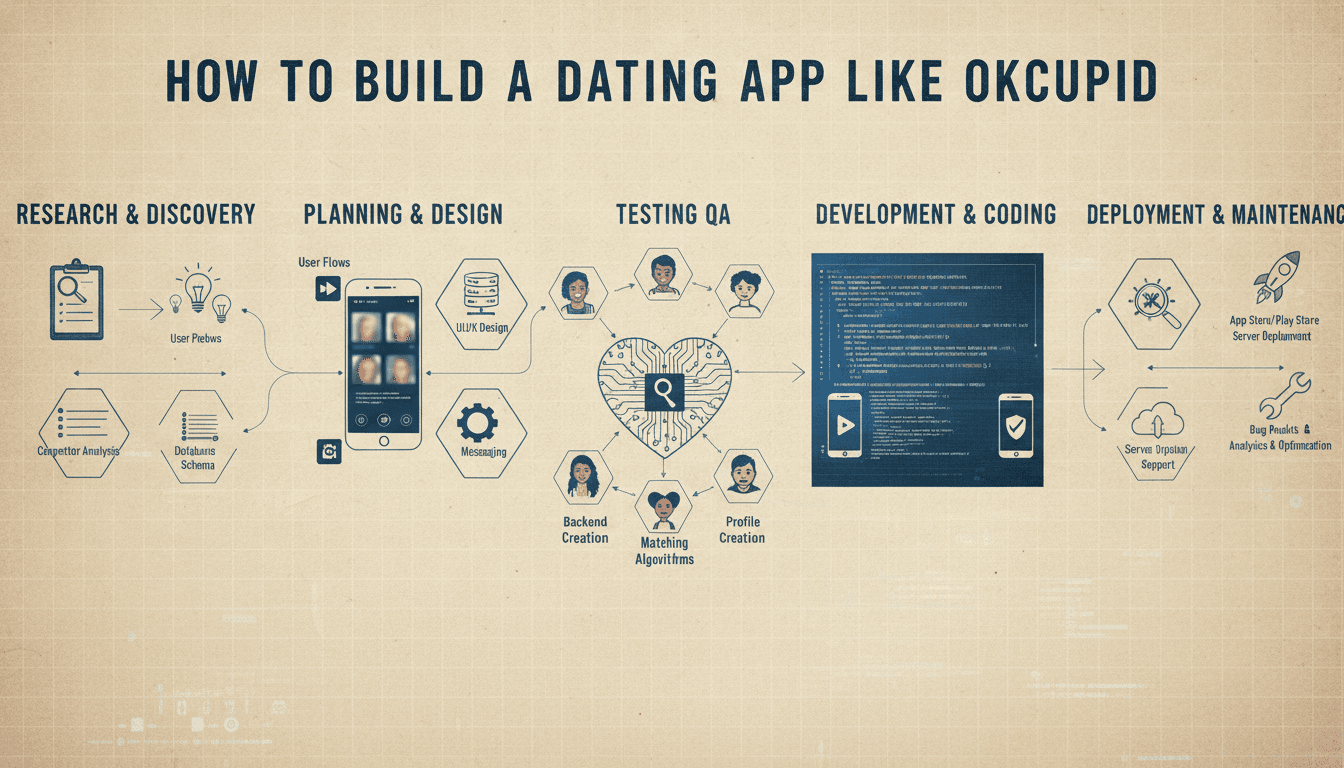
Building a dating app that competes with OkCupid means solving hard problems in matchmaking algorithms, user trust, real-time messaging, and content moderation — all at the same time. This post breaks down the architecture, feature set, and engineering decisions you'll face.
What Does OkCupid Actually Do Under the Hood?
OkCupid's core product is a compatibility engine. Users answer questions, weight those answers by importance, and the platform calculates a match percentage. That percentage is not a gimmick — it drives engagement more than pure swipe mechanics do.
The original OkCupid algorithm, described publicly by co-founder Christian Rudder, used a geometric mean of two directional compatibility scores. If you rate someone's answer as "mandatory" and they answered differently, your score toward them drops sharply. The system is asymmetric by design.
On top of that, OkCupid runs A/B tests relentlessly. Rudder's book Dataclysm documented experiments where the platform deliberately showed users "bad" matches. Even with suppressed match percentages, people found connections — which told them profile photos carry disproportionate weight relative to compatibility data.
You're building against that baseline.
Core Architecture: What You Need to Build First
User Profiles and the Question Engine
Profiles in a dating app are not just forms. They're signals. You need a schema flexible enough to store structured answers (multiple choice, sliders, free text) alongside media, and queryable enough to run compatibility scoring at scale.
A practical starting point:
- PostgreSQL for structured profile data and relational queries
- Elasticsearch for full-text search across bios and interests
- Redis for caching active user sessions and feed state
- S3-compatible object storage for photos and video
The question engine needs a many-to-many relationship between users and questions, with per-user answer weighting stored separately. At OkCupid's scale (roughly 50 million users as of recent estimates), this gets expensive to query naively. You'll need pre-computed compatibility scores stored in a graph structure or a dedicated recommendation service.
Matching and Recommendation Service
The matching layer is where most teams underestimate complexity. A naive approach — compute compatibility between every pair — is O(n²) and breaks at around 100,000 users if you're doing it synchronously.
Real systems use approximate nearest-neighbour search. Libraries like FAISS (Facebook AI Similarity Search) or Spotify's Annoy let you find the top-k similar users in sublinear time by embedding user profiles into a vector space. You encode answers, preferences, and behavioural signals (who they swiped on, who they messaged) into dense vectors and run similarity search against those.
A simpler intermediate approach: pre-filter by hard constraints (location radius, age range, gender preferences) using geospatial indexing in PostGIS, then run scoring only within that filtered set. This works up to a few million users before you need to move to proper ANN infrastructure.
Real-Time Messaging
Dating apps live or die on messaging. Users expect sub-second delivery. WebSockets are the standard choice; Socket.IO over Node.js handles this well at moderate scale. Past around 10,000 concurrent connections per server, you'll want to move to a message broker like Apache Kafka or RabbitMQ to decouple message delivery from storage.
Message storage is a separate concern. Store messages in Cassandra or DynamoDB — both handle high write throughput and time-series access patterns better than PostgreSQL for this use case.
End-to-end encryption for messages is increasingly expected by users and may become a regulatory requirement depending on your jurisdiction. Signal Protocol is the gold standard; there are open-source implementations in most major languages.
/// Not sure where to start?
Get the architecture before you commit
Tell us what you're building and we'll map the technical approach, stack, and rough timeline. No cost, no obligation, no sales call required.
How Do You Handle Trust, Safety, and Content Moderation?
This is the part most product briefs underweight.
Dating platforms attract bad actors — catfishing, harassment, explicit unsolicited content, scams. OkCupid uses a combination of automated detection and human review. You'll need both from day one, not as a later phase.
Photo verification is now table stakes. Most implementations use a challenge-response approach: ask the user to take a selfie in a specific pose, then run facial similarity comparison against their profile photos using a model like AWS Rekognition or Azure Face API. Neither is perfect — false positive rates matter a lot here because a wrongly rejected user usually churns permanently.
Text moderation for messages and bios can be handled with a combination of keyword filtering and ML classifiers. Perspective API from Jigsaw (Google) gives you toxicity scores via a simple REST call and is free at modest volumes.
Reporting and blocking flows need to be first-class features, not afterthoughts. The data from reports is also training signal for your moderation models — capture it properly from the start.
For GDPR and similar regulations, you need explicit consent flows, data deletion capabilities (including cascade deletes across your message stores and vector indices), and audit logs. Build this into your data model before you go live, not after.
What Does the Tech Stack Look Like End to End?
| Layer | Recommended Choice | Alternatives |
|---|---|---|
| API | Node.js + GraphQL or REST | Go, Python/FastAPI |
| Database | PostgreSQL + PostGIS | MySQL |
| Search | Elasticsearch 8.x | OpenSearch |
| Cache | Redis 7.x | Memcached |
| Messaging | Kafka + Cassandra | RabbitMQ + DynamoDB |
| Recommendation | FAISS + custom embedding model | Pinecone (managed) |
| Object Storage | AWS S3 | GCS, Cloudflare R2 |
| Mobile | React Native or Flutter | Native Swift/Kotlin |
| Moderation | AWS Rekognition + Perspective API | Custom models |
React Native is a reasonable choice if your team skews toward JavaScript. Flutter gives you better UI performance consistency across Android and iOS, which matters for a media-heavy app where animations and photo loading feel sluggish if not handled carefully.
Monetisation: How OkCupid Does It and What You Should Copy
OkCupid's revenue model has three tiers: a free base product, OkCupid Basic, and OkCupid Premium. The premium tier (priced at roughly $34.99/month as of 2024) unlocks features like seeing who liked you, advanced filters, and Boost (profile promotion).
The freemium gate should sit at the point where users feel genuine value from the free product but hit a wall that premium removes. For OkCupid, that wall is seeing mutual likes without paying. For your app, that decision is a product experiment, not an engineering one — but your paywall implementation needs to handle App Store and Google Play in-app purchase flows, which have their own complexity around receipt validation and subscription state management.
RevenueCat is the most practical third-party solution for managing subscription state across both platforms without building it yourself. Their SDK handles edge cases like billing grace periods, refunds, and family sharing that take months to get right natively.
Building vs. Buying: Where to Draw the Line
You should build: the matching algorithm, the question engine, and the core profile schema. These are your product differentiation.
You should buy or use managed services for: push notifications (Firebase Cloud Messaging), email (SendGrid or AWS SES), payment processing (Stripe), and photo moderation (AWS Rekognition). The engineering time saved is significant and the failure modes are well-understood.
The recommendation system sits in the middle. A managed vector database like Pinecone reduces operational burden considerably compared to running your own FAISS cluster. Whether that trade-off makes sense depends on your data volume and team size.
Conclusion
The hardest part of building an app like OkCupid is not the matching algorithm or the messaging infrastructure. It's moderation and trust at scale — and those get harder the faster you grow.
Start with a clear data model for profiles and compatibility scoring, get moderation flows live before launch, and defer the recommendation system complexity until you have real user data to train against. A simple geographic filter with a scoring function will serve you better in the first six months than a vector similarity search over 500 users.
If you want to talk through the architecture specific to your target market and user volume, get in touch with the team at Sodio.
FAQ
How long does it take to build a dating app like OkCupid? A production-ready MVP with matching, messaging, and basic moderation typically takes 6 to 9 months with a team of 5 to 7 engineers. A full feature parity product with advanced recommendation and robust moderation pipelines is an 18-month project minimum. Budget accordingly.
What is the approximate cost to build a dating app? A serious MVP will cost between $150,000 and $300,000 depending on team location and seniority. That range covers backend, mobile (both platforms), and basic moderation tooling. Infrastructure costs at early scale run $2,000 to $5,000 per month on AWS or GCP.
How do dating app matching algorithms work? Most modern dating apps use a combination of explicit preference matching (age, location, intent) and implicit behavioural signals (who you swipe on, who you message, how long you spend on a profile). The explicit layer filters candidates; the implicit layer ranks them. OkCupid adds a structured question-and-answer layer on top of both.
What are the main compliance requirements for a dating app? GDPR applies if you operate in Europe and requires explicit consent, data portability, and the right to erasure. COPPA applies in the US if any users might be under 13. Most platforms enforce 18+ age gates with a terms-of-service declaration, though stronger age verification is increasingly being legislated in various markets.
Can you build a dating app without a recommendation algorithm? Yes, and you probably should at first. A simple filter-and-sort system (proximity, age, recent activity) is fast to build and easy to reason about. The cost of a sophisticated recommendation system is high in both engineering time and data requirements. Build the simpler system first and add complexity once you understand your users' actual behaviour.
Have a project in mind? Contact Sodio Technologies to discuss your requirements and explore the right technology solution for your business.
/// Work with us
Talk to the engineers who'd build it
You'll get a technical scope, timeline and cost estimate from the people doing the work, not an account manager. In-house team, no subcontracting, since 2016.