

How to Make an App Like Tinder
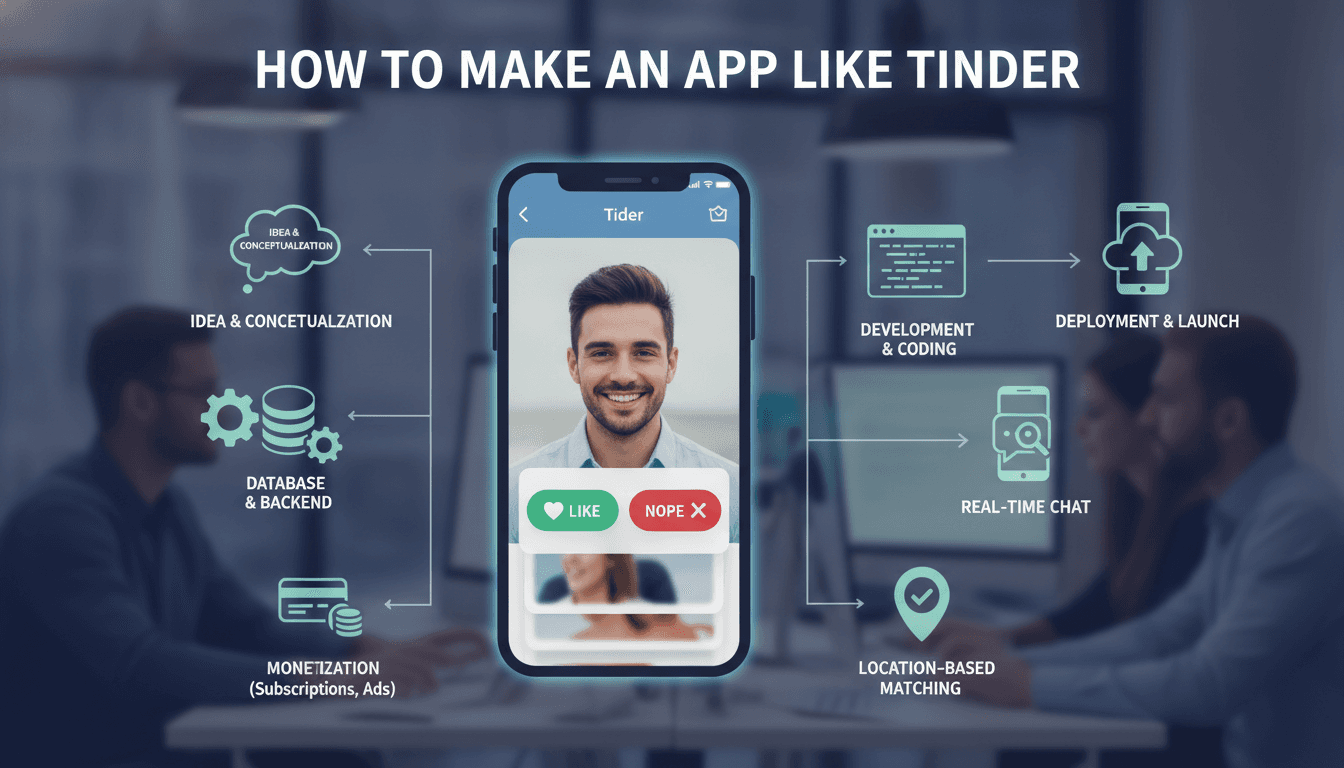
Building a dating app is a well-understood engineering problem in 2024, but "well-understood" does not mean simple. Tinder processes over 1.6 billion swipes per day. The architecture behind that kind of throughput touches real-time matching, geolocation queries, media delivery, and a recommendation engine all at once. This post walks through how to build something at that level — the stack choices, the hard parts, and the trade-offs you will actually face.
What Does the Core Architecture Look Like?
A Tinder-like app is a collection of distinct services that must coordinate tightly. If you try to build it as a monolith, you will hit scaling walls fast, specifically around the discovery feed and the chat service.
The standard breakdown:
- Auth service — handles registration, login, JWT issuance, OAuth2 integrations (Google, Apple Sign-In)
- Profile service — stores user data, preferences, photos
- Discovery/matching engine — the core product logic; produces the swipe deck
- Swipe service — records like/pass events and triggers match creation
- Chat service — real-time messaging between matched users
- Notification service — push notifications via APNs and FCM
- Media service — photo upload, processing, and CDN delivery
Each of these has different scaling characteristics. The chat service is I/O bound and stateful. The discovery engine is compute-intensive. Separating them gives you the ability to scale each independently.
Choosing the Right Database Per Service
This is where a lot of teams make mistakes. There is no single database that fits everything.
| Service | Recommended DB | Reason |
|---|---|---|
| User profiles | PostgreSQL | Structured, relational, ACID compliance needed |
| Swipe events | Cassandra or DynamoDB | High write throughput, append-only pattern |
| Active sessions / swipe deck cache | Redis | Sub-millisecond reads, TTL support |
| Chat messages | Cassandra | Time-series pattern, high write volume |
| Geolocation queries | PostGIS or Elasticsearch with geo filters | Native support for radius and bounding box queries |
Do not put swipe events in PostgreSQL. At Tinder's scale, that table would receive millions of writes per hour and become a bottleneck immediately.
How Does the Matching and Discovery Engine Actually Work?
This is the most product-critical and technically interesting part.
The naive approach is: query all users within X kilometres who match age and gender preferences, exclude already-swiped profiles, return a ranked list. That works up to roughly 50,000 users. Beyond that, it falls over.
Geolocation Filtering
Tinder uses a geohash-based approach. A geohash encodes a latitude/longitude pair into a short alphanumeric string. Users in the same geohash cell are geographically close. You index users by geohash in Redis or Elasticsearch and query adjacent cells to build a candidate pool. This keeps the initial filter fast.
At city scale, you are typically querying 3 to 5 geohash cells at precision level 5 or 6 (roughly 4.9 km x 4.9 km per cell at level 5).
Ranking the Candidate Pool
Once you have a candidate pool, you need to rank it. Tinder historically used a variant of the Elo rating system, though they have moved to a more complex ML-based approach. For a new product, a weighted scoring function is a reasonable starting point:
- Recency of activity (users active in the last 24 hours score higher)
- Distance (closer users rank higher within the preference radius)
- Photo quality score (via a pre-trained image quality classifier)
- Swipe-rate on the candidate (crowdsourced desirability signal)
Run this ranking asynchronously and cache the result per user with a TTL of 15 to 30 minutes. Do not recompute on every swipe.
/// Not sure where to start?
Get the architecture before you commit
Tell us what you're building and we'll map the technical approach, stack, and rough timeline. No cost, no obligation, no sales call required.
Real-Time Chat: WebSockets vs. Long Polling
For chat, you need persistent bidirectional connections. WebSockets are the right choice here. Long polling introduces latency and server overhead that compounds badly under load.
The architecture:
- A WebSocket gateway layer (built on Node.js with Socket.IO or a Go-based server using Gorilla WebSocket)
- A message broker in the middle, typically Apache Kafka or Redis Pub/Sub
- A persistence layer that stores messages independently of the connection state
The gateway holds the WebSocket connections. When User A sends a message, it publishes to Kafka. The consumer picks it up, writes it to Cassandra, and publishes to the channel User B is subscribed to. If User B is offline, the notification service picks up the Kafka event and sends a push.
One thing to get right early: message ordering and deduplication. Assign each message a UUID and a client-side timestamp. On the receiver side, sort by timestamp and deduplicate by UUID before rendering. This prevents the classic "messages appear out of order on slow connections" bug.
What Does the Media Pipeline Look Like?
Photo upload is not a solved problem when you need to handle it at scale. A user uploading a 10 MB HEIC photo from an iPhone needs to end up with a 200 KB WebP thumbnail served from a CDN edge node near them.
The pipeline:
- Client uploads directly to S3 (or GCS) using a pre-signed URL generated by your media service. This offloads bandwidth from your servers.
- S3 triggers a Lambda function (or a Pub/Sub event) on upload completion.
- The Lambda runs ImageMagick or libvips to produce multiple resized variants: 100px (thumbnail), 400px (card view), 800px (full view).
- Outputs land in a separate S3 bucket fronted by CloudFront or Cloudflare.
- The profile service stores the CDN URLs, not the S3 paths.
libvips is significantly faster than ImageMagick for batch resizing. On a c5.xlarge EC2 instance, libvips processes roughly 500 images per minute versus 150 for ImageMagick. That gap matters at scale.
Safety and Moderation Features You Cannot Skip
Dating apps carry a higher duty of care than most consumer products. Skipping moderation tooling is not a viable shortcut.
The minimum viable safety stack:
- Photo moderation — run uploads through AWS Rekognition or Google Vision API to detect explicit content before the image is served. Flag for human review at confidence scores between 0.6 and 0.85; auto-reject above 0.85.
- Profile text moderation — a fine-tuned text classifier or the OpenAI Moderation API catches harassment, solicitation, and hate speech in bios and messages.
- Block and report flows — these need to be in the first release, not a later sprint. The database schema for blocks needs to be considered in your swipe query logic from day one; retrofitting it is painful.
- ID verification — integrating Onfido or Persona for optional verification adds a trust signal that meaningfully affects user behaviour on the platform.
Conclusion
Building a dating app at production quality means making a series of explicit architectural choices upfront: which database fits which service, how you cache and expire the discovery feed, how you keep chat reliable under connectivity issues, and how you build moderation in rather than on.
The stack described here — PostgreSQL and Cassandra for persistence, Redis for caching, Kafka for event streaming, WebSockets for chat, and a CDN-fronted media pipeline — is not experimental. It is proven at scale and well-supported.
If you are planning a build and want a technical review of your architecture before committing to it, get in touch with the team at Sodio. We have built systems at this level of complexity and can give you an honest assessment of what will hold and what will not.
FAQ
How long does it take to build a Tinder-like app? A production-ready MVP with core swipe, match, and chat functionality typically takes 4 to 6 months with a team of 4 to 6 engineers. That includes backend services, iOS and Android clients, and a basic admin dashboard. Timelines stretch when moderation, payments, or advanced recommendation features are included in the initial scope.
How much does it cost to build a dating app? Costs vary significantly by team location and seniority. A mid-market engineering team building a full-featured dating app typically runs between $150,000 and $400,000 for the initial build. Ongoing infrastructure costs at early scale (under 100,000 monthly active users) run roughly $2,000 to $5,000 per month on AWS, depending on media storage and CDN traffic.
What is the best tech stack for a dating app? There is no single best stack, but a common and well-validated choice is: React Native for cross-platform mobile clients, Node.js or Go for backend services, PostgreSQL and Cassandra for data persistence, Redis for caching, and AWS for infrastructure. The matching engine is often the part most worth customising; everything else can follow conventions.
Do you need a recommendation algorithm from day one? No. A distance-plus-recency ranking function is good enough for your first 10,000 users. ML-based ranking requires training data you do not have yet. Build a simple, explainable scoring function first, instrument it well, and introduce a learned model once you have 3 to 6 months of swipe data to train on.
How do you handle user safety on a dating platform? Minimum requirements are: automated photo moderation via a vision API, text moderation on bios and messages, in-app block and report flows, and a process for human review of escalated reports. ID verification is worth adding early as an optional feature — platforms that offer it see measurable increases in user trust metrics.
Have a project in mind? Contact Sodio Technologies to discuss your requirements and explore the right technology solution for your business.
/// Work with us
Talk to the engineers who'd build it
You'll get a technical scope, timeline and cost estimate from the people doing the work, not an account manager. In-house team, no subcontracting, since 2016.