

How to Make an App Like Castbox
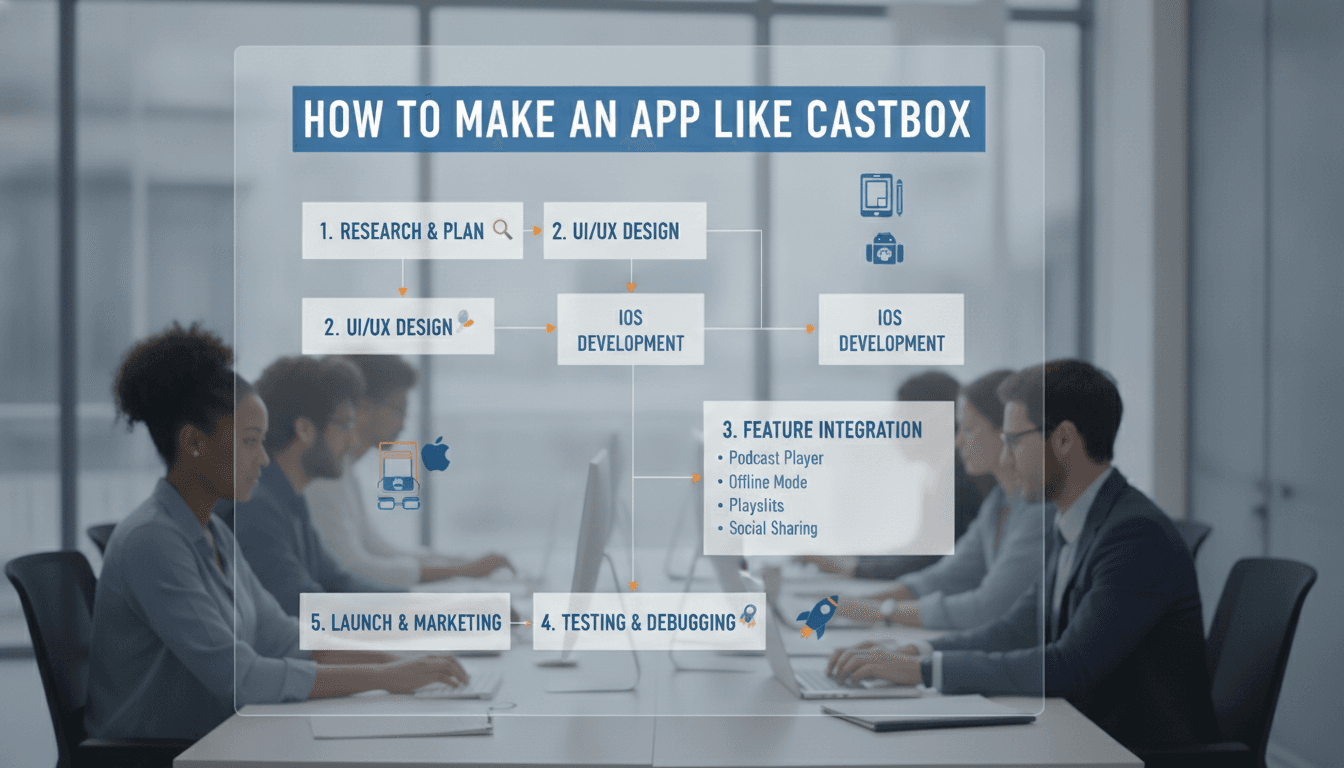
How to Make an App Like Castbox
Podcasting has quietly become one of the most durable forms of digital media. Unlike short-form video, which lives and dies by the algorithm, podcasts build habitual, long-session listening — commutes, workouts, chores, commutes again. Castbox capitalised on that behaviour early, layering in-app discovery, an in-house content network, and AI-powered audio search on top of a standard RSS podcast player.
If you're planning to build something similar, this guide walks through the product thinking, feature set, architecture, and cost realities of launching a podcast app that can actually compete.
We cover a closely related subject in How to Make an App Like Pocket Casts.
Why Build a Podcast App in the First Place?
Before writing a line of code, be clear on your wedge. The podcast player market has Spotify, Apple Podcasts, Pocket Casts, Overcast, and Castbox already in it. Generic "another podcast app" products don't survive.
To explore this further, see How to Make an App Like Apple Podcasts.
Successful angles tend to be one of these:
- Niche verticals — true crime, Islamic content, language learning, business audio, kids' audio. Curation beats catalogue size for a defined audience.
- Regional/language focus — markets underserved by English-first apps (Hindi, Bahasa, Portuguese, Arabic).
- Creator-first monetisation — better revenue splits, dynamic ad insertion, subscriptions, tipping.
- Technology differentiation — this was Castbox's play: full-text search inside audio via speech-to-text indexing.
- Community layer — comments at timestamps, listener rooms, clip sharing.
Pick one. Build the rest as table stakes.
How Castbox Actually Works
Understanding the mechanics makes the build far less mysterious.
Podcasts are, at their core, RSS feeds. A podcast is an XML file containing show metadata and a list of episodes, each pointing to an MP3 or AAC file hosted somewhere (Libsyn, Buzzsprout, Anchor, an S3 bucket). Castbox does not host most of that audio. It:
- Crawls and indexes millions of public RSS feeds
- Normalises and stores the metadata in its own searchable database
- Re-polls feeds on a schedule to detect new episodes
- Streams the audio directly from the publisher's CDN to the listener
- Layers its own social, playlist, analytics, and recommendation features on top
On top of that, Castbox added Castbox Originals (owned content) and an ad network — because a pure player has thin margins, while owning content and ad inventory does not.
Related reading: How to Make an App Like Google Podcasts.
Core Feature Set
Listener-Facing Features
Onboarding & personalisation Topic selection on first launch, optional social/email sign-in, and immediate value before forcing registration. Let people listen before they sign up.
Search & discovery
- Search by show, episode, host, and keyword
- Category and sub-category browsing
- Editorial collections and "staff picks"
- Trending/top charts, ideally region-aware
- In-audio search (the hard, differentiating one)
The player — the heart of the app
- Background playback with lock-screen and notification controls
- Variable speed (0.5x–3x) with pitch correction
- Silence trimming and volume boost
- Sleep timer
- Skip forward/back with configurable intervals
- Chapter support and per-episode resume position
- Continuous queue playback
Subscriptions & library Subscribe to shows, auto-download new episodes on Wi-Fi, manage storage, mark played/unplayed, archive, and filter.
Offline listening Critical, non-negotiable. Users listen on planes, subways, and in areas with poor coverage. Download management with storage caps and auto-cleanup rules.
Cross-device sync Playback position, subscriptions, and queue must sync across phone, tablet, web, CarPlay, Android Auto, and wearables.
Social & community Comments, timestamped reactions, clip creation and sharing, ratings and reviews, follow-a-user feeds.
Notifications New episode alerts, personalised recommendation nudges, and re-engagement for lapsed listeners — with granular controls so you don't get muted.
Creator-Facing Features
- Submit and claim an RSS feed
- Verify ownership (email in feed or a verification token)
- Analytics: downloads, unique listeners, completion rate, drop-off curves, geography, device
- Monetisation dashboard: ad revenue, subscriptions, tips
- Premium/paid episode gating
Admin & Moderation
- Feed crawling health and error dashboards
- Content moderation queues (podcasts and comments both need this)
- DMCA/takedown workflow
- Editorial curation tools
- Ad campaign management
Technical Architecture
The Ingestion Pipeline
This is the unglamorous engine of the whole product.
Feed discovery — Seed from public directories (Apple's directory, the Podcast Index API, ListenNotes), sitemap crawling, and manual submissions.
Feed parsing — RSS 2.0 with the itunes: and podcast: namespace extensions. Feeds in the wild are messy: malformed XML, missing enclosures, wrong durations, inconsistent encodings, duplicate GUIDs. Your parser needs to be forgiving and your data model needs a "quality score."
Scheduled re-crawling — Don't poll every feed every hour; that's wasteful and gets you rate-limited. Use adaptive scheduling based on publishing cadence, plus ETag and If-Modified-Since headers. Support WebSub (formerly PubSubHubbub) for feeds that push updates.
Deduplication and normalisation — Same show, multiple feeds. Same episode, different GUIDs. Normalise categories across inconsistent tagging.
Media processing (optional but valuable) — Transcoding to consistent bitrates, waveform generation, chapter extraction, and speech-to-text transcription for in-audio search.
Backend Stack
A pragmatic setup:
- API layer — Node.js/NestJS, Go, or Python/FastAPI. Go is excellent for the crawler workers.
- Primary database — PostgreSQL for users, subscriptions, playback state, and relational metadata.
- Search — Elasticsearch or OpenSearch for full-text over shows, episodes, and transcripts.
- Cache — Redis for charts, trending data, session state, and rate limiting.
- Queue — Kafka, RabbitMQ, or SQS for crawl jobs, transcription jobs, and notification fan-out.
- Object storage — S3 or equivalent for artwork, transcripts, originals, and user clips.
- CDN — CloudFront/Cloudflare for artwork and any audio you host yourself.
- Analytics — ClickHouse or BigQuery for the event firehose; you'll generate enormous volumes of playback events.
A microservices split makes sense here: an ingestion service, a search service, a user/library service, a playback-state service, a recommendation service, and a notification service.
Mobile Clients
Native gives you the best audio experience. On iOS that means AVPlayer/AVAudioSession, background modes, CarPlay, and MPNowPlayingInfoCenter. On Android it's ExoPlayer (Media3), MediaSessionCompat, foreground services, and Android Auto.
Flutter or React Native are viable and will cut your timeline meaningfully, but plan for native modules around the audio engine, background playback, download management, and auto-integration. just_audio + audio_service on Flutter is mature; react-native-track-player covers most React Native needs.
Our general advice: if audio quality, background reliability, and car integration are core to your differentiation, go native. If speed to market and budget matter more, go cross-platform and write native bridges for the player layer.
The Recommendation Engine
Start simple, then get sophisticated:
- Phase 1 — Popularity and editorial curation. Charts by category and region.
- Phase 2 — Collaborative filtering. "Listeners who subscribed to X also subscribed to Y." Matrix factorisation or an item-item similarity model.
- Phase 3 — Content-based signals from transcripts and metadata embeddings, so you can recommend new shows with no listening history.
- Phase 4 — Hybrid ranking model that blends behavioural signals, content embeddings, recency, and diversity constraints.
Track meaningful signals: not just plays, but completion rate, subscribe-after-sample, skip position, and return listening.
In-Audio Search (The Castbox Differentiator)
If you want this feature:
- Run ASR (Whisper, AssemblyAI, Deepgram, or Google STT) over episodes at ingestion
- Store transcripts with word-level timestamps
- Index transcripts in Elasticsearch with the episode reference
- Return results that deep-link to the exact timestamp
Be realistic about cost. Transcribing millions of hours of audio is expensive. Most teams start by transcribing only the top N% of episodes by popularity, plus everything from partner creators, and expand from there.
Monetisation Models
Advertising — Programmatic display and audio ads, plus dynamic ad insertion (DAI) into episodes you have rights to. This is the volume play and requires serious scale.
Premium subscription — Ad-free listening, unlimited downloads, advanced player features, exclusive content. Typically $5–10/month.
Paid/exclusive content — Originals and creator-gated episodes with revenue sharing.
Creator tools SaaS — Charge creators for hosting, analytics, and distribution.
Tipping and micro-payments — Lower revenue but strong community signal.
Most successful podcast apps run a blend: free ad-supported tier, premium subscription, and owned content.
Compliance and Legal Considerations
Don't skip this section.
- You generally don't own the audio. Respect RSS feed terms, honour takedown requests, and build a DMCA workflow before launch.
- Streaming vs. downloading — Caching for offline use is standard practice but should respect publisher signals and not rehost content publicly.
- Store policies — Apple and Google both have specific rules around podcast content, explicit-content tagging, and user-generated comments. Ship robust moderation or risk rejection.
- Privacy — GDPR, CCPA, and the IAB Podcast Measurement guidelines for download counting. Be explicit about analytics in your privacy policy.
- Accessibility — Transcripts double as an accessibility feature and an SEO asset.
Development Timeline and Cost
A realistic MVP — search, subscribe, a solid player, offline downloads, and cross-device sync — is roughly 4 to 6 months with a team of a product manager, a designer, two mobile engineers, two backend engineers, and a QA engineer.
Indicative ranges:
| Scope | Timeline | Ballpark Cost |
|---|---|---|
| MVP, single platform | 3–4 months | $40k–$70k |
| MVP, iOS + Android | 4–6 months | $70k–$120k |
| Full product with recommendations, social, creator tools | 8–12 months | $150k–$300k+ |
| Castbox-level with ASR search and originals | 12–18 months | $350k+ |
Rates vary widely by region and team seniority, so treat these as directional. Ongoing costs — infrastructure, transcription, CDN, moderation, and content acquisition — are frequently underestimated and often exceed initial build cost within the first year.
A Sensible Build Roadmap
Phase 1 — Foundations (Months 1–2) Feed ingestion pipeline, metadata database, search index, basic API. Get 500k+ shows indexed and accurate before building any UI.
Phase 2 — Core App (Months 2–4) Player, subscriptions, library, downloads, sync, onboarding. Ship to TestFlight and an internal Android track early — audio bugs surface only through real-world use.
Phase 3 — Discovery (Months 4–6) Charts, categories, editorial collections, first-pass recommendations, notifications. Launch publicly.
Phase 4 — Differentiation (Months 6+) Your wedge — in-audio search, community features, creator tools, or originals. Plus CarPlay, Android Auto, web player, and wearables.
Phase 5 — Monetisation (Months 9+) Ads, premium tier, creator revenue share.
Mistakes to Avoid
- Underinvesting in the player. Users forgive an ugly UI; they do not forgive playback that stops when the screen locks or loses their position.
- Treating ingestion as a side project. Stale feeds and broken episodes destroy trust faster than anything else.
- Launching with a thin catalogue. Index broadly before you launch, even if you curate narrowly in the UI.
- Ignoring download economics. Audio bandwidth adds up fast if you host anything.
- Building social features before you have listeners. Empty comment sections signal a dead product.
- Skipping car and wearable integration. A huge share of listening happens in vehicles.
Final Thoughts
Building an app like Castbox is less about cloning a feature list and more about executing three things exceptionally well: a rock-solid ingestion pipeline, a player that never lets users down, and a discovery experience that surfaces something worth listening to. Everything else — social, monetisation, originals — is built on that foundation.
Start with a defined audience, ship a focused MVP, and let real listening data tell you what to build next. If you'd like help scoping the architecture or estimating your build, we're happy to talk through it.
Have a project in mind? Contact Sodio Technologies to discuss your requirements and explore the right technology solution for your business.
/// Work with us
Talk to the engineers who'd build it
You'll get a technical scope, timeline and cost estimate from the people doing the work, not an account manager. In-house team, no subcontracting, since 2016.