

How to Make an App Like Clash of Clans
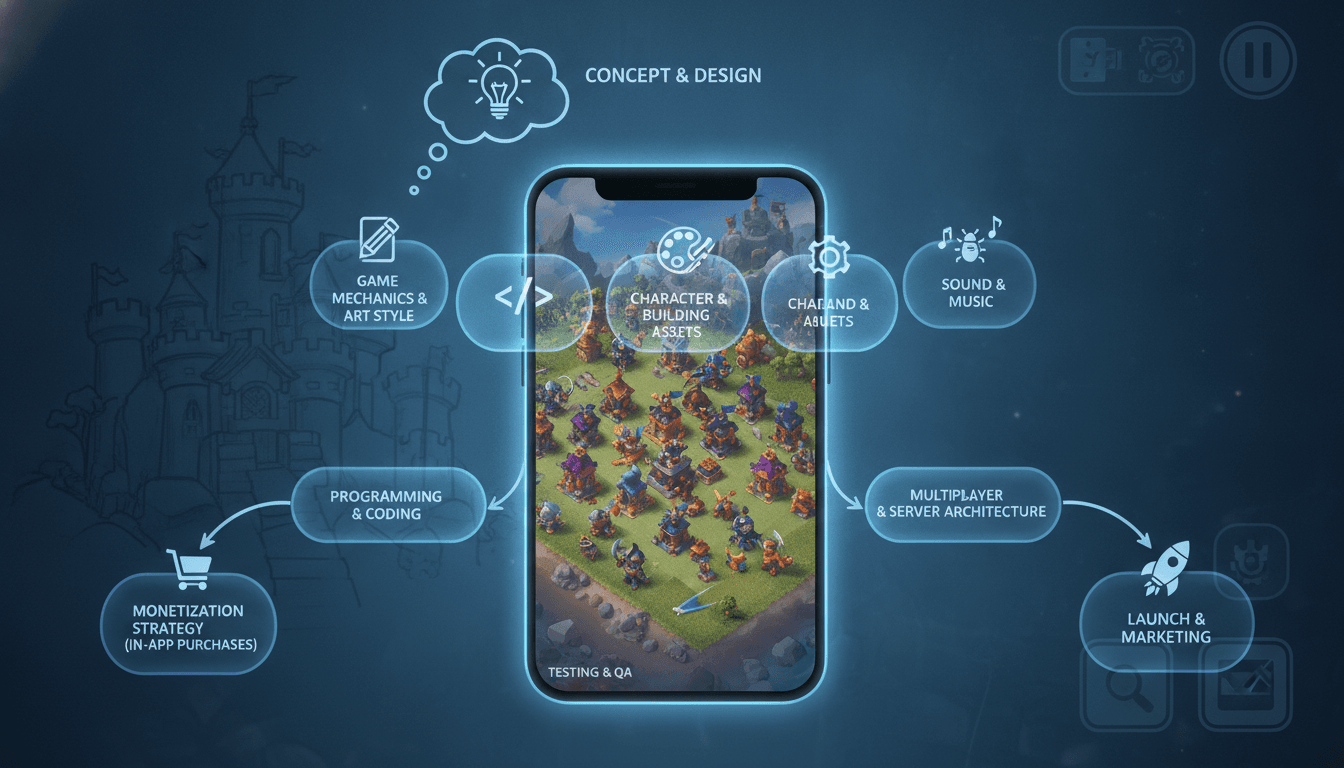
Building a strategy game at the scale of Clash of Clans is one of the more technically demanding things you can do in mobile development. This post walks through the architecture, server infrastructure, real-time systems, and monetisation logic you need to get right — and where most teams underestimate the work.
What Makes Clash of Clans Hard to Build?
Most people look at Clash of Clans and see a base-building game. Engineers look at it and see a synchronisation problem.
The game has to maintain consistent state across millions of concurrent players, handle asynchronous attacks on offline bases, resolve troop AI in real time, and push notifications at exactly the right moment. None of those problems are uniquely hard in isolation. Doing all of them together, at scale, with sub-second latency expectations, is where the complexity compounds.
Supercell has never published their full architecture, but from reverse-engineering, community analysis, and standard patterns in the genre, we can piece together what a production system looks like.
Core Architecture: What Does the Server Stack Actually Look Like?
Game State and Persistence
Every player's base is a serialised state object. The village layout, resource counts, building levels, troop inventory — all of it lives in a document store. Supercell has referenced their use of a custom in-house server framework, but for a new build, you are choosing between something like a Redis-backed session layer over PostgreSQL, or a purpose-built game database like Aerospike, which is used in production by several large mobile game studios for its sub-millisecond read/write at scale.
Clash of Clans uses a tick-based server model for resource generation. Elixir and Gold accumulate server-side on a schedule. The client never trusts its own clock for anything that affects game economy. This prevents cheating and keeps state canonical. Your architecture needs to do the same: all economy-affecting events must be validated and committed server-side before the client reflects them.
Real-Time vs. Asynchronous Systems
Attacks in Clash of Clans are resolved in real time on the client, but the outcome is submitted to the server for validation. The server runs a simplified simulation to check whether the claimed result (loot stolen, trophies gained, percentage destruction) is plausible given the attacker's troop composition and the defender's base state.
This is called a replay validation model. You store the attack inputs, not the full simulation output. The server replays the attack deterministically and compares outcomes. Determinism is non-negotiable here: your troop AI and physics must produce identical results on every platform, every time, given the same inputs.
Clan Wars and Clan War Leagues introduce a second layer: long-running, time-boxed events where player actions within a window affect a shared leaderboard. This is a classic distributed counter problem. You need atomic increments, conflict resolution, and a read model that can serve thousands of concurrent reads without hitting your write master.
How Do You Build the Matchmaking and Social Layer?
Matchmaking in Clash of Clans is trophy-based at the casual end and uses a more complex Elo-adjacent rating for competitive modes. Building a matchmaking service means writing a queue processor that continuously compares players in a bracket and finds acceptable opponents within a latency budget (typically under 5 seconds for a match).
The social layer is genuinely complex. Clans are persistent groups with their own chat, donation systems, war participation records, and permission hierarchies. At scale, clan chat alone is a significant infrastructure problem. You need a pub/sub backbone — Apache Kafka or Google Cloud Pub/Sub are common choices — with message persistence so players who come back online see what they missed.
Push notifications for attack reports, building completions, and shield expiry are handled via APNs (Apple Push Notification service) and FCM (Firebase Cloud Messaging). Your backend needs a notification scheduler that fires events at the right time regardless of whether the originating server is still alive. This is a job queue problem, not a cron job problem. Use something like Sidekiq backed by Redis, or a managed workflow system like Temporal.
/// Not sure where to start?
Get the architecture before you commit
Tell us what you're building and we'll map the technical approach, stack, and rough timeline. No cost, no obligation, no sales call required.
Economy Design and Monetisation Logic
Clash of Clans runs on a freemium model with Gems as the premium currency. The economy is built around time friction: building upgrades take real hours or days, and Gems let you skip that time. The builder system (you can only have a limited number of simultaneous upgrades) creates artificial scarcity that makes premium currency feel valuable without blocking progress entirely.
From an engineering standpoint, the monetisation system is a receipts-validation pipeline. Every in-app purchase must be validated against Apple's StoreKit or Google Play Billing before Gems are credited. You validate server-side, not client-side. Your receipt validation service should be idempotent: if the client sends the same receipt twice due to a network retry, you credit the purchase exactly once.
The subscription model (Clash of Clans introduced the Gold Pass in 2019) adds a new dimension: entitlement management. You need to track subscription status, handle grace periods, and revoke benefits if a subscription lapses. Apple and Google both provide real-time developer notifications for subscription state changes. Wire those into your entitlement service on day one.
What Technology Stack Should You Actually Use?
There is no single right answer, but here is a realistic comparison for a production build:
| Component | Option A | Option B | Trade-off |
|---|---|---|---|
| Game client | Unity 2022 LTS | Unreal Engine 5 | Unity has a larger mobile ecosystem and better Addressables support; Unreal is overkill for 2D strategy |
| Backend language | Go | Java (Spring Boot) | Go handles concurrency more cheaply at scale; Java has a larger talent pool |
| Real-time transport | WebSocket over TCP | UDP with QUIC | WebSocket is easier to implement; QUIC reduces head-of-line blocking on mobile networks |
| Database | PostgreSQL + Redis | Aerospike | Postgres is easier to operate; Aerospike handles higher write throughput with lower latency |
| Notification queue | Temporal + FCM/APNs | Sidekiq + FCM/APNs | Temporal gives you durable workflows; Sidekiq is simpler if your retry logic is straightforward |
| Analytics | BigQuery + dbt | ClickHouse | BigQuery scales automatically; ClickHouse is cheaper at high ingest volumes |
For a game targeting under 500,000 DAU at launch, PostgreSQL and Redis will handle the load if you index correctly and keep your hot path in cache. Do not over-engineer the data layer before you have real traffic patterns.
How Long Does It Take and What Does It Cost?
A realistic MVP (single-player base building, one resource type, basic matchmaking, no Clan system) takes a competent team of eight to ten engineers approximately 14 to 18 months. That includes client, server, QA, and DevOps.
A full feature-parity build with Clans, Clan Wars, seasonal events, and a live ops pipeline is a two to three year project with a team of 25 to 40. Supercell spent several years in soft launch before Clash of Clans went global in 2012, and they iterated heavily during that period.
Budget estimates vary enormously by region. In India, blended engineering rates for a team of this size sit between ₹80 lakh and ₹2 crore per month depending on seniority mix. In Western Europe or North America, multiply that by three to five.
The cost that most teams miss is live operations. After launch, you need engineers dedicated to balancing patches, seasonal content, anti-cheat, and backend stability. That is not optional — it is the difference between a game that retains players at 30-day intervals and one that dies in month two.
Conclusion
Building at this scale requires making the right architectural decisions early, particularly around state management, deterministic simulation, and economy validation. The client is a presentation layer; the server is the source of truth for everything that matters.
If you are scoping a project like this, start by defining your target DAU ceiling for year one and work backwards to your infrastructure requirements. That single decision will shape your database choice, your matchmaking architecture, and your real-time transport layer more than anything else.
Get that number wrong, and you will either over-build for a product that never finds its audience, or under-build for one that does.
FAQ
How much does it cost to build a game like Clash of Clans? A full-featured build with Clans, matchmaking, and live ops infrastructure typically runs two to three years and tens of millions of dollars at Western rates. In India, costs are significantly lower, but the timeline remains similar. An MVP with core gameplay mechanics can be scoped to 14 to 18 months with a focused team of eight to ten engineers.
What game engine should I use to build a Clash of Clans-style game? Unity 2022 LTS is the practical choice for 2D strategy games targeting iOS and Android. It has mature mobile build pipelines, strong Addressables support for live content updates, and a large pool of experienced developers. Unreal Engine 5 is better suited to 3D, high-fidelity titles where mobile is secondary.
How does Clash of Clans prevent cheating? State authority sits entirely on the server. The client never commits economy-affecting changes locally. Attacks are validated using a replay model: the server reruns the attack simulation with the submitted inputs and checks whether the claimed outcome is within acceptable tolerance. Resource generation is tick-based and server-computed, not client-reported.
What database architecture works for a mobile strategy game at scale? Most production games use a layered approach: a relational database like PostgreSQL for durable game state, Redis for hot-path reads (active session data, leaderboard counters), and a time-series or columnar store like BigQuery or ClickHouse for analytics. Aerospike is a viable alternative to the PostgreSQL and Redis combination if you need sub-millisecond latency at very high write volumes.
How do you handle real-time clan chat at scale? Clan chat is a pub/sub problem. Messages are published to a topic per clan and consumed by connected clients through a WebSocket gateway. Apache Kafka or Google Cloud Pub/Sub handle the message backbone. Messages are persisted for a rolling window (typically 7 to 30 days) so returning players see conversation history. At large scale, fan-out from a single clan event can hit thousands of concurrent connections.
Have a project in mind? Contact Sodio Technologies to discuss your requirements and explore the right technology solution for your business.
/// Work with us
Talk to the engineers who'd build it
You'll get a technical scope, timeline and cost estimate from the people doing the work, not an account manager. In-house team, no subcontracting, since 2016.