

How to Make an App Like Coffee Meets Bagel
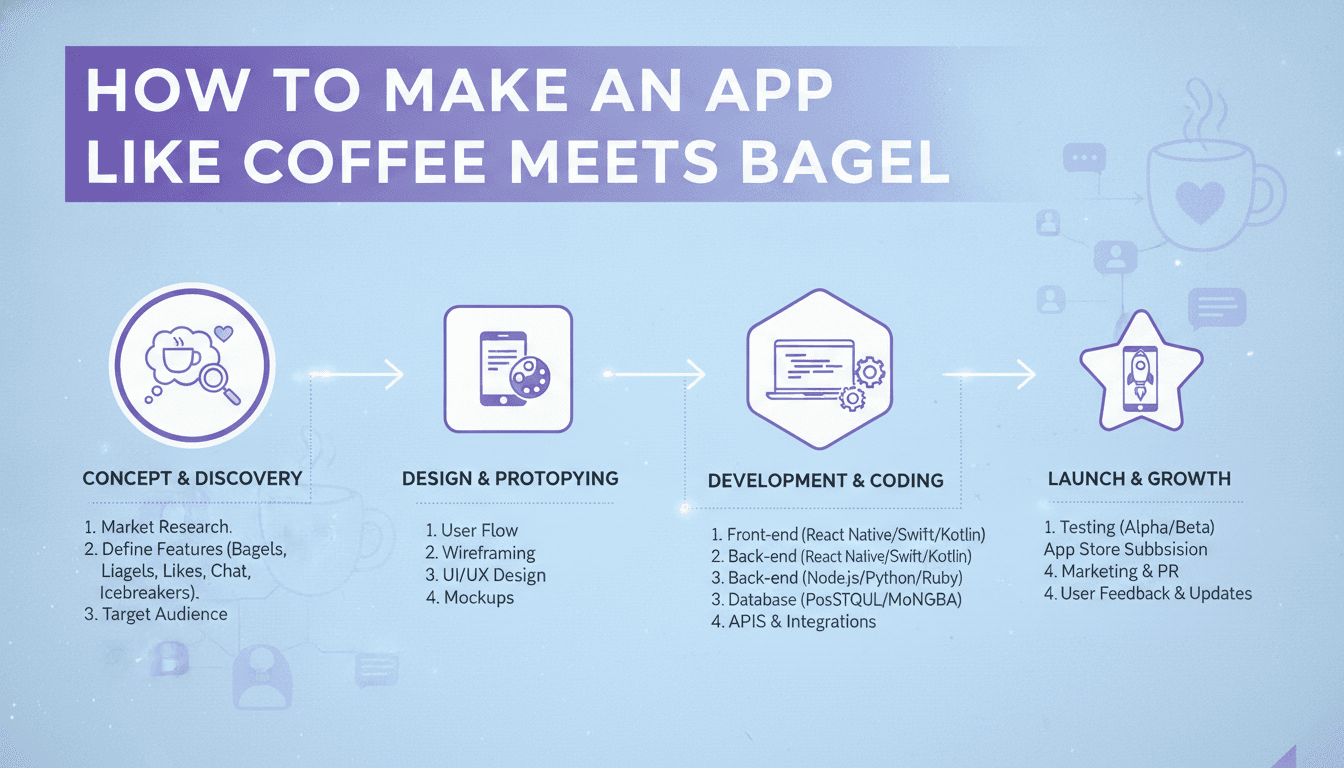
A practical breakdown of the architecture, matching logic, and monetisation mechanics behind a curated dating app — written for engineers and product leads who are ready to build.
What Makes Coffee Meets Bagel Different From a Swipe App?
Most dating apps are volume games. Swipe right, swipe left, repeat. Coffee Meets Bagel took a deliberately constrained approach: women receive a curated batch of matches (called "Bagels") each day at noon, men get a wider pool to like, and a match only opens a conversation if the woman also liked the man. The result is lower volume, higher intent, and a monetisation model built around quality signals rather than endless scrolling.
If you are building something in this space, that constraint is the product. Your architecture has to enforce it, not just suggest it.
The core technical pieces are:
- A daily batch job that scores and selects candidates per user
- An asymmetric matching model (one side curates, the other side signals interest first)
- A time-boxed conversation window to create urgency
- A virtual currency layer ("Beans" in CMB's case) for premium interactions
- Push notifications timed to a specific hour each day
Each of these has real implementation decisions behind it. Let's get into them.
How Does the Matching Algorithm Actually Work?
CMB does not publish its full algorithm, but the public signals and patent filings give a clear enough picture to build from.
Candidate Scoring
At its core, you are running a recommendation system. Each candidate gets a score relative to a given user based on:
- Collaborative filtering: users who are similar to you liked certain profiles, so those profiles rank higher
- Explicit preference signals: age range, distance radius, deal-breakers set during onboarding
- Activity signals: how recently the candidate was active, their historical response rate, whether they complete conversations
- Social graph proximity: CMB originally weighted Facebook mutual friends heavily; if you are building fresh, LinkedIn or phone contact graph are alternatives
The score is computed offline, not in real time. You run a batch job (typically nightly) that generates a ranked candidate list per user. At noon local time, the top N candidates from that list are served.
The Batch Job Architecture
This is where most teams underestimate complexity. If you have 500,000 daily active users, you are computing pair-wise scores for a very large candidate space. A naive O(n²) approach does not scale.
The standard solution is a two-stage pipeline:
- Candidate retrieval: Use approximate nearest-neighbour search (FAISS or ScaNN work well here) on a user embedding to pull the top 500 or so rough candidates. This runs in milliseconds per user.
- Re-ranking: Apply your full scoring model (collaborative filtering weights, deal-breaker filters, activity signals) to that shortlist. This is where your ML model runs.
Run this as a Spark or Flink job the night before. Write results to a low-latency store (Redis or DynamoDB) keyed by user ID. At noon, the API just reads from cache. No heavy computation at serve time.
Asymmetric Matching Logic
The asymmetric model is a deliberate product choice with a real database implication. You need to track:
- Which profiles were served to which user (and when)
- Which side initiated interest (like vs. be liked)
- Whether a mutual like has occurred
A match only becomes a conversation when both sides have liked. Store this in a match_events table with clear state transitions: served → liked → mutual → expired. Expiry matters. CMB conversations expire after a set number of days if neither party sends a message. Enforce this at the application layer with a scheduled cleanup job, not just at the UI layer.
/// Not sure where to start?
Get the architecture before you commit
Tell us what you're building and we'll map the technical approach, stack, and rough timeline. No cost, no obligation, no sales call required.
What Does the Tech Stack Look Like?
There is no single right answer, but here is a stack that maps well to this product's requirements:
| Layer | Recommended Choice | Why |
|---|---|---|
| Mobile | React Native or Flutter | Shared codebase, fast iteration; CMB itself is native but most new entrants can't justify the cost |
| API | Node.js (Fastify) or Go | High concurrency for real-time chat; Go is better if you expect >10k concurrent users at launch |
| Matching batch | Python + PySpark | ML ecosystem, easy FAISS integration |
| Primary DB | PostgreSQL | Relational integrity for match state; JSONB for flexible profile fields |
| Cache / serve layer | Redis | Precomputed match lists, session tokens |
| Real-time chat | WebSockets via Socket.io or a managed service like Sendbird | Chat is not worth building from scratch unless you have specific compliance needs |
| Push notifications | Firebase Cloud Messaging | Reliable, free at most scales, handles scheduled delivery well |
| Media storage | S3 + CloudFront | Profile photos; run a moderation pass with AWS Rekognition before photos go live |
One thing worth flagging: real-time chat is genuinely complex to build correctly (delivery guarantees, read receipts, offline queuing). Unless you have a strong reason to own the infrastructure, use Sendbird, Stream, or Twilio Conversations. The licensing cost is predictable and far cheaper than the engineering time.
How Do You Monetise Without Killing the Core Experience?
CMB uses a virtual currency called Beans. Users earn Beans by being active (logging in, extending likes, sharing profiles) and spend them on premium actions like seeing who liked them, extending a conversation that is about to expire, or unlocking additional daily Bagels.
This model works because the free experience is genuinely usable. Users who want more control pay, but those who do not are not punished.
The alternative is a subscription tier (CMB also has one, called "Premium"). Subscriptions give predictable MRR; virtual currency gives higher single-transaction revenue from power users. Running both in parallel is common, but it adds significant product complexity. If you are building v1, pick one.
Technically, virtual currency needs:
- A ledger table that records every credit and debit with a reason code
- Idempotency keys on all transaction endpoints (double-spend bugs are career-limiting)
- Server-side validation of all purchases via Apple's StoreKit receipt validation or Google Play's Purchase API before crediting the account
Never trust the client to tell you a purchase succeeded.
What Are the Hardest Problems to Get Right?
Cold start. A new user with no activity history gets poor matches. Solve this by front-loading onboarding to collect enough explicit preference data to substitute for behavioural signals. Ask more questions than feels comfortable. Users will answer if they trust the product.
Geographic density. Dating apps die in low-density markets. If your launch city has 10,000 users, your matching pool per user is small and the algorithm has little to work with. Plan your city-by-city rollout accordingly. A waitlist approach (Superhuman used this for email; several dating apps have copied it for density reasons) lets you time your launch to when you have enough supply.
Moderation at scale. Abuse reports, fake profiles, and inappropriate photos are inevitable. Build your reporting pipeline on day one, not after your first incident. AWS Rekognition handles explicit image detection reasonably well. For text, a fine-tuned classifier on top of a pre-trained model (distilBERT works) is more accurate than keyword lists for detecting harassment.
Photo ranking. Users with better photos get more matches. That is not your fault, but it shapes retention curves. Consider a photo review or ordering suggestion feature (CMB has one) that helps users put their best images forward. It improves match quality for everyone.
Conclusion
Building an app in this space is not architecturally exotic. The matching batch pipeline, the asymmetric like model, and the virtual currency ledger are all well-understood patterns. The hard part is product discipline: enforcing the constraints that make the experience feel curated rather than overwhelming, and launching in markets dense enough for the algorithm to produce good results from day one.
If you are at the stage of scoping this build, the first decision worth locking down is whether you are building native iOS and Android or going cross-platform. That choice affects your team composition more than any other single technical decision.
Talk to us at Sodio if you want a technical review of your current spec or help scoping the matching pipeline. We have built recommendation systems and mobile products across fintech, social, and on-demand verticals and can give you an honest read on where the complexity is hiding in your requirements.
FAQ
How long does it take to build a dating app like Coffee Meets Bagel? A v1 with core matching, asymmetric likes, time-boxed chat, and basic monetisation takes roughly 4 to 6 months with a focused team of 4 to 5 engineers. The matching algorithm and batch pipeline account for the most time; the chat layer is faster if you use a managed service like Sendbird rather than building it yourself.
What does it cost to build an app like Coffee Meets Bagel? Depending on team location and seniority, expect $80,000 to $200,000 for a well-scoped v1. The range is wide because the matching ML component varies significantly in complexity. A rules-based scorer is cheap; a full collaborative filtering model with embeddings and a FAISS retrieval layer adds meaningful engineering time.
Can you build the matching algorithm without machine learning? Yes. A rule-based scorer using explicit preferences, distance, and activity recency will work well enough for the first 50,000 users. ML adds measurable lift after that, once you have enough behavioural data to train on. Starting with rules and migrating to a learned model later is a legitimate engineering strategy, not a shortcut.
Do you need separate apps for iOS and Android? Not necessarily. React Native and Flutter both support this product type well. Native development makes sense if you are building deep OS integrations (like background location or custom camera processing) or if you expect to exceed 1 million DAU and need fine-grained performance control. For most new entrants, a cross-platform codebase is the right call.
How do you handle user safety and moderation? Layer your defences: automated photo screening with AWS Rekognition or Microsoft Azure Content Moderator, a trained text classifier for chat harassment detection, a human review queue for escalated reports, and an account suspension system with clear reinstatement criteria. Build the reporting flow into the app before launch, not as a retrofit after your first serious incident.
Have a project in mind? Contact Sodio Technologies to discuss your requirements and explore the right technology solution for your business.
/// Work with us
Talk to the engineers who'd build it
You'll get a technical scope, timeline and cost estimate from the people doing the work, not an account manager. In-house team, no subcontracting, since 2016.