

How to Make an App Like Hinge
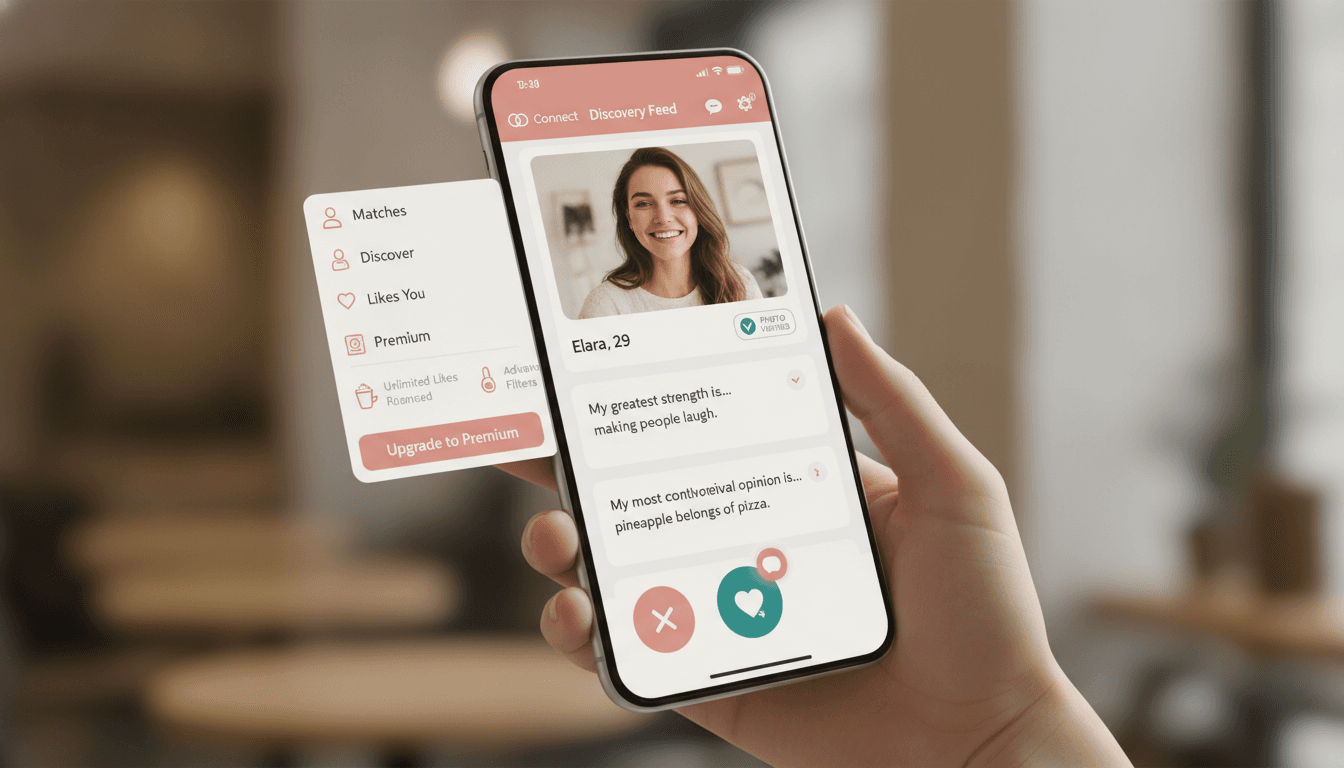
Building a dating app that competes with Hinge is a serious engineering undertaking. This post breaks down the architecture, key technical decisions, and cost realities so you can plan accurately before writing a line of code.
What Makes Hinge Architecturally Different From a Basic Dating App?
Most dating apps are, at their core, a profile store with a swipe mechanic bolted on. Hinge is more opinionated than that. Its "designed to be deleted" philosophy is not a marketing line — it shapes product decisions that have direct engineering consequences.
Hinge's core loop is built around prompts and comments rather than anonymous swipes. Users respond to a specific prompt on a profile, not the profile as a whole. That means your data model is richer from day one. A profile is not a flat document; it is a collection of media, answers, and preference signals, all of which need to be stored, indexed, and served efficiently.
The recommendation engine is where the real complexity lives. Hinge uses a machine learning ranking model that considers hundreds of signals: mutual connections, interaction history, stated preferences, implicit behaviour (how long someone views a photo, which prompt they tap), and geographic proximity. Replicating that from scratch takes time. Plan for it.
The data model you actually need
At minimum, your schema needs to handle:
- User profiles (media references, prompt answers, preference vectors)
- Like and comment events with target entity IDs (photo ID or prompt ID, not just user ID)
- Match state machine (liked, matched, conversation opened, conversation ended)
- Recommendation queue per user, refreshed on a cadence
- Block and report records, which affect feed generation globally
PostgreSQL handles this well up to a few hundred thousand active users. Beyond that, you will want to separate your social graph into a purpose-built store. Neo4j is a reasonable choice; so is a custom adjacency list in Redis for lower-latency traversal.
What Does the Core Feature Set Actually Require to Build?
Before you estimate timelines, map features to engineering work. Here is a realistic breakdown:
| Feature | Primary stack | Estimated effort (engineers) |
|---|---|---|
| Profile creation with prompts | REST API + S3/GCS media | 2 weeks, 2 engineers |
| Photo and video upload + CDN | FFmpeg, CloudFront or Cloudflare | 1 week, 1 engineer |
| Recommendation feed | ML ranking service + Redis queue | 6–10 weeks, 2–3 engineers |
| Like/comment interaction | WebSocket or long-poll + DB writes | 2 weeks, 2 engineers |
| Real-time chat | XMPP or a managed service like Stream | 3–4 weeks, 2 engineers |
| Push notifications | FCM + APNs via a unified gateway | 1 week, 1 engineer |
| Subscription and paywall | Stripe + in-app purchase reconciliation | 2–3 weeks, 1 engineer |
| Moderation pipeline | Auto-flagging + human review queue | 3–4 weeks, 2 engineers |
The recommendation feed is the long pole. Do not underestimate it. A naive approach (filter by distance, sort by last active) ships fast but kills retention. If retention is your product metric, the ranker is where you invest first.
Media handling specifics
Dating apps are media-heavy. Hinge allows up to 6 photos and video prompts. You need:
- Client-side compression before upload (sharp on the server side for thumbnails, ffmpeg for video transcoding)
- A CDN with signed URLs so media is not publicly guessable
- Perceptual hash deduplication to catch re-uploaded banned content
- NSFW detection on every upload, ideally a fine-tuned model rather than a generic one
AWS Rekognition covers the basics. For a production system, a fine-tuned classifier trained on your own moderation data will outperform it within a few months of operation.
/// Not sure where to start?
Get the architecture before you commit
Tell us what you're building and we'll map the technical approach, stack, and rough timeline. No cost, no obligation, no sales call required.
How Does the Matching Algorithm Actually Work?
The matching logic in a Hinge-style app is a two-sided ranking problem. You are not just showing user A to user B; you are solving for mutual interest probability across your entire active user base.
A practical starting architecture:
- Candidate generation: Pull candidates using approximate nearest-neighbour search on preference embeddings (FAISS or Pinecone work here) filtered by hard constraints (distance, age range).
- Ranking: Score each candidate with a gradient-boosted model or a two-tower neural network trained on historical match and conversation-start data.
- Diversity injection: Without explicit shuffling, the feed collapses to a narrow band of "high-scoring" profiles. Inject diversity by capping repeat candidate types per refresh.
- Feedback loop: Write every like, skip, and view back to your feature store. Retrain or fine-tune weekly at minimum.
Cold start is the hardest problem. New users have no interaction history. Use a collaborative filtering fallback: find users with similar stated preferences, and seed their feed from what those users engaged with. It is imperfect, but it is better than random.
What Are the Real Infrastructure Costs?
Developers routinely underestimate dating app infrastructure costs because the read/write ratio is extreme. A user opening the app fires a feed request that might touch thousands of candidate profiles. At 10,000 daily active users, that is manageable. At 500,000, you need caching, pre-computation, and careful database tuning.
A rough monthly cost baseline on AWS for 50,000 DAU:
- Compute (ECS Fargate, autoscaled): $800–$1,400
- RDS PostgreSQL (multi-AZ, db.r6g.large): $400–$600
- ElastiCache Redis (cache.r6g.large, 2 nodes): $300–$500
- S3 + CloudFront (estimated 10 TB egress): $900–$1,200
- ML inference (SageMaker or self-hosted): $500–$1,000
- Managed chat (Stream or Sendbird): $400–$800 depending on MAU tier
Total: roughly $3,400–$5,500/month before engineering time. That number scales non-linearly. Plan your unit economics early.
Safety and Moderation: The Non-Negotiable Engineering Work
Dating apps carry serious safety obligations. Hinge has an ID verification feature, photo verification, and a block/report system that feeds a global blacklist. These are not nice-to-haves.
At minimum, you need:
- NLP-based message scanning for grooming patterns and explicit content (both pre-trained classifiers and rule-based pattern matching for common attack strings)
- A human moderation queue with SLA, integrated into your admin panel
- Rate limiting on messages to new matches (Hinge limits early message frequency)
- Integration with NCMEC's hash matching database if you allow image sharing in chat
Skipping this work creates legal liability, not just product risk. Budget for it from the start.
Conclusion
A Hinge-like app is achievable, but the timeline and cost surprise most teams. The profile and interaction layer is the straightforward part; the recommendation engine and safety infrastructure are where projects stall. If you are scoping this seriously, start by defining your retention target and working backwards to the ranking model you need to support it.
If you want to talk through the architecture in more detail, the team at Sodio has built recommendation systems and social graph infrastructure across several consumer apps. Reach out and we can look at your specific constraints.
FAQ
How long does it take to build a dating app like Hinge? A minimum viable product with core matching, profiles, and chat takes 4–6 months with a team of 4–5 engineers. A production-grade version with a real recommendation engine, safety tooling, and subscription billing is closer to 9–12 months. Timeline depends heavily on how much ML work you do in-house versus using third-party services.
What tech stack does Hinge use? Hinge has not published its full stack, but based on job postings and public engineering content, it runs on a microservices architecture with Go and Kotlin on the backend, React Native for cross-platform mobile, and a combination of PostgreSQL and Redis for data storage. Their ML infrastructure is Python-based, likely TensorFlow or PyTorch.
How much does it cost to build an app like Hinge? Engineering cost alone for a first version ranges from $150,000 to $400,000 depending on team location and scope. Add ongoing infrastructure (see the estimates above) and moderation staffing. Apps that launch without budget for moderation and safety infrastructure tend to face serious problems within the first year.
Can you build a dating app without a recommendation algorithm? Yes, and many early-stage apps do. A distance-filtered, recently-active sort works fine for validation. The problem is that retention drops off quickly without personalisation. If you have fewer than 10,000 users in a city, a simple filter is often better anyway since the candidate pool is small enough that ranking adds noise.
What is the biggest technical mistake teams make building dating apps? Underbuilding the data model early. If your like and interaction events do not capture entity-level detail (which photo, which prompt) from day one, you cannot train a meaningful ranker later. Retrofitting that schema after launch with live data is painful. Design the event schema for ML from the start, even if you do not use it immediately.
Have a project in mind? Contact Sodio Technologies to discuss your requirements and explore the right technology solution for your business.
/// Work with us
Talk to the engineers who'd build it
You'll get a technical scope, timeline and cost estimate from the people doing the work, not an account manager. In-house team, no subcontracting, since 2016.