

How to Make an App Like Cookpad
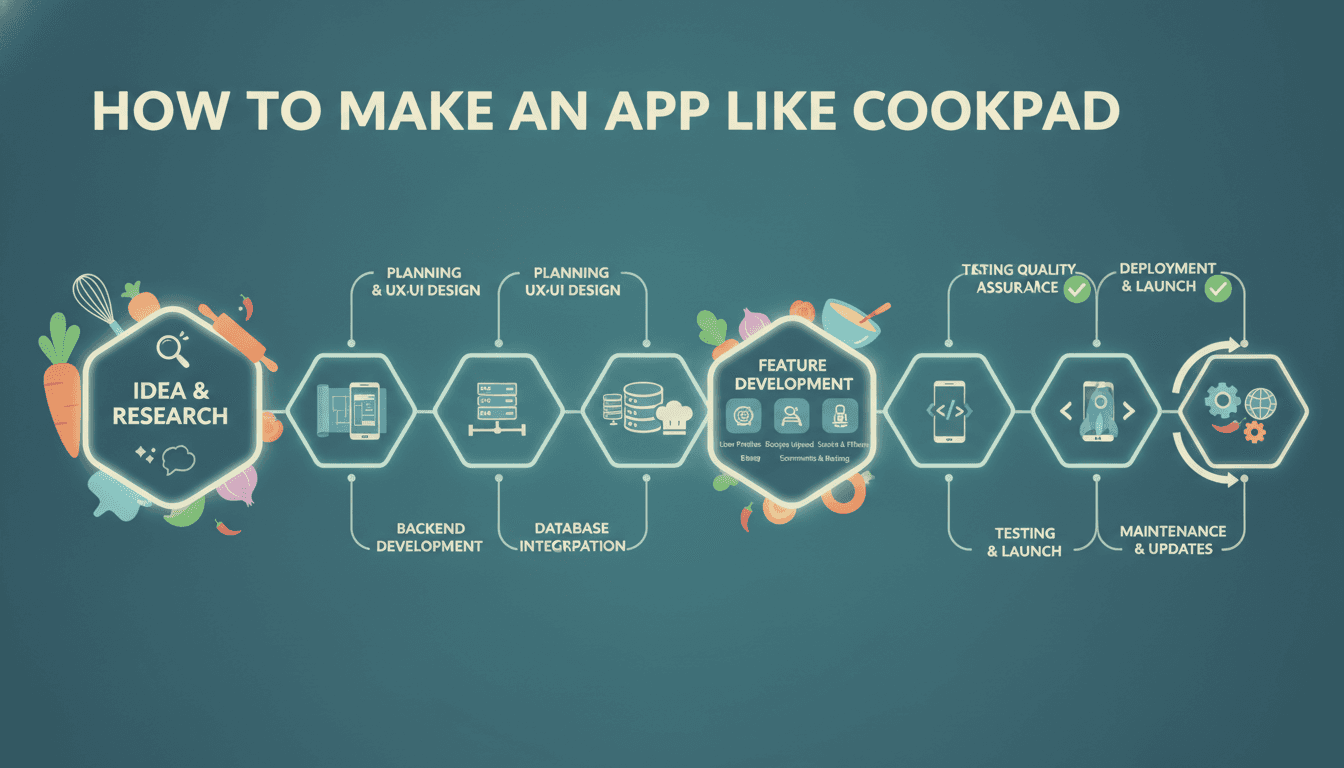
How to Make an App Like Cookpad
Cookpad turned a simple idea — let people share the recipes they actually cook at home — into a global platform with tens of millions of monthly users across more than 70 countries. It isn't a glossy magazine of chef-authored dishes. It's a community cookbook, written by home cooks, for home cooks.
That distinction matters if you're planning to build something similar. A recipe app like Cookpad isn't really a content app. It's a social network that happens to be organised around food. Understanding that shapes every decision you'll make about features, architecture, and growth.
You may also find our article on How to Make an App Like Food Network useful.
Here's how to approach building one.
Why Recipe Sharing Apps Still Have Room
The food and recipe app market keeps expanding because cooking is a daily, repeated behaviour with endless personal variation. People don't search for "dinner" once — they search for it 300 times a year, filtered by what's in the fridge, who's eating, how much time they have, and what they can afford.
We cover a closely related subject in How to Make an App Like Paprika.
Opportunities that remain open:
- Regional and cultural niches. Cookpad succeeded partly by localising aggressively. There is still space for apps focused on specific cuisines, diaspora communities, or regional ingredient availability.
- Dietary specificity. Diabetic-friendly, low-FODMAP, halal, keto, allergen-aware — broad apps handle these poorly.
- Budget and waste reduction. Cost-per-serving and "use what you have" cooking are growing concerns.
- Family and household coordination. Shared meal planning, shopping lists, and cooking schedules for multi-person homes.
- Creator monetisation. Home cooks with followings have few good ways to earn from recipes.
Understanding the Cookpad Model
Before writing code, it's worth breaking down what actually makes the product work.
User-generated content at scale. Cookpad doesn't produce recipes. Its users do — millions of them. This keeps content costs near zero but makes quality control, search relevance, and moderation the hard problems.
The "cooksnap" loop. Users post photos of dishes they made from someone else's recipe. This is the engagement engine: it rewards recipe authors with social proof, gives cooks a reason to return after cooking, and generates fresh content without requiring anyone to write a recipe.
Search as the primary entry point. Most sessions start with a search, not a browse. Someone has chicken thighs and 20 minutes. Search quality is the product.
Freemium subscription. Premium tiers unlock advanced search, curated collections, and ad-free browsing. The free tier stays genuinely useful, which is why the community keeps growing.
Core Feature Set
Must-Have Features (MVP)
User accounts and profiles Email, phone, and social sign-in. Profiles should display published recipes, cooksnaps, followers, and saved collections. Keep onboarding short — ask for cuisine preferences and dietary restrictions, nothing more.
Recipe creation This is your most important input flow and most teams underinvest in it. A good recipe editor needs:
- Step-by-step instruction builder with per-step photos
- Structured ingredient entry with quantity, unit, and item parsed separately
- Serving size, prep time, and cook time fields
- Draft saving and autosave
- Photo upload with compression and cropping
- Optional video for key techniques
Structured ingredients are non-negotiable. If you store ingredients as free text, you lose the ability to build shopping lists, scale servings, substitute items, or search by pantry contents. That's most of your future roadmap gone.
Search and discovery Full-text search across titles, ingredients, and steps, plus filters for time, difficulty, cuisine, dietary tags, and ingredients to include or exclude. Add typo tolerance and synonym handling — users type "corriander," "aubergine," and "brinjal" for things your database may label differently.
Recipe view and cooking mode The cooking screen should assume greasy hands and a propped-up phone: large type, screen-awake lock, checkable steps, built-in timers parsed from instruction text, and portion scaling that recalculates ingredient quantities live.
Social features Follow authors, comment, save to collections, and post cooksnaps. Cooksnaps deserve a first-class posting flow, not a comment attachment — they're the retention mechanism.
Notifications Someone cooksnapped your recipe. Someone you follow published something. Your saved recipe is trending. Keep these tightly relevant or users will disable them entirely.
Features for Version Two
- Meal planning calendar with drag-and-drop recipes across a week
- Auto-generated shopping lists aggregated across planned meals, grouped by supermarket aisle
- Pantry tracking to power "what can I make right now" search
- AI-assisted recipe suggestions based on cooking history and available ingredients
- Nutrition estimates calculated from structured ingredients
- Offline access for saved recipes
- Voice navigation for hands-free step advancement
- Grocery delivery integrations with local partners
- Creator monetisation via tips, premium recipe collections, or revenue sharing
Technical Architecture
Mobile Clients
Cross-platform (React Native or Flutter) is the pragmatic choice for most teams. A recipe app is mostly lists, forms, images, and text — territory where cross-platform frameworks are strong. You'll ship iOS and Android with one codebase and a smaller team.
Native (Swift and Kotlin) makes sense if camera handling, video editing, or deep OS integrations like widgets, Live Activities, and voice assistants are central to your differentiation.
Backend
A modular monolith is usually the right starting point — resist splitting into microservices before you have traffic to justify it. Structure services around clear domains:
- Identity and auth
- Recipe content and versioning
- Media processing
- Search indexing
- Social graph and activity feed
- Notifications
- Moderation
- Analytics
Node.js, Python (Django or FastAPI), Go, and Ruby on Rails are all proven here. Choose based on team expertise rather than benchmarks.
Data Layer
PostgreSQL for relational data — users, recipes, ingredients, relationships. Its JSON support handles flexible fields, and full-text search can serve you well before you need dedicated search infrastructure.
Elasticsearch, OpenSearch, or Algolia for real search. Recipe search involves multi-field relevance, faceted filters, synonyms, and fuzzy matching. Postgres will get you to launch; a search engine gets you to scale.
Redis for caching feeds, session data, trending calculations, and rate limiting.
Object storage plus CDN (S3, Cloudflare R2, GCS) for images and video. A recipe app is an image app in disguise — most of your bandwidth and a good share of your infrastructure cost will be media.
Media Pipeline
Build this properly from the start:
- Client-side compression and resizing before upload
- Direct-to-storage upload via presigned URLs
- Async processing for multiple resolution variants
- Modern format conversion (WebP, AVIF)
- CDN delivery with aggressive cache headers
- Automated moderation screening before publication
Serving full-resolution photos to phone-sized viewports is the single most common and most expensive mistake in this category.
Search Relevance
Your ranking should weigh more than keyword matching:
- Text relevance across title, ingredients, and steps
- Cooksnap count as a quality signal
- Save and completion rates
- Recency for seasonal relevance
- Author reputation
- Personalisation from the user's own history and restrictions
- Regional ingredient availability
Start simple, instrument everything, and iterate against real query logs. Your users' failed searches are the best product roadmap you'll ever get.
The Cold Start Problem
A user-generated recipe app with no recipes is worthless. This is the hardest part of the build, and it's not a technical problem.
We cover a closely related subject in How to Make an App Like SideChef.
Approaches that work:
Go narrow first. Launch for one city, one cuisine, or one dietary community. A hundred great recipes for a well-defined audience beats ten thousand generic ones.
Seed with real cooks. Recruit food bloggers, home cooks with social followings, and cooking club members. Pay them, feature them, give them early creator status.
Licence or partner for baseline content. Fill gaps with licensed recipes while community content grows, and clearly label the difference.
Make consumption valuable before contribution. Meal planning, shopping lists, and cooking mode give users reasons to stay even before they post anything.
Lower the contribution barrier. Let people import from photos or text, save private recipes, and publish later. Private-first storage converts to public sharing surprisingly often.
Moderation and Trust
User-generated food content carries real risks. Plan for:
- Automated screening for inappropriate imagery and spam before publication
- Allergen and safety flags on recipes involving raw eggs, undercooked meat, home canning, or foraged ingredients
- Plagiarism detection — recipe scraping is rampant, and authors will notice
- Community reporting with visible resolution
- Clear content policy about attribution and originality
Add a food safety disclaimer and, where nutrition data appears, be explicit that figures are estimates.
Monetisation
Freemium subscription is Cookpad's core model and translates well. Gate advanced search, unlimited collections, meal planning, offline access, and nutrition insights.
Advertising works at scale but degrades the cooking experience. If you use it, keep ads out of cooking mode entirely.
Grocery and commerce partnerships convert shopping lists into affiliate revenue or delivery integrations — often the highest-margin option.
Brand and sponsored content from food producers, but label it honestly.
Creator revenue sharing builds long-term content supply even though it reduces short-term margin.
Ecosystem rules matter: Apple and Google take their cut of in-app subscriptions, so model the economics before committing to a price point.
Development Timeline and Cost
Rough guidance for a competent team:
| Phase | Duration | Scope |
|---|---|---|
| Discovery and design | 4–6 weeks | Research, user flows, UI system, prototypes |
| MVP build | 12–16 weeks | Auth, recipe CRUD, search, social basics, cooking mode |
| Beta and iteration | 4–8 weeks | Closed testing, seeding, performance work |
| Public launch | 2–4 weeks | Store submission, analytics, support setup |
An MVP in the region of $45,000–$100,000 is realistic depending on region, team composition, and scope. Full-featured builds with meal planning, AI recommendations, and commerce integrations run considerably higher. Budget an ongoing 15–25% of build cost annually for maintenance, infrastructure, and moderation.
Mistakes to Avoid
Storing ingredients as plain text. Already mentioned, but worth repeating because it's the most common and most expensive architectural regret in this category.
Treating search as a checkbox. It's the product, not a feature.
Building for chefs instead of home cooks. Cookpad won because it embraced imperfect, everyday cooking. Polished aspirational content already has plenty of homes.
Launching globally on day one. Localisation means ingredient names, measurement systems, available produce, and cultural norms — not translated strings.
Deferring moderation tooling. You'll need it the week you launch.
Ignoring the kitchen context. Wet hands, bad lighting, a phone on a counter three feet away, interruptions mid-recipe. Test in an actual kitchen.
Getting Started
Build the narrowest version that delivers real value to a specific group of cooks: recipe creation, solid search, cooking mode, and cooksnaps. Ship it, watch what people actually search for and abandon, and expand from evidence rather than assumption.
The technology here is well understood. The hard parts are content supply, search relevance, and earning trust from a community that cares deeply about food. Get those right and the platform builds itself.
Have a project in mind? Contact Sodio Technologies to discuss your requirements and explore the right technology solution for your business.
/// Work with us
Talk to the engineers who'd build it
You'll get a technical scope, timeline and cost estimate from the people doing the work, not an account manager. In-house team, no subcontracting, since 2016.