

How to Make an App Like Food Network
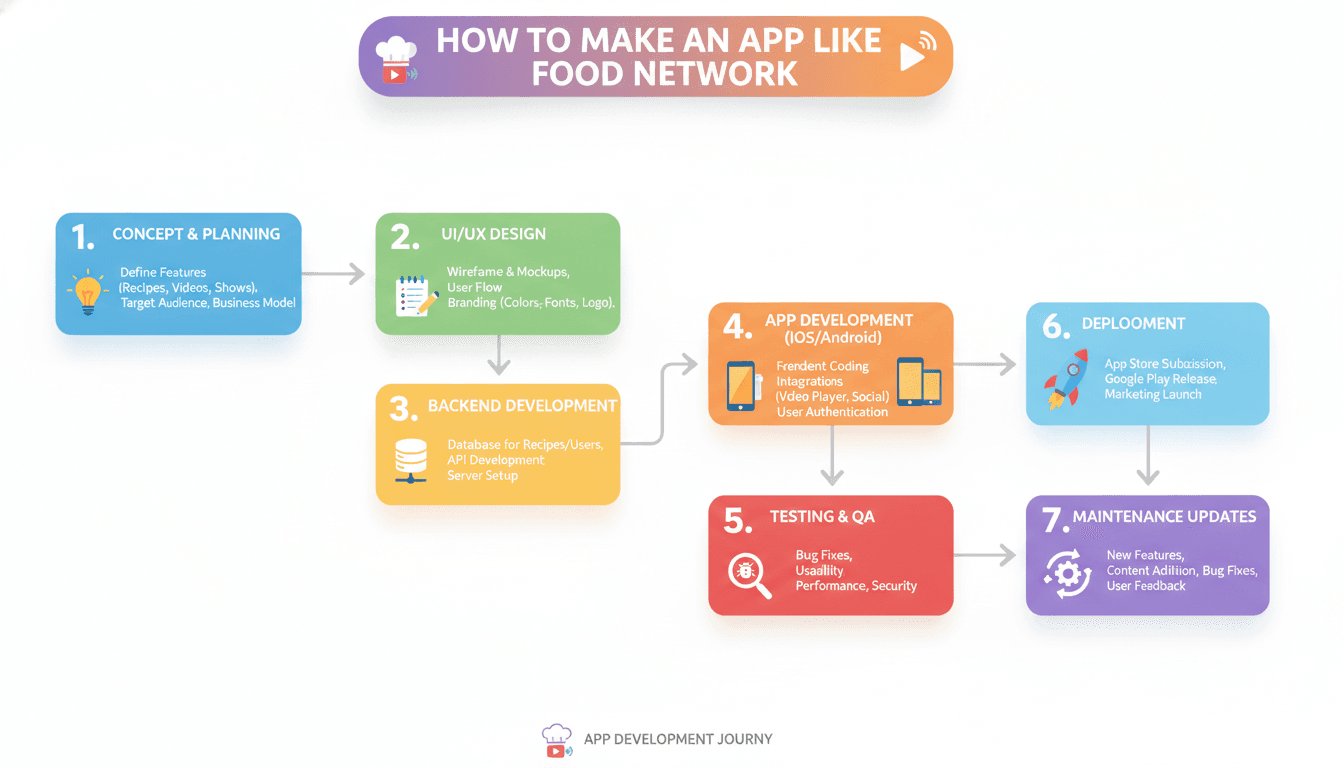
How to Make an App Like Food Network
Food content is one of the most consumed categories on mobile devices. People cook with their phones propped against the backsplash, save recipes during their commute, and watch cooking shows while waiting for their own dinner to finish. The Food Network app captured that behavior early by blending recipe discovery, video streaming, and personality-driven content into a single experience.
If you're planning to build something similar, the real challenge isn't the recipe list. It's the content pipeline, the video infrastructure, and the personalization layer that keeps users coming back three times a week instead of once a month.
Understanding What Food Network Actually Does Well
Before writing a line of code, it helps to break the product down into its working parts.
Recipe discovery at scale. Tens of thousands of recipes, each tagged by cuisine, difficulty, cooking time, dietary restriction, ingredient, and the show or chef it came from. Search and filtering do the heavy lifting here.
Video as a first-class citizen. Full episodes, short how-to clips, and step-by-step technique videos embedded directly in recipe pages. Video isn't a bonus feature; it's the reason many users open the app.
Personality and brand. Users don't just want a chicken recipe. They want Ina's chicken recipe. Chef and show identity drive engagement in a way generic recipe databases can't match.
Utility features that create habit. Saved recipes, shopping lists, meal planning, and cook mode (a screen that stays awake and lets you swipe through steps with sticky fingers).
Your version needs a point of view on all four.
Core Feature Set
Must-Have Features for Version One
Onboarding and taste profiling Ask a handful of questions during signup: dietary preferences, skill level, favorite cuisines, household size. This data seeds your recommendation engine immediately rather than waiting weeks for behavioral signals.
Recipe browsing and search Full-text search plus faceted filters. Users should be able to combine "vegetarian," "under 30 minutes," and "Italian" in a single query and get instant results. Ingredient-based search — "what can I make with chicken thighs and a lemon?" — is a strong differentiator.
Structured recipe pages Ingredients with scalable quantities, numbered instructions, prep and cook times, nutrition data, equipment needed, and user ratings. Structure the data properly in your database rather than storing recipes as blobs of text. You'll need that structure later for shopping lists, nutrition calculation, and voice interfaces.
Cook mode A dedicated in-kitchen view: large type, step-by-step navigation, screen wake lock, built-in timers triggered from the instruction text, and optional voice navigation. This is the feature users mention in reviews.
Video playback Adaptive bitrate streaming with offline download for premium users. Chapter markers that map video segments to recipe steps.
Save, collect, and plan Personal recipe boxes, custom collections, and a calendar-based meal planner that users can drag recipes into.
Shopping list generation Auto-generated from selected recipes, with ingredients consolidated across recipes and grouped by grocery aisle. Integration with grocery delivery APIs is a natural monetization path.
Features Worth Adding in Phase Two
- Live streaming and scheduled cooking classes
- User-generated content: photo uploads, recipe reviews, cook-along notes
- Smart TV and cast support for kitchen-to-living-room continuity
- Voice assistant integration for hands-free cooking
- Pantry tracking with expiration reminders
- Social following between users and creators
- Subscription tier with ad-free video and exclusive series
Technical Architecture
Client Applications
For most teams, React Native or Flutter makes sense here. The app is content-heavy rather than hardware-intensive, so a cross-platform codebase gets you to market faster on both iOS and Android with near-native performance. If video experience is your central differentiator and you want deep control over playback, native Swift and Kotlin builds are defensible.
To explore this further, see How to Make an App Like Epicurious.
You'll also want a responsive web app. Recipe pages are a major organic search entry point, and server-side rendering matters for SEO.
Backend Services
A microservices approach keeps the domains clean:
- Content service — recipes, articles, metadata, taxonomy
- Media service — video ingestion, transcoding orchestration, thumbnail generation
- User service — auth, profiles, preferences, subscriptions
- Personalization service — recommendations, feed ranking
- Commerce service — shopping lists, grocery partner integrations, in-app purchases
- Notification service — push, email, meal reminders
Node.js or Python works well for the content and API layers. Python is the natural choice for the recommendation and data pipeline services.
Data Storage
Use PostgreSQL for relational data: users, recipes, structured ingredient records. Add Elasticsearch or Algolia for search — recipe search has enough complexity around synonyms, typos, and faceting that a purpose-built engine pays for itself. Redis handles session caching and hot content. Object storage like S3 holds raw media, fronted by a CDN.
Related reading: How to Make an App Like Cookpad.
Video Pipeline
This is where budgets get eaten. The flow looks like this: upload to object storage, trigger transcoding into multiple bitrate renditions with HLS and DASH packaging, generate thumbnails and captions, apply DRM if you're licensing third-party content, then distribute via CDN.
To explore this further, see How to Make an App Like SideChef.
Managed services like AWS Elemental MediaConvert, Mux, or Cloudflare Stream will save you months compared to building this yourself. Reserve custom pipeline work for when your volume justifies it.
Content Management
Your editorial team needs a CMS they can actually use. A headless CMS with a custom recipe content model gives editors structured fields for ingredients and steps while your apps consume everything through a single API. Build in scheduled publishing, versioning, and role-based approvals from the start — retrofitting editorial workflow is painful.
Building the Recommendation Layer
Generic recipe feeds don't retain users. Your personalization approach should combine several signals:
Content-based filtering matches recipes to a user's stated preferences and the attributes of recipes they've saved or cooked.
Collaborative filtering surfaces recipes popular among users with similar behavior patterns.
Contextual signals matter enormously in food. Time of day, day of week, season, local weather, and upcoming holidays all shift what someone wants to cook. A soup recommendation lands very differently in January than in July.
Explicit feedback loops — a simple "made it" button, a thumbs down, a "not this cuisine again" option — give you high-quality training data.
Start with a rules-based system augmented by content similarity. You need meaningful behavioral volume before machine learning models outperform well-designed heuristics.
Design Considerations
Food apps live or die on photography. Your design system should treat imagery as the primary interface element: full-bleed hero shots, consistent aspect ratios, and strict quality standards for any content you accept.
Beyond that:
- Design cook mode for wet hands and awkward angles. Tap targets should be generous, and critical actions shouldn't require precision.
- Make ingredient scaling obvious. Users cooking for two versus eight need one tap, not mental math.
- Respect the kitchen context. Dark mode, offline access to saved recipes, and no ads that interrupt a cooking session.
- Handle accessibility properly. Large text support, screen reader labels on every step, and sufficient contrast over photo backgrounds.
Content Strategy and Licensing
An app like this is a content business wearing a technology costume. You have three paths:
Original production gives you full ownership and brand control but requires studio capability and sustained investment.
Licensing from publishers, networks, or recipe databases gets you volume quickly. Read the terms carefully — territory restrictions, expiration dates, and platform limitations all need enforcement in your CMS.
Creator partnerships let independent chefs and food creators publish through your platform under a revenue share. This scales well and brings audiences with it, but demands moderation tooling and quality review.
Most successful products blend all three.
Monetization Models
- Freemium subscription — free recipe access, paid tier for ad-free video, offline downloads, exclusive series, and advanced meal planning
- Advertising — display and pre-roll video, with native sponsored recipe placements as the higher-value inventory
- Brand partnerships — sponsored collections from food and appliance brands, integrated authentically into content
- Commerce affiliate — grocery delivery integrations, kitchen equipment referrals, ingredient kits
- Live classes and events — ticketed cooking sessions with named chefs
Development Timeline and Cost
A realistic phased approach:
Discovery and design (4 to 6 weeks) — requirements, content modeling, wireframes, UI design system
MVP build (14 to 20 weeks) — core apps, backend services, CMS setup, basic video playback, search
Content loading and QA (4 to 6 weeks) — recipe ingestion, editorial training, device testing
Launch and iteration (ongoing) — analytics-driven refinement, personalization tuning, phase two features
Budget ranges vary widely with scope. A focused MVP with cross-platform apps and managed video infrastructure typically lands in the $80,000 to $150,000 range. A full-featured platform with live streaming, original video production support, smart TV apps, and a custom recommendation engine can run $250,000 and beyond. Ongoing costs for CDN bandwidth, transcoding, and content licensing deserve their own line in the model — video delivery at scale is not cheap.
Metrics That Actually Matter
Track these from day one:
- Weekly cooking sessions per active user
- Recipe save-to-cook conversion rate
- Video completion rate by content type
- Search success rate and zero-result query volume
- Shopping list generation frequency
- Subscription conversion and churn by acquisition channel
- Day 1, 7, and 30 retention cohorts
Recipe saves feel good but mean little on their own. Cooking sessions are the signal that your app has become part of someone's routine.
Common Pitfalls
Treating recipes as unstructured content. If ingredients aren't parsed into quantity, unit, and item, you can't build shopping lists, scaling, or nutrition features later without a painful migration.
Underestimating video costs. Bandwidth bills scale with success. Model your unit economics before you launch, not after a viral week.
Launching with thin content. A beautiful app with 200 recipes fails discovery testing. Plan content volume alongside engineering.
Neglecting the editorial workflow. If publishing a recipe takes an editor forty minutes, your content velocity will never reach a useful level.
Building a recipe search engine without search expertise. Users search for "chicken parm," "chicken parmigiana," and "chicken parmesan." Handle that properly or lose them.
Getting Started
The path forward is less about replicating Food Network feature for feature and more about identifying an underserved angle. Maybe that's a specific cuisine, a dietary community, a skill level, or a creator-first model that established networks can't easily match.
Build the structured content foundation properly, lean on managed services for video, ship a focused MVP that nails discovery and cook mode, then let real usage data guide what comes next. The technology is well-understood at this point. The differentiation lives in content quality and how well you understand the moment someone stands in their kitchen wondering what to make.
Have a project in mind? Contact Sodio Technologies to discuss your requirements and explore the right technology solution for your business.
/// Work with us
Talk to the engineers who'd build it
You'll get a technical scope, timeline and cost estimate from the people doing the work, not an account manager. In-house team, no subcontracting, since 2016.