

How to Make an App Like Coursera
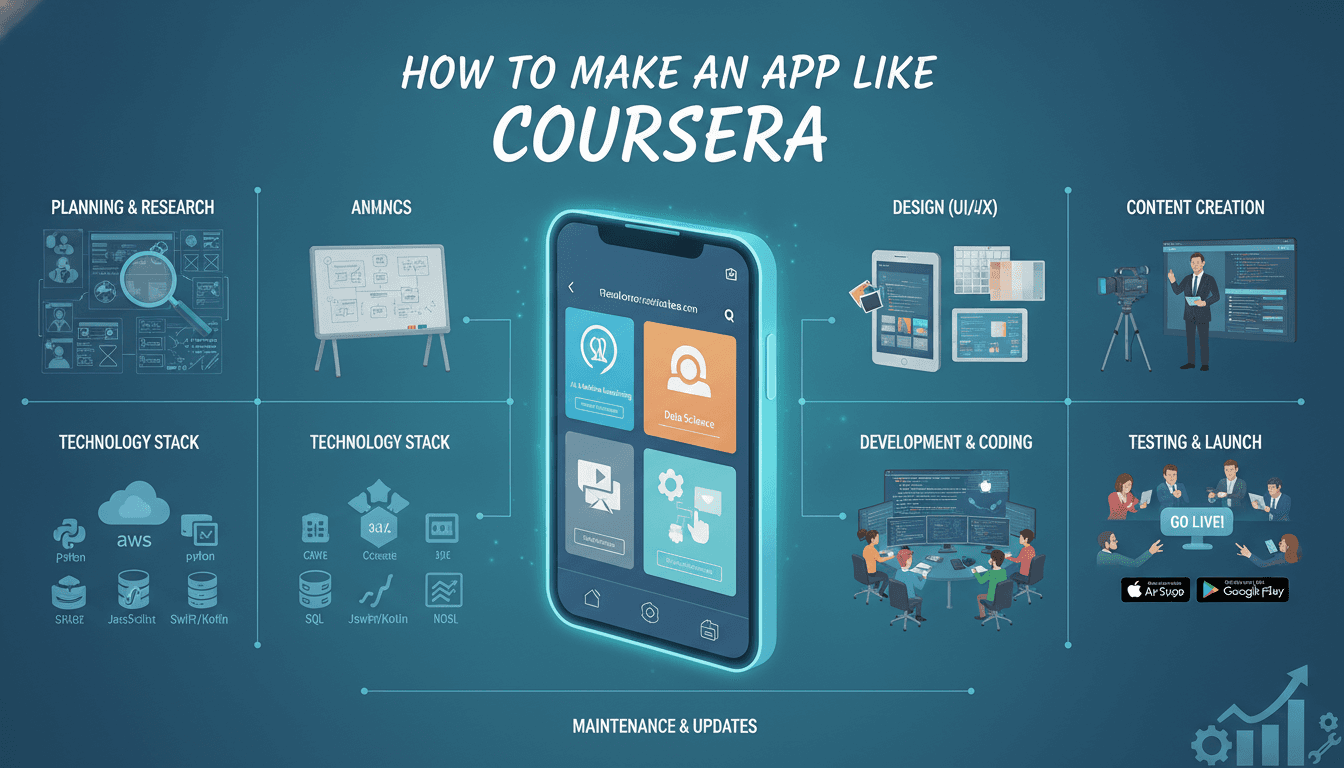
How to Make an App Like Coursera
Online learning has moved from a "nice to have" to a core part of how people build careers. Coursera alone serves well over 100 million registered learners, and the broader e-learning market is projected to keep expanding at double-digit rates through the decade. That growth has a lot of founders asking the same question: what would it actually take to build a platform like Coursera?
This guide walks through the product thinking, feature set, tech stack, monetisation options, and realistic costs involved in building a massive open online course (MOOC) platform.
We cover a closely related subject in How to Make an App Like Lynda.com.
Why Build a Coursera-Style Platform?
Before writing a line of code, it's worth being clear on the opportunity you're chasing. A direct clone of Coursera is a hard sell — it competes with an incumbent that has university partnerships, brand recognition, and an enormous content library. The more successful plays tend to be focused:
- Vertical-specific learning — platforms dedicated to healthcare certifications, trades, compliance training, or a single technology ecosystem.
- Regional or language-first platforms — serving learners underserved by English-dominant incumbents.
- Corporate L&D platforms — B2B learning management aimed at upskilling employees, often with reporting and compliance baked in.
- Creator-led marketplaces — where independent experts publish and monetise their own courses.
Pick your wedge early. It shapes everything from your content model to your pricing.
Core Features of a MOOC Platform
An app like Coursera is really three products stitched together: a learner experience, an instructor toolkit, and an administrative backend.
Related reading: How to Make an App Like edX.
Learner-Facing Features
Onboarding and profiles. Social and email sign-up, skill/interest selection, goal setting, and a profile that tracks enrolled courses, progress, and earned credentials.
Course discovery. Search with faceted filters (subject, level, duration, language, price, credential type), curated collections, and personalised recommendations.
Course player. Adaptive-bitrate video streaming, playback speed controls, captions and transcripts, in-video notes, and downloadable resources.
Assessments. Quizzes, auto-graded coding or math problems, timed exams, and peer-reviewed assignments with rubrics.
Progress tracking. Completion percentages, streaks, deadlines, and syllabus checkpoints.
Certificates and credentials. Verifiable completion certificates, shareable to LinkedIn, with optional specialisation or degree pathways.
Community. Discussion forums per lesson, Q&A threads, study groups, and mentor or TA interaction.
Offline mode. Downloadable lessons for mobile learners with intermittent connectivity — a genuine differentiator in emerging markets.
Notifications. Deadline reminders, new content alerts, and re-engagement nudges.
Instructor-Facing Features
- Course authoring tools with drag-and-drop module and lesson structuring
- Video upload with automatic transcoding and captioning
- Quiz and assignment builders with question banks
- Learner analytics: enrolment, drop-off points, quiz performance, completion rates
- Revenue dashboards and payout management
- Announcement and messaging tools
Admin Features
- Content moderation and course approval workflows
- User and role management
- Payment, refund, and payout reconciliation
- Platform-wide analytics and reporting
- Partner/institution management for universities or enterprise clients
- Promotions, coupons, and pricing controls
Advanced Features Worth Considering
Once the fundamentals are solid, these are the features that make a platform feel modern:
AI-powered recommendations. Suggest next courses based on completed content, career goals, and behaviour patterns of similar learners.
AI tutoring and summarisation. LLM-backed assistants that answer questions about lecture content, generate practice questions, or summarise long videos.
Adaptive learning paths. Adjust difficulty and sequencing based on assessment performance rather than serving everyone the same linear syllabus.
Automated proctoring. Identity verification and behaviour monitoring for credential-bearing exams.
Plagiarism detection for written and code submissions.
Gamification. Points, badges, leaderboards, and streaks — used carefully, these materially improve completion rates.
Hands-on labs. Browser-based sandboxes for coding, data science notebooks, or simulated environments.
Employer integrations. Job boards, skills-based hiring signals, and partnerships that turn credentials into outcomes.
Choosing a Tech Stack
There's no single correct stack, but here's a combination that scales well for this category of product.
Frontend
- Web: React or Next.js for server-side rendering and strong SEO on course landing pages — critical, since organic search drives a huge share of MOOC traffic.
- Mobile: React Native or Flutter for cross-platform delivery, or native Swift/Kotlin if you need deep offline and media capabilities.
Backend
- Languages/frameworks: Node.js (NestJS), Python (Django/FastAPI), or Go for high-throughput services.
- Architecture: Start modular-monolith, extract microservices as load demands — typically video processing, search, notifications, and payments are the first to split out.
- APIs: REST for core CRUD, GraphQL where clients need flexible data shaping, WebSockets for live sessions and real-time discussions.
Data Layer
- PostgreSQL for relational data: users, enrolments, courses, transactions.
- Redis for sessions, caching, and rate limiting.
- Elasticsearch or OpenSearch for course search and filtering.
- ClickHouse or BigQuery for learning analytics and event data.
- Object storage (S3 or equivalent) for video masters and course assets.
Video Infrastructure
This is the single biggest technical and cost consideration. You'll need:
- Transcoding into multiple renditions (AWS MediaConvert, Mux, or FFmpeg on your own workers)
- HLS/DASH adaptive streaming
- A CDN with global edge coverage
- DRM or signed URLs to prevent content piracy
- Automatic speech-to-text for captions and searchable transcripts
Managed services like Mux, Cloudflare Stream, or Vimeo OTT will get you to market faster; rolling your own gives you better unit economics at scale.
To explore this further, see How to Make an App Like Udacity.
Other Integrations
- Payments: Stripe, PayPal, plus regional gateways and local payment methods
- Auth: Auth0, Firebase Auth, or Keycloak, with SSO/SAML for enterprise clients
- Email/SMS: SendGrid, Twilio
- Analytics: Mixpanel or Amplitude for product, plus your own event pipeline
- Standards: SCORM, xAPI (Tin Can), and LTI if you plan to integrate with existing LMS ecosystems
Monetisation Models
Coursera itself runs a hybrid model, and most successful platforms do the same.
| Model | How it works | Best for |
|---|---|---|
| Per-course purchase | One-off fee for lifetime access | Marketplaces, niche skills |
| Subscription | Monthly/annual access to a catalogue | High-volume content libraries |
| Freemium / audit | Free content, paid certificates | Top-of-funnel growth |
| Degrees & programs | High-ticket, institution-backed | University partnerships |
| B2B licensing | Seat-based enterprise contracts | Corporate L&D — highest LTV |
| Revenue share | Split with instructors | Creator marketplaces |
B2B is where the healthiest margins usually live. Consumer subscriptions are great for scale but suffer from churn once a learner finishes what they came for.
Development Roadmap
Phase 1: Discovery and Design (3–5 weeks)
Market and competitor research, user personas, feature prioritisation, information architecture, wireframes, and a high-fidelity UI kit.
Phase 2: MVP Build (3–5 months)
Focus ruthlessly. A viable MVP is: sign-up, course catalogue and search, video player, basic quizzes, progress tracking, payments, and a minimal instructor upload tool. Everything else waits.
Phase 3: Beta and Iteration (4–8 weeks)
Onboard a small cohort of instructors and learners. Watch drop-off in the player, measure completion, and fix the friction you find.
Phase 4: Scale (ongoing)
Mobile apps, AI features, certifications, enterprise tooling, localisation, and infrastructure hardening.
Cost Breakdown
Costs vary enormously by region and scope, but as a rough guide:
- MVP web platform: $60,000 – $120,000
- MVP with iOS and Android apps: $100,000 – $180,000
- Full-featured platform with AI, proctoring, and enterprise tooling: $250,000 – $500,000+
Ongoing costs are easy to underestimate. Budget for:
- Video storage, transcoding, and CDN bandwidth (scales directly with usage)
- Cloud hosting and database costs
- Third-party service fees
- Content acquisition or instructor revenue share
- Maintenance, typically 15–20% of initial build cost annually
Key Challenges to Plan For
Completion rates. MOOC completion hovers in the single digits industry-wide. Design for engagement from day one: shorter lessons, cohort deadlines, reminders, and social accountability.
Content supply. A platform with no courses is worthless. Decide early whether you're producing content in-house, partnering with institutions, or recruiting creators — each is a distinct go-to-market motion.
Video costs. Bandwidth bills can spiral. Use adaptive bitrate aggressively, cache hard, and monitor cost per active learner.
Credential credibility. A certificate only has value if employers recognise it. Accreditation partnerships and verifiable credentials (including blockchain-backed options) help.
Compliance. GDPR, CCPA, FERPA for educational records, WCAG 2.1 AA for accessibility, and PCI DSS for payments. Accessibility in particular is both a legal requirement in many markets and a genuine reach multiplier.
Making It Succeed
The technology is the solvable part. What separates platforms that grow from those that stall is usually:
- A clear audience. "Online courses for everyone" is not a strategy.
- Outcome focus. Learners pay for jobs, promotions, and certifications — not for video.
- SEO and content. Course pages are your acquisition engine; treat them as such.
- Instructor experience. Good creators go where publishing is easy and payouts are fair.
- Data discipline. Instrument everything, then use drop-off data to fix your curriculum.
Final Thoughts
Building an app like Coursera is a substantial undertaking — but it's a well-understood one. The architecture patterns exist, the third-party services are mature, and the demand is real and growing. Start with a narrow, defensible audience, ship an MVP that does the core learning loop exceptionally well, and expand from there.
If you're planning an e-learning platform and want help scoping the build, mapping the architecture, or getting an MVP into users' hands, it's worth talking to a team that has shipped this kind of product before.
Have a project in mind? Contact Sodio Technologies to discuss your requirements and explore the right technology solution for your business.
/// Work with us
Talk to the engineers who'd build it
You'll get a technical scope, timeline and cost estimate from the people doing the work, not an account manager. In-house team, no subcontracting, since 2016.