

How to Make an App Like Epicurious
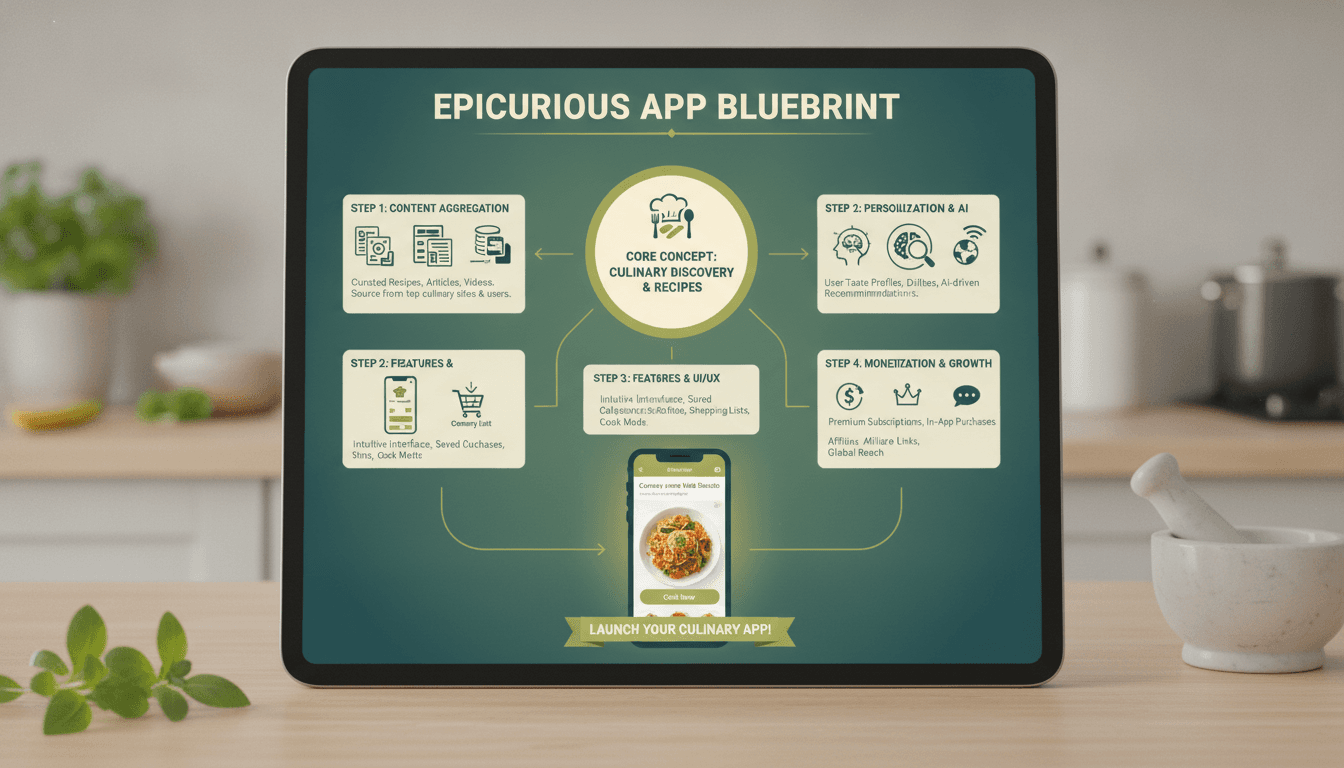
How to Make an App Like Epicurious
Recipe apps have quietly become one of the stickiest categories in mobile. People cook every single day, and the phone has replaced the stained cookbook on the kitchen counter. Epicurious — with its editorially curated recipe archive, saved recipe box, and shopping list tools — is the benchmark many founders point to when they say, "I want to build something like that."
This guide walks through what it actually takes to build an app like Epicurious: the features that matter, the architecture behind them, the team you'll need, and the realistic budget and timeline.
You may also find our article on How to Make an App Like Food Network useful.
What Makes Epicurious Work
Before writing a line of code, it's worth understanding why Epicurious holds users' attention.
Editorial trust. Every recipe is tested and vetted. Users don't have to gamble on whether a dish will work. That trust is a moat — and it's the hardest part to replicate.
A recipe box, not just a feed. Saving, organizing, and returning to recipes turns a content app into a personal utility. Retention comes from the box, not the browse.
Cooking-mode UX. Step-by-step views, screen-stays-awake, scalable serving sizes, and unit conversion. These small touches decide whether the app gets used in the kitchen or abandoned on the couch.
Shopping lists that aggregate. Adding three recipes and getting one consolidated, aisle-grouped grocery list is a genuine time-saver.
If your app nails those four things, you're competitive. If it only nails browsing, you've built a magazine.
Core Feature Set
Must-Have (MVP)
- Onboarding & preferences — dietary restrictions, allergies, cuisine likes, skill level
- Recipe discovery — search, category browsing, collections, seasonal features
- Advanced filtering — by ingredient, cook time, diet, difficulty, equipment
- Recipe detail view — hero image, ingredients, steps, nutrition, ratings, reviews
- Recipe box / favorites — folders, tags, offline access
- Shopping list — auto-generated from recipes, consolidated, checkable, editable
- Cooking mode — large-type steps, built-in timers, keep-screen-on
- User accounts & cross-device sync
- Ratings and reviews
Phase Two Differentiators
- Meal planner — drag recipes onto a weekly calendar, auto-build the grocery list
- AI recipe assistant — "what can I make with chicken, lemons, and rice?"
- Smart substitutions — ingredient swaps for allergies or empty pantries
- Grocery delivery integration — Instacart, Amazon Fresh, or local partners
- Video and step imagery
- Voice control — hands-free navigation while cooking, plus Alexa/Google Assistant
- Social layer — user-submitted recipes, cook-alongs, photo uploads
- Nutrition tracking — calorie and macro logging, health app sync
Admin & Editorial Side
Don't underestimate this. You need a CMS where editors can create structured recipes (not free text), attach photos, tag ingredients against a canonical database, schedule publication, and moderate reviews. A weak editorial backend will bottleneck your whole content operation.
We cover a closely related subject in How to Make an App Like Paprika.
The Hard Technical Problem: Structured Recipe Data
This is where most recipe apps stumble. A recipe can't be stored as a blob of text if you want filtering, scaling, shopping lists, and nutrition to work.
Each ingredient line needs to be parsed into structured components:
"2 1/2 cups all-purpose flour, sifted"
→ quantity: 2.5
→ unit: cup
→ ingredient_id: 1047 (all-purpose flour)
→ preparation: sifted
Once ingredients are structured, everything else becomes possible:
- Scaling — multiply quantities, with smart fraction rounding
- Unit conversion — metric/imperial toggle, volume-to-weight where density is known
- Shopping list consolidation — merge "1 cup flour" and "2 tbsp flour" into a single line
- Nutrition calculation — map ingredient IDs to a nutrition database (USDA FoodData Central is a good free starting point)
- Ingredient-based search — "recipes I can make with what's in my fridge"
Build a canonical ingredient database early. Retrofitting structure onto thousands of unstructured recipes is painful and expensive.
Recommended Tech Stack
Frontend (mobile): React Native or Flutter for cross-platform efficiency. If you want deeply native kitchen integrations — Live Activities, widgets, CarPlay, Wear OS — go native with Swift and Kotlin.
Backend: Node.js (NestJS) or Python (Django/FastAPI). Python has an edge if you're doing heavy NLP for ingredient parsing.
Database: PostgreSQL for relational recipe and user data. Redis for caching hot recipes and session data.
Search: Elasticsearch or Algolia. Recipe search is faceted, typo-tolerant, and latency-sensitive — do not try to do this with SQL LIKE queries.
Media: S3 or Cloudflare R2 with a CDN, plus on-the-fly image resizing. Food photography is your heaviest asset class; optimize aggressively.
AI layer: An LLM API for conversational recipe search, substitution suggestions, and ingredient parsing assistance. Vector embeddings (pgvector or Pinecone) for semantic "recipes like this one" recommendations.
Offline: Local storage (SQLite/Realm/WatermelonDB) so saved recipes work without a signal — kitchens often have bad Wi-Fi.
Content Strategy: Where Do the Recipes Come From?
You have four options, and the choice shapes your entire business.
- Create original content. Hire recipe developers, food stylists, and photographers. Highest quality and strongest brand, highest cost — expect $150–$500+ per fully tested and photographed recipe.
- License existing content. Partner with publishers, cookbook authors, or media brands. Faster to scale, ongoing royalty costs.
- Aggregate via API/partnerships. Services like Spoonacular or Edamam provide large recipe datasets. Fast and cheap, but the same data everyone else has — poor differentiation.
- User-generated content. Community submissions with moderation. Scales cheaply but quality is uneven and cold-start is brutal.
Most successful apps blend approaches: a licensed or aggregated base for breadth, plus original content for identity. Note that in most jurisdictions ingredient lists aren't copyrightable but the descriptive text, headnotes, and photos absolutely are. Get legal advice before scraping anything.
Monetization Models
- Freemium subscription — free browsing, paid meal planner, offline access, ad-free experience, and exclusive collections. Typical pricing: $4.99–$9.99/month or $29–$59/year.
- Advertising — display and native ads. Requires very large traffic to be meaningful.
- Affiliate commerce — grocery delivery referrals, cookware and appliance links, cookbook sales.
- Brand partnerships — sponsored recipes and collections with food brands. Historically lucrative in this category.
- Premium content drops — celebrity chef collections, technique courses.
Subscription plus affiliate is the most durable combination for an independent app.
UX Principles for Cooking Apps
Design for messy hands. Large tap targets, minimal precision gestures, and voice or swipe navigation in cooking mode.
Respect the glance. A user looks at the screen for two seconds between stirring. Current step should be readable from arm's length.
Never lose the user's place. If the app backgrounds mid-recipe, restore exactly where they were.
Photos do the selling. Recipe cards live or die on the hero image. Budget for consistent, high-quality photography and enforce style guidelines.
Progressive disclosure. Nutrition, reviews, tips, and variations are valuable but shouldn't crowd the ingredients and steps.
Team and Timeline
A typical build team:
- 1 Product Manager
- 1–2 UI/UX Designers
- 2–3 Mobile Developers
- 2 Backend Developers
- 1 QA Engineer
- 1 DevOps (part-time)
- Content/editorial lead (often overlooked, always needed)
Timeline for a solid MVP: 4–6 months.
| Phase | Duration |
|---|---|
| Discovery & product definition | 2–3 weeks |
| UI/UX design | 4–6 weeks |
| Backend & CMS development | 8–12 weeks |
| Mobile development | 10–14 weeks |
| QA & beta | 3–4 weeks |
| Launch prep & store submission | 1–2 weeks |
Design, backend, and mobile overlap significantly, which is how six months of work compresses into four calendar months.
Cost Estimate
Ranges vary widely by region and team seniority, but as a planning baseline:
- Lean MVP (single platform, core features): $45,000 – $75,000
- Full cross-platform MVP with CMS: $80,000 – $140,000
- Feature-rich app with AI, meal planning, integrations: $150,000 – $300,000+
Add content production costs on top, plus ongoing infrastructure (roughly $500–$3,000/month early on, scaling with traffic and image delivery).
Common Mistakes to Avoid
- Storing recipes as unstructured text. You'll rebuild everything later.
- Shipping without offline mode. Kitchens have bad connectivity.
- Ignoring the editorial workflow. A great app with a painful CMS produces little content.
- Launching with 200 recipes. Users churn fast when the library feels thin. Aim for 1,000+ at launch, well-organized.
- Copying Epicurious feature-for-feature. You need a wedge — a cuisine niche, a dietary focus, a budget angle, a skill-building approach. Breadth is a losing fight against incumbents.
- Neglecting SEO and web presence. Recipe discovery starts in search engines. A web app with schema.org Recipe markup feeds your mobile funnel.
Go-to-Market Notes
Recipe apps have a natural organic growth loop: structured recipe markup on the web surfaces in Google's rich results, which drives traffic, which converts to app installs. Pair that with Pinterest and short-form video, where food content performs exceptionally well, and a modest content budget can go a long way.
For a closer look at a related topic, read our guide on How to Make an App Like Mealime.
Seasonal moments — holidays, back-to-school, New Year health resolutions — are your highest-intent windows. Plan editorial calendars and campaigns around them.
Final Thoughts
Building an app like Epicurious is less about replicating a feature list and more about pairing solid engineering with genuine content quality. The technical foundation — structured ingredient data, fast faceted search, reliable offline sync, and a kitchen-ready interface — is well-understood and achievable in a few months. The harder, longer work is building a recipe library people trust and a point of view that separates you from the dozens of other apps competing for the same kitchen counter.
Start narrow, get the data model right, and let the content do the differentiating.
Have a project in mind? Contact Sodio Technologies to discuss your requirements and explore the right technology solution for your business.
/// Work with us
Talk to the engineers who'd build it
You'll get a technical scope, timeline and cost estimate from the people doing the work, not an account manager. In-house team, no subcontracting, since 2016.