

How to Make an App Like Flipboard
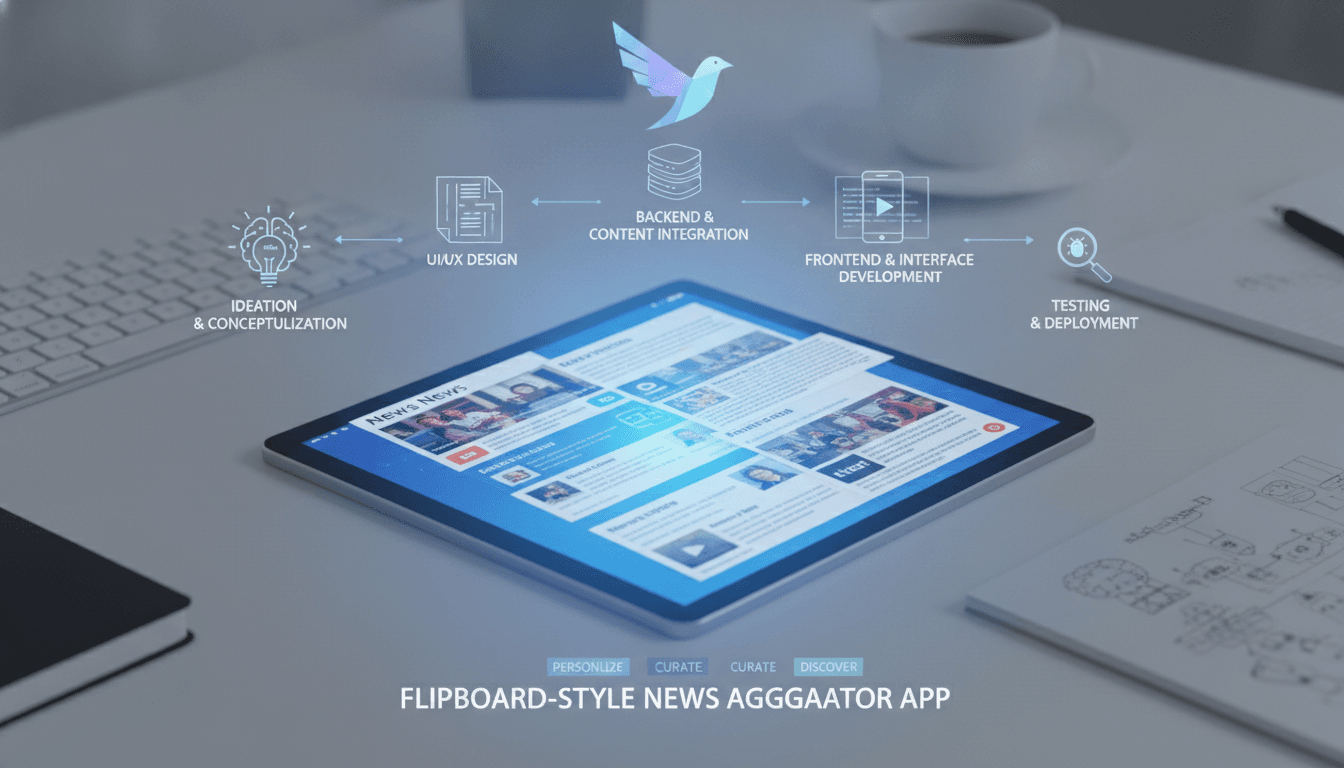
Building a content aggregation app like Flipboard is more involved than it looks. The feed is the easy part. The hard parts are personalisation at scale, content licensing, and keeping the reading experience fast when you're pulling from hundreds of sources simultaneously.
This post walks through the architecture, the product decisions, and the traps that catch teams who underestimate the problem.
What Does Flipboard Actually Do Under the Hood?
Flipboard is a content aggregation and curation platform. At its core, it does four things: crawls and ingests content from RSS feeds, publisher APIs, and social sources; parses and normalises that content into a common schema; ranks and personalises the feed per user; and renders it in a magazine-style layout.
Each of those steps has non-trivial engineering behind it.
The ingestion layer needs to handle tens of thousands of sources with wildly inconsistent data quality. RSS is the backbone, but many publishers have moved to Atom, JSON Feed, or custom APIs. Some block scrapers. Some throttle aggressively. Your crawler needs retry logic, rate limiting per domain, and a dead-letter queue for sources that go silent.
The normalisation step is where most teams lose time. A Guardian article, a Medium post, and a Reddit thread all have different metadata structures. You need a unified content schema that captures title, author, canonical URL, published timestamp, lead image, body text, and topic tags, without losing fidelity for downstream ranking.
How Does Personalisation Work at This Scale?
Flipboard's personalisation is driven by implicit signals: what you read, how long you stay, what you share, what you skip. Explicit signals like magazine subscriptions matter too, but the implicit ones do the heavy lifting.
The practical architecture for this is a two-stage retrieval and ranking pipeline.
Stage 1: Candidate retrieval. Pull a candidate set of articles from your content store. This is typically done with a combination of collaborative filtering (users with similar behaviour see similar content) and content-based filtering (topic tags, publisher affinity). For a new app, Approximate Nearest Neighbour search using a library like FAISS or Weaviate works well. You embed each article into a vector space and retrieve the top-k candidates per user.
Stage 2: Ranking. Score the candidate set using a model that factors in recency, engagement probability, and diversity. XGBoost or LightGBM are standard choices here before you have enough data for a neural ranker. The diversity constraint matters more than most teams expect: a feed full of the same story from ten sources is a fast way to lose users.
Cold start is a genuine problem. For new users you have no implicit signal. The usual approach is to use onboarding topic selection (Flipboard asks you to pick interests) to seed a rule-based feed, then transition to the ML pipeline once you have 50 to 100 interaction events. That threshold is a rough industry figure; your own data will tell you where the model starts beating the rules.
/// Not sure where to start?
Get the architecture before you commit
Tell us what you're building and we'll map the technical approach, stack, and rough timeline. No cost, no obligation, no sales call required.
The Content Licensing Problem Nobody Talks About Upfront
Aggregation apps operate in legally grey territory in several jurisdictions. Displaying full article text without a publisher agreement is a copyright risk. Flipboard navigated this partly through publisher partnerships and partly by displaying excerpts with click-throughs to the original source.
Your choices are:
- Excerpt-only model: Show title, lead image, and the first 200 to 300 characters. Low legal risk, but lower time-on-app.
- In-app browser / WebView: Render the publisher's page inside your app. The content stays on their server; you just frame it. Some publishers block this via X-Frame-Options headers.
- Full-text syndication agreements: Negotiate directly with publishers. This is how the big players operate. It requires a business development function, not just an engineering one.
- Publisher-permissioned RSS: Some publishers explicitly grant full-text RSS. Parse the Creative Commons or rights metadata in the feed and honour it.
Most startups start with the excerpt model and upgrade to partnerships as they grow. If you're targeting a specific vertical (finance, health, tech), direct publisher relationships are achievable early and worth pursuing.
Rendering: The Magazine Layout Is Harder Than It Looks
Flipboard's signature is the tiled, magazine-style layout. On mobile this is a grid of cards that vary in size based on content type and visual weight. Getting this right requires a layout engine that makes decisions per card, not just per screen.
On iOS, UICollectionView with a custom UICollectionViewLayout subclass gives you the control you need. On Android, RecyclerView with a StaggeredGridLayoutManager is the starting point, though you'll likely need a custom LayoutManager for true editorial flexibility.
On the web, CSS Grid with auto-placement handles most cases. For more complex editorial grids, a JavaScript masonry library like Masonry.js or the native CSS grid-template-areas approach works, but be careful with reflow cost on large feeds.
Image handling is critical. Lead images need to be resized, compressed, and served from a CDN. Use a pipeline like ImageMagick or Sharp (Node.js) behind a CDN edge like Cloudflare. Lazy loading and progressive JPEG encoding matter on slow connections.
Performance targets to aim for: Time to Interactive under 3 seconds on a mid-range Android device on a 4G connection. First Contentful Paint under 1.5 seconds. If your feed misses these on first load, expect high bounce rates.
What Tech Stack Should You Build On?
There is no single right answer, but here is a realistic stack for a team of 4 to 8 engineers building a Flipboard-style app from scratch.
| Layer | Technology | Notes |
|---|---|---|
| Mobile (cross-platform) | Flutter | Single codebase, good rendering performance |
| Mobile (native, if budget allows) | Swift (iOS) + Kotlin (Android) | Better layout control for complex UIs |
| Backend API | Node.js (Fastify) or Go | High throughput, low latency |
| Content ingestion | Python (Scrapy, Feedparser) | Mature RSS/Atom parsing ecosystem |
| Content storage | PostgreSQL + Elasticsearch | Relational for metadata, search for discovery |
| Vector search | Weaviate or Qdrant | For personalisation candidate retrieval |
| Message queue | Apache Kafka | Decouples ingestion from ranking |
| CDN & image processing | Cloudflare + Sharp | Edge delivery, on-the-fly image resizing |
| Analytics | ClickHouse | Fast OLAP queries on event data |
Flutter is worth considering seriously for the initial build. The rendering engine (Impeller from Flutter 3.10 onwards) gives you consistent frame rates across platforms, which matters for the scroll experience.
Realistic Build Timeline and Cost
A minimum viable Flipboard-like app, meaning RSS ingestion, basic personalisation, mobile apps for iOS and Android, and a CMS for editorial curation, takes 4 to 6 months with a team of 5 to 6 engineers. That includes a backend engineer, a data/ML engineer, two mobile engineers, a frontend engineer, and a product lead.
Trying to do this in 2 to 3 months with fewer people results in a feed that works but personalisation that doesn't, which is the core product value you're trying to deliver.
The ML personalisation layer alone, done properly with offline evaluation, A/B testing infrastructure, and monitoring, adds 6 to 8 weeks to the timeline. Teams regularly underestimate this because they treat it as a feature rather than a system.
If you're resource-constrained, use Algolia Recommend or a managed recommendation API in the short term. The quality ceiling is lower, but the time-to-market trade-off is real.
Conclusion
The technical complexity in a Flipboard-style app concentrates in three places: content ingestion reliability, personalisation pipeline quality, and layout rendering performance. Get those three right and the rest is standard mobile product engineering.
The clearest next step is to define your content vertical before you write a line of code. A general news aggregator competes directly with Flipboard and Apple News. A vertical aggregator, say fintech or climate, has a defensible niche, more tractable publisher relationships, and a user base with higher intent. That decision shapes every architectural choice downstream.
If you want to talk through the architecture for your specific use case, the engineering team at Sodio is reachable via the contact page.
FAQ
How long does it take to build an app like Flipboard? A functional MVP with RSS ingestion, basic personalisation, and native mobile apps takes 4 to 6 months with a team of 5 to 6 engineers. Adding a mature ML ranking pipeline and editorial CMS extends that to 8 to 10 months. Cutting corners on personalisation is possible but undermines the core product value.
How does Flipboard personalise content without user logins? Flipboard uses device-level identifiers and session behaviour to build implicit interest profiles. Topic selections made during onboarding seed an initial rule-based feed. Implicit signals like dwell time and tap patterns gradually shift control to a machine learning ranker as interaction data accumulates.
What is the best tech stack for a content aggregation app? Python (Scrapy, Feedparser) for ingestion, Kafka for the event pipeline, Elasticsearch for content discovery, and a vector database like Weaviate for personalisation retrieval are a solid foundation. Flutter covers mobile if you want a single codebase. The stack matters less than getting the data pipeline architecture right from the start.
How do you handle copyright when aggregating third-party content? The safest approach is excerpt-plus-click-through: display the title, lead image, and a short text snippet, then link to the original source. Full-text display requires either a publisher agreement or content that is explicitly licensed for redistribution. Ignoring this is a legal risk that scales with your traffic.
Can you build a Flipboard-style app with a small team? Yes, but scope accordingly. A team of 3 to 4 engineers can ship a focused vertical aggregator with RSS ingestion and rule-based curation in 3 to 4 months. ML personalisation requires dedicated data engineering capacity. Trying to build the full Flipboard feature set with fewer than 5 engineers leads to a product that is wide but shallow.
Have a project in mind? Contact Sodio Technologies to discuss your requirements and explore the right technology solution for your business.
/// Work with us
Talk to the engineers who'd build it
You'll get a technical scope, timeline and cost estimate from the people doing the work, not an account manager. In-house team, no subcontracting, since 2016.