

How to Make an App Like PressReader
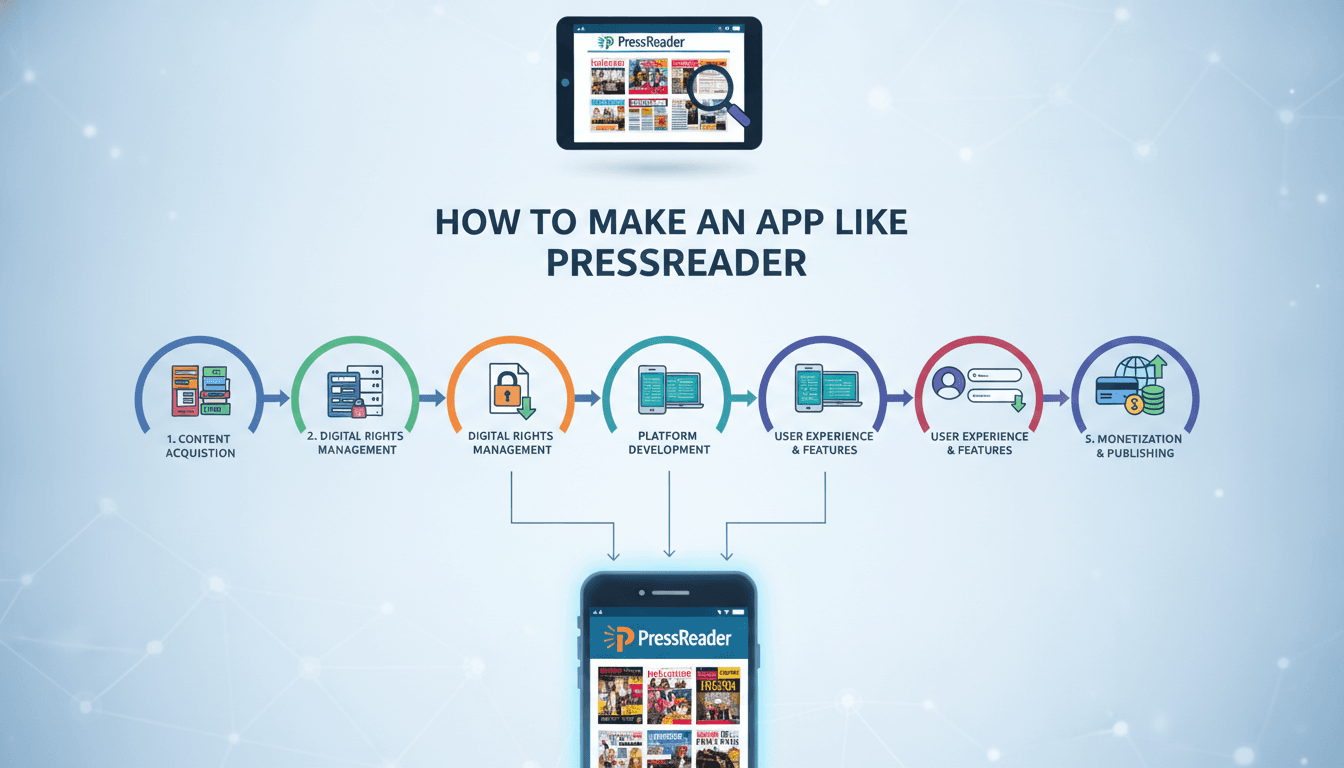
Building a digital newsstand platform is genuinely hard. PressReader serves over 7,000 publications across 60+ languages, handles DRM for major publishing houses, and delivers content offline on mobile. If you want to build something in that category, the architecture decisions you make in the first six months will either let you scale or force a painful rewrite at around 50,000 active users. This post covers what those decisions are and what they actually cost.
What Does a PressReader-Style App Actually Involve?
The surface is simple: users browse, subscribe, and read publications. Underneath that, you are dealing with several distinct technical problems at once.
First, content ingestion. Publications arrive as IDML, PDF, or ePub files, sometimes via FTP, sometimes via publisher APIs. You need a pipeline that normalises these into a format your reader can display. PressReader uses a proprietary HTMl5 format they call HNM. You do not need to clone that, but you do need a canonical internal format.
Second, digital rights management. Every publication has its own licensing terms. Some publishers allow offline reading; others do not. Some restrict geography. You need a DRM layer that enforces these rules without making the read experience feel broken.
Third, content delivery at scale. A Sunday edition of a broadsheet can be 400–600 MB of high-resolution images. You need a CDN strategy, image compression pipelines, and smart prefetching to make that load fast on a 4G connection.
Fourth, search across publications. Full-text search across thousands of issues is a non-trivial indexing problem. Elasticsearch 8.x is the practical choice here; Typesense is faster for smaller corpora but does not handle multilingual content as well.
The Monetisation Layer
This is where most teams underestimate complexity. You will likely need:
- Individual subscriptions with trial periods
- Library or institutional access (where the user authenticates via their library card, not a credit card)
- Publisher white-label options
Each of these has different entitlement logic, different invoice formats, and different churn reporting requirements. Model this early. Trying to retrofit institutional access onto a consumer-only billing model is painful.
What Does It Cost to Build?
Rough numbers, based on standard market rates for a team in India:
| Component | Estimated Dev Time | Notes |
|---|---|---|
| Content ingestion pipeline | 8–12 weeks | Depends on number of publisher formats |
| Reader UI (iOS + Android) | 10–14 weeks | Native preferred; Flutter adds ~20% if cross-platform |
| DRM and entitlement service | 6–8 weeks | Compliance review adds time |
| Search and discovery | 4–6 weeks | Elasticsearch setup, multilingual tuning |
| Subscription and billing | 5–7 weeks | Stripe + webhook handling + dunning logic |
| Admin and publisher portal | 4–6 weeks | Often underscoped |
| Total | 37–53 weeks | With a team of 6–8 engineers |
That puts a full MVP at 9–13 months with a mid-size team. A smaller scope (say, one or two publishers, no offline mode, no institutional access) can reach beta in 5–6 months.
/// Not sure where to start?
Get the architecture before you commit
Tell us what you're building and we'll map the technical approach, stack, and rough timeline. No cost, no obligation, no sales call required.
How Do You Handle Offline Reading Without Breaking DRM?
This is the most technically interesting part of the stack.
The naive approach is to download the full publication as a PDF and display it locally. That breaks DRM because there is no way to revoke access to a file that already lives on the device. Publishers will not accept this.
The correct approach is to encrypt content at rest on the device using a key that is bound to the user's current entitlement. When the user goes offline, the app uses the locally cached key to decrypt content. When the entitlement expires (say, the subscription lapses), the next time the device connects, the key is rotated and the previously downloaded issues become inaccessible.
Adobe's DRM SDK handles this for ePub content. For PDF, you will likely need to implement your own key management using something like AWS KMS. The client stores an encrypted blob; the KMS endpoint issues decryption keys only to authenticated, entitled users. Offline periods can be bounded (PressReader uses 30 days as a standard offline window for most publishers).
The other consideration is storage. Give users controls over what they cache. Automatically downloading every issue in a user's subscription will fill an iPhone in a week. A good default is to cache the current issue only, with an explicit "download for offline" action for anything older.
What's the Right Tech Stack?
There is no single right answer, but here is what works at scale:
Backend: Node.js or Go for the API layer. Go handles concurrency better at high throughput; Node.js is faster to iterate on. PostgreSQL for relational data (subscriptions, entitlements, user accounts). Redis for session management and rate limiting. Elasticsearch 8.x for search.
Mobile: Native Swift (iOS) and Kotlin (Android) give you the best PDF rendering performance and access to platform-level DRM APIs. Flutter is viable if you need to move faster and are willing to accept slightly worse rendering fidelity. React Native is not a good fit here because high-performance document rendering is one of its weakest areas.
Content delivery: CloudFront or Fastly in front of S3 or GCS. Use signed URLs with short expiry windows (5–15 minutes) to prevent content sharing. For images, run a WebP conversion pipeline (sharp for Node.js works well) and serve different resolutions based on device screen density.
Reader engine: Building a custom PDF/ePub reader is expensive and rarely worth it. PDF.js (for web), PSPDFKit (for iOS/Android), or Foxit SDK are all production-grade options. PSPDFKit licences start at around $12,000 per year for mobile, which is painful early but saves 3–4 months of engineering time.
Publisher Onboarding
This is the operational challenge nobody talks about. Publishers have wildly different technical capabilities. Some will send you a perfectly formed ePub. Others will FTP you a zip of TIFFs with a metadata spreadsheet.
Build your ingestion pipeline to be format-agnostic from day one. A queue-based architecture (SQS or RabbitMQ) with separate workers for each format type lets you add new publisher integrations without touching the core pipeline. Budget 2–3 weeks per new publisher format if it is significantly different from what you already handle.
Should You Build In-House or Outsource?
If your core business is publishing or media, the reader and content pipeline are not your competitive advantage. The editorial content is. Outsourcing the platform build to a team that has done it before is usually faster and cheaper than staffing up internally.
If you are building a platform business where the technology itself is the product (say, a white-label newsstand SaaS), you will eventually need to own the engineering. Start with an external team, but plan for a handover at the 18–24 month mark.
The one thing you should not outsource is the publisher relationships. Those take years to build and are not something a development partner can do for you.
Conclusion
A PressReader-style platform is a 9–13 month build for a full-featured product. The hard parts are DRM, offline access, and content ingestion, not the reader UI. If you are evaluating this, start by defining your publisher list and their format requirements. That scoping exercise alone will tell you whether you are looking at a 6-month project or a 2-year one.
If you want a technical scoping call with engineers who have built content delivery and DRM systems, reach out to Sodio. We can give you a realistic breakdown within a week.
FAQ
How long does it take to build a PressReader-style app? A full-featured platform with DRM, offline reading, multi-format ingestion, and subscription billing typically takes 9–13 months with a team of 6–8 engineers. A reduced scope targeting one or two publishers, no offline mode, and a single subscription tier can reach beta in 5–6 months.
What is the most expensive part of the build? Content ingestion and DRM are the most time-consuming components. Reader SDKs like PSPDFKit cost around $12,000 per year but save significant engineering time. The hidden cost most teams miss is publisher onboarding, which takes 2–3 weeks per non-standard format.
Can you use Flutter to build a digital newsstand app? Yes, but with caveats. Flutter is viable for cross-platform development and reduces overall build time by roughly 20% compared to separate native codebases. The trade-off is rendering fidelity for complex PDF layouts. For publications with dense typographic layouts, native Swift and Kotlin deliver noticeably better results.
How does offline DRM actually work? Content is encrypted on-device using a key issued by a key management service (such as AWS KMS). The app decrypts content locally during offline periods. When the device reconnects, the entitlement service checks the user's subscription status and rotates or revokes keys accordingly. Offline windows are typically capped at 30 days.
Do you need to build a custom PDF reader? No. Production-grade SDKs like PSPDFKit, Foxit, and PDF.js handle the hard parts of document rendering. Building a custom reader from scratch adds 3–4 months of engineering time and introduces maintenance burden. Use an SDK unless you have a very specific rendering requirement that existing tools cannot meet.
Have a project in mind? Contact Sodio Technologies to discuss your requirements and explore the right technology solution for your business.
/// Work with us
Talk to the engineers who'd build it
You'll get a technical scope, timeline and cost estimate from the people doing the work, not an account manager. In-house team, no subcontracting, since 2016.