

How to Make an App Like Goodbudget
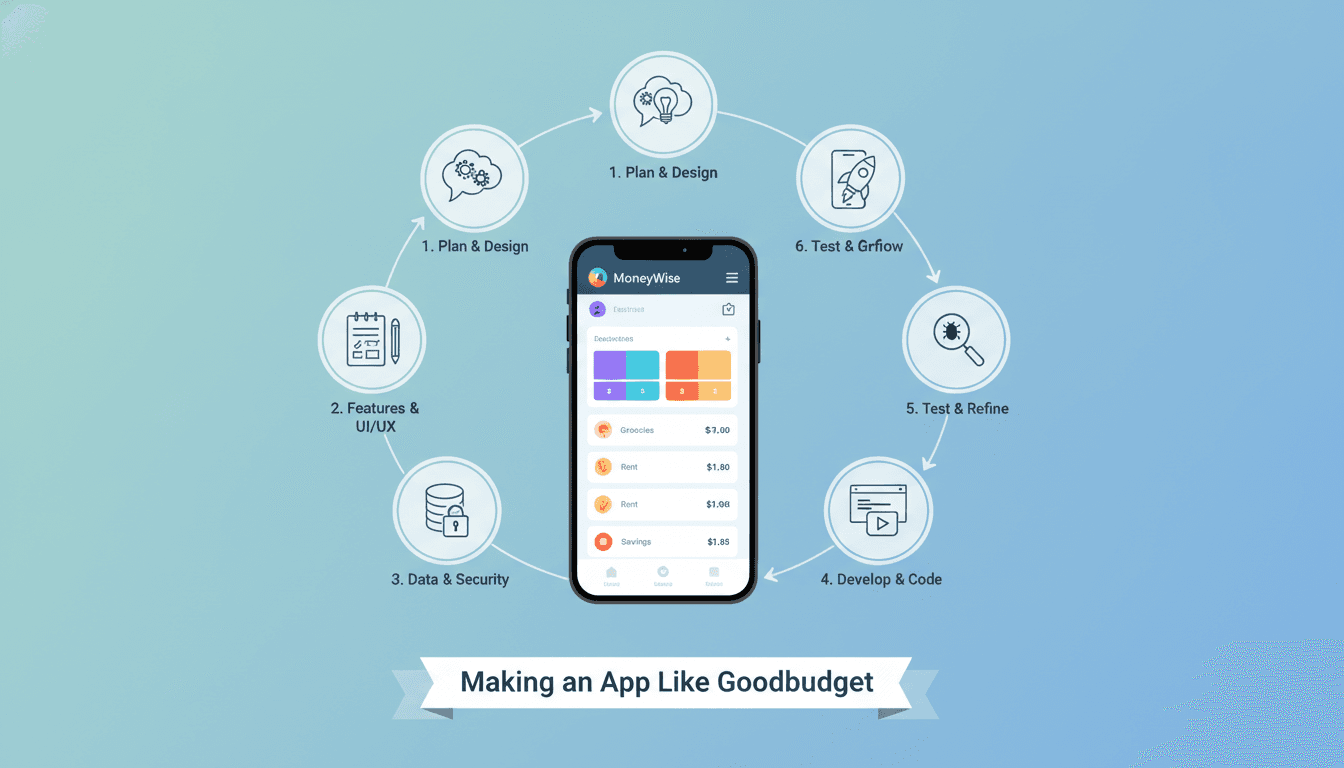
A practical breakdown of what it takes to build an envelope-based personal finance app — architecture, data handling, sync, and the decisions that trip up most teams.
What Makes Goodbudget Different From Other Finance Apps
Most budgeting apps connect directly to a bank account and categorise transactions automatically. Goodbudget does not. It uses the envelope method: you allocate money into named spending categories at the start of each period, then manually record transactions against those envelopes. The balance tracks what you have left to spend, not what you have already spent.
Related reading: How to Make an App Like Fudget.
This distinction matters because it changes the entire system design. You are not building a bank aggregator. You are building a shared ledger with manual entry, multi-device sync, and period-based budget logic. The complexity sits in different places than you might expect.
What Does the Core Data Model Actually Look Like?
The envelope system maps to a relatively small set of entities, but the relationships between them require care.
At the top level you have an Account (a user or household). Under that you have Envelopes, each with a name, an allocated amount per period, and a running balance. Transactions debit a specific envelope (or split across multiple). A Fill event adds money to envelopes, typically at the start of a pay cycle.
We cover a closely related subject in How to Make an App Like Expensify.
| Entity | Key fields | Notes |
|---|---|---|
| Account | id, name, currency, timezone | One per household |
| Envelope | id, account_id, name, period_budget, balance | Balance is derived but cached |
| Transaction | id, envelope_id, amount, date, payee, memo | Supports splits via line items |
| Fill | id, account_id, date, line_items[] | Distributes income across envelopes |
| FillLineItem | fill_id, envelope_id, amount | N-to-1 with Fill |
The balance on an envelope is technically derivable from fills minus transactions, but you will almost certainly cache it and update it transactionally. Recomputing from scratch on every read does not scale once a user has three years of history.
Keep your currency handling clean from day one. Store amounts as integers in the smallest denomination (pence, cents). Never store floats. Rounding errors in financial software compound.
Handling Splits
A single transaction at a supermarket might span three envelopes: groceries, household, and personal care. You need a TransactionLineItem table that links a transaction to multiple envelopes with individual amounts. The parent transaction holds the total, the line items hold the allocation. Enforce that line item amounts sum to the parent total at the database constraint level, not just in application code.
If this is relevant to your project, check out How to Make an App Like YNAB (You Need A Budget).
Multi-Device Sync Is Where This Gets Hard
Goodbudget explicitly supports shared budgeting across two devices on the free tier and unlimited on paid. This is the hardest engineering problem in the product.
You have several realistic options:
- Last-write-wins with timestamps: Simple, but silently loses data when two people enter transactions offline simultaneously.
- CRDTs (Conflict-free Replicated Data Types): Correct for counters and sets, but envelope balances are not simple counters. A debit from device A and a debit from device B hitting the same envelope concurrently must both be applied, and the balance must reflect both. A grow-only counter CRDT works for debits, but you need to model credits and debits separately.
- Operational log with server reconciliation: Each client sends operations (not state), the server applies them in order, and clients pull the authoritative log. This is the pattern Goodbudget almost certainly uses. It gives you a full audit trail, makes conflict resolution deterministic, and lets you replay history.
The operational log approach means your API is not a CRUD API. Clients do not PUT /envelopes/123 with a new balance. They POST /operations with { type: "TRANSACTION_CREATED", envelope_id: 123, amount: -1500, ... }. The server applies the operation, updates balances atomically, and appends to the log. Clients sync by fetching operations since their last known sequence number.
This model also makes undo straightforward: you append a compensating operation rather than mutating existing records.
/// Not sure where to start?
Get the architecture before you commit
Tell us what you're building and we'll map the technical approach, stack, and rough timeline. No cost, no obligation, no sales call required.
Choosing Your Tech Stack
There is no single correct answer here, but some choices close doors faster than others.
For the backend, PostgreSQL is the right database. You need ACID transactions (updating envelope balance and inserting transaction atomically), you need good support for SERIAL or BIGINT sequence numbers on your operations log, and you might eventually want row-level security if you go multi-tenant at the database layer. SQLite is fine for a local-first prototype but adds complexity when you introduce server sync.
For the API layer, REST is simpler to implement and easier for mobile clients to consume. GraphQL adds marginal value here because your query patterns are predictable. If you are using Node.js, Fastify with Zod for schema validation is a clean choice. If you prefer Python, FastAPI with Pydantic works well. For mobile, React Native covers both platforms with one codebase. Goodbudget itself ships separate native apps, but that doubles your maintenance surface.
A few concrete decisions and their trade-offs:
| Decision | Option A | Option B | Trade-off |
|---|---|---|---|
| Mobile | React Native | Native (Swift/Kotlin) | RN ships faster; native gives smoother animations and better offline storage APIs |
| Auth | Firebase Auth | Custom JWT + refresh | Firebase is fast to ship; custom gives you full control over session lifecycle |
| Sync | REST polling | WebSocket push | Polling is simpler; WebSockets matter only if you need real-time co-budgeting |
| Background sync | Expo TaskManager | Native background fetch | Expo is easier; native is more reliable on iOS |
On notifications: recurring envelope fills and budget alerts are table stakes. Use a job queue (BullMQ on Redis, or Sidekiq if you are on Ruby) rather than cron jobs. Cron does not handle missed runs gracefully.
Monetisation and What It Changes About Your Architecture
Goodbudget's free tier allows one account with two devices and limited envelope history. Paid unlocks unlimited devices, unlimited history, and additional envelope slots.
If you are building a similar model, your entitlement system needs to be a first-class concept, not an afterthought. Every data access query that touches envelopes, transactions, or device registrations needs to check entitlements. Embedding this in middleware is cleaner than spreading it across route handlers.
Stripe is the standard choice for subscription billing. Use Stripe's webhook system to keep your internal subscription_status field in sync. Do not trust the client to report its own subscription state.
If you go with an annual plan, you also need a grace period model: what happens to data when a subscription lapses? Goodbudget continues to show read-only data. That is the right call. Deleting data on lapse is a support and trust problem.
Conclusion
Building an app like Goodbudget is a well-scoped problem with a few genuinely tricky parts: the operational sync model, correct multi-envelope transaction splitting, and entitlement enforcement across a tiered product. If you get those three right, the rest is standard mobile product engineering.
If you are at the stage of deciding whether to build this in-house or bring in a team that has done it before, the sync architecture is the part worth talking through first. It is the decision that is hardest to reverse.
FAQ
How long does it take to build a Goodbudget-style app? A functional MVP with core envelope budgeting, manual transaction entry, and basic sync across two devices takes roughly 12 to 16 weeks with a team of three (one backend, one mobile, one product/design). Adding shared household budgeting, recurring transactions, and a subscription tier adds another 8 to 10 weeks.
Do I need to connect to Open Banking or Plaid? No, and for this category of app you probably should not. The envelope method works because users engage actively with their spending. Auto-import of bank transactions removes the friction that makes the habit stick. You can offer it as an optional import tool, but it should not be the primary flow.
What database should I use for the transaction history?
PostgreSQL. Store amounts as integers in the smallest currency unit, never as floats. Use a NUMERIC(19,0) column if you want extra safety. Keep a separate operations log table with an append-only constraint enforced at the application layer; this gives you audit history and sync without extra infrastructure.
How do I handle currency for international users? Store all amounts in a single base currency per account, chosen at account creation. Display conversion is a UI concern only. Do not store multi-currency transaction pairs in your core ledger unless you are explicitly building a multi-currency feature, which adds significant complexity to balance calculations.
What is the biggest mistake teams make building this type of app? Treating the envelope balance as the source of truth rather than a cached derived value. If you update the balance field without atomically recording the transaction that caused the change, you will eventually have phantom balances that do not match the transaction history. Always write the transaction first, update the balance in the same database transaction.
Have a project in mind? Contact Sodio Technologies to discuss your requirements and explore the right technology solution for your business.
/// Work with us
Talk to the engineers who'd build it
You'll get a technical scope, timeline and cost estimate from the people doing the work, not an account manager. In-house team, no subcontracting, since 2016.