

How to Make an App Like Fudget
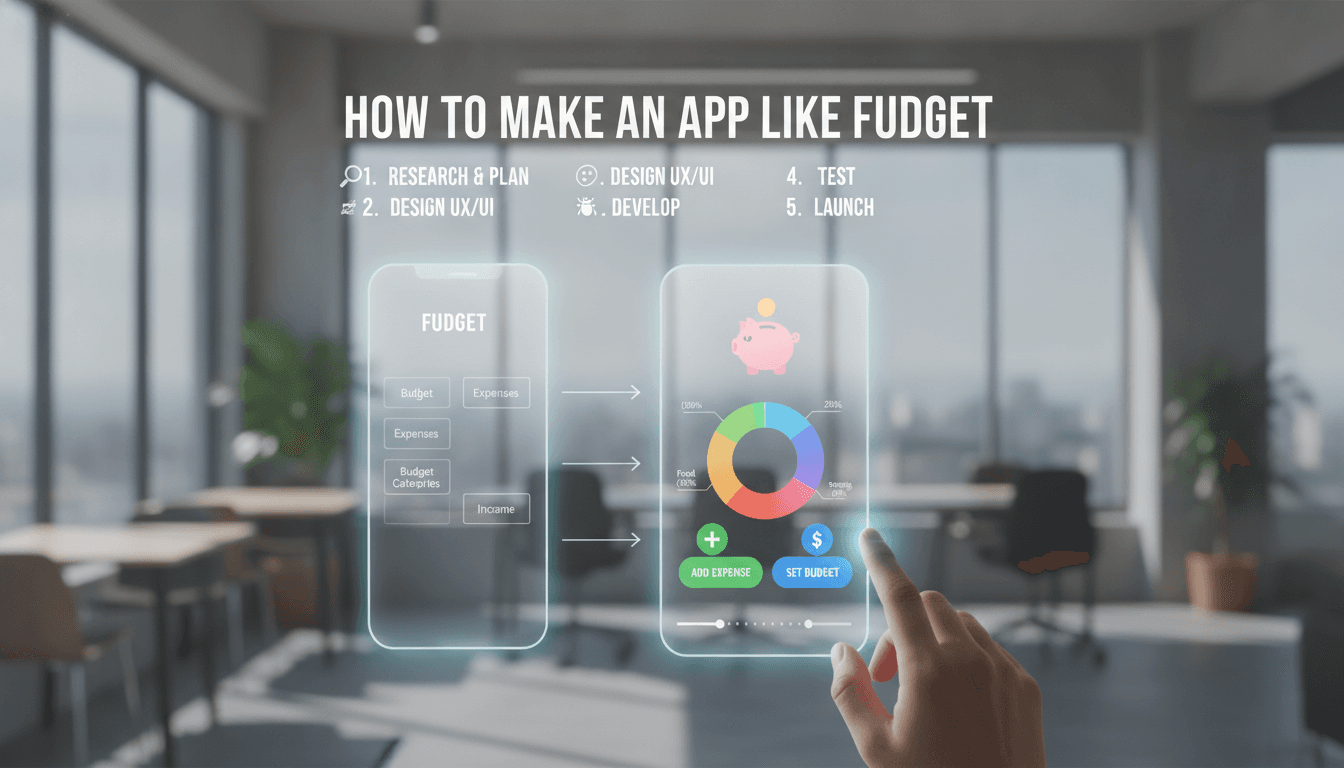
A practical breakdown of what it takes to build a personal budgeting app with the simplicity and focus of Fudget — covering architecture, feature decisions, monetisation, and the trade-offs you'll face along the way.
What Makes Fudget Worth Studying?
Fudget is not a full-featured finance app. That is the point. It strips personal budgeting down to a single list of income and expenses with a running balance. No bank syncing, no graphs, no AI insights. Just numbers.
You may also find our article on How to Make an App Like Money Lover useful.
That constraint is a product decision, not a technical limitation. It is what makes Fudget fast to open and fast to use. If you are building something similar, the first question is whether you are building the same thing or something that starts there and grows. The answer changes almost every architectural choice downstream.
What Does It Actually Take to Build the Core?
The core of a Fudget-style app is a budget ledger. Each budget has a list of entries. Each entry has a label, an amount, a sign (income or expense), and an optional date. The running balance is computed from those entries in order.
Related reading: How to Make an App Like YNAB (You Need A Budget).
Data Model
A minimal schema looks like this:
| Field | Type | Notes |
|---|---|---|
| budget_id | UUID | Parent budget |
| entry_id | UUID | Primary key |
| label | String (255) | User-facing description |
| amount | Decimal (19,4) | Never store money as a float |
| type | Enum: income / expense | |
| created_at | Timestamp | For ordering |
| position | Integer | For manual reordering |
Use Decimal(19,4) or an integer of the smallest currency unit (pence, cents). Floating-point arithmetic on money is a well-documented source of rounding errors that compound across a ledger.
Recurrence
Fudget Pro adds recurring entries. This is where the complexity starts. You need a recurrence engine that can expand a rule (daily, weekly, monthly, custom) into concrete entries across a date range. The iCalendar RFC 5545 RRULE spec is the standard reference here. Libraries like rrule.js on the frontend or python-recurrent on the backend handle most of it, but edge cases around month-end dates (does "monthly on the 31st" fire in February?) require explicit product decisions.
Store the rule, not the expanded entries. Materialise them at query time or on a scheduled job for notification purposes. Storing expanded entries for years ahead creates unnecessary data and makes rule edits painful.
Sync and Offline
Fudget is primarily local-first. Data lives on device. Fudget Pro adds iCloud sync on iOS. If you are building cross-platform (iOS, Android, web), iCloud is not an option for Android users. You will need your own sync layer.
The cleanest approach for a small app like this is a conflict-free replicated data type (CRDT) strategy for the ledger entries, or a simpler last-write-wins model with a updated_at timestamp and a conflict resolution policy your users can understand. Full CRDT implementations (Automerge, Yjs) are well-maintained but add complexity. For a budget ledger where conflicts are rare (most users open the app on one device at a time), last-write-wins is usually sufficient.
For a closer look at a related topic, read our guide on How to Make an App Like Goodbudget.
Backend: a lightweight REST or GraphQL API in front of PostgreSQL works fine. If you are going mobile-first, Firebase Firestore gives you offline support and real-time sync with less infrastructure to manage, at the cost of vendor lock-in and less control over query patterns.
How Should You Handle Monetisation?
Fudget uses a freemium model. The free tier is the core app. Fudget Pro (approximately $3.99/month or $23.99/year as of 2024 pricing) unlocks recurring entries, budget templates, and a few UI extras.
If you are replicating this model, you have two implementation paths:
In-app purchase (IAP): Apple StoreKit 2 and Google Play Billing Library 6 handle the purchase flow. Both now require server-side receipt validation. Apple takes 15% for developers earning under $1M/year and 30% above that. Google matches that structure. RevenueCat is a third-party service that abstracts both stores into a single API and handles entitlement management. It costs a percentage of revenue (1% after $2.5K monthly revenue as of current pricing) but saves significant integration time.
Web-based subscription: If you want to avoid store fees, you can offer a subscription via your own website using Stripe and then unlock features by checking subscription status via your own backend. Apple explicitly prohibits directing users to purchase outside the app on iOS (App Store Review Guideline 3.1.1). Android is less restrictive here. This is a legitimate architecture for an Android-first or web app.
/// Not sure where to start?
Get the architecture before you commit
Tell us what you're building and we'll map the technical approach, stack, and rough timeline. No cost, no obligation, no sales call required.
What Are the Real Technical Trade-offs?
Being honest about trade-offs is more useful than listing features.
Local-first vs. server-first: A local-first app (SQLite on device, optional sync) is faster and works offline by default. It is also harder to support. Debugging a sync conflict a user cannot reproduce is genuinely painful. A server-first app (API + local cache) is easier to debug but slower on poor connections and requires authentication from day one.
React Native vs. Flutter vs. native: For a data-entry-heavy app with modest UI complexity, all three are viable. React Native has a larger hiring pool and good SQLite support via react-native-quick-sqlite. Flutter gives you more consistent UI across platforms and better performance on low-end Android devices. Native (Swift + Kotlin) gives you the best access to platform features like StoreKit 2 and WidgetKit (for home screen budget widgets), but doubles your codebase.
No bank sync as a feature: Plaid, TrueLayer, and similar open banking APIs add significant compliance overhead (especially under PSD2 in the EU and similar frameworks elsewhere). Fudget's choice to avoid this entirely is not a limitation, it is a scoping decision that keeps the app out of regulated territory. If you add bank sync, expect to spend time on OAuth flows, webhook handling for transaction updates, and data retention policies.
What Does the Development Timeline Actually Look Like?
A realistic breakdown for a cross-platform MVP (iOS + Android, core budgeting, no sync):
| Phase | Scope | Estimated Time |
|---|---|---|
| Product definition | Flows, edge cases, monetisation model | 2 weeks |
| Core app (local) | Budget CRUD, entry CRUD, balance computation | 4 weeks |
| IAP integration | RevenueCat + StoreKit 2 + Play Billing | 2 weeks |
| Recurring entries | RRULE engine, UI | 3 weeks |
| Sync layer | Backend API, conflict resolution | 4 weeks |
| QA and submission | Testing, App Store and Play Store review | 2 weeks |
That is roughly 17 weeks for a solid v1. Budget sync adds 4 to 6 weeks on top, minimum, before compliance review.
Conclusion
A Fudget-style app is deceptively simple to describe and moderately complex to build correctly. The interesting decisions are not in the UI. They are in how you handle money precision, recurring rule expansion, sync conflicts, and monetisation architecture.
If you are planning a v1, start local-first with no sync. Add sync in v2 once you know how users actually interact with the app. Get the decimal handling right from day one; retrofitting it is painful.
If you want to talk through architecture decisions or get a realistic scope estimate for your specific feature set, the team at Sodio has built this kind of app before and can give you a straight answer.
FAQ
How long does it take to build an app like Fudget? A cross-platform MVP covering core budgeting and in-app purchase integration takes roughly 11 to 13 weeks with a focused team. Adding sync, recurring entries, and a backend API brings that to around 17 weeks. Bank sync via Plaid or open banking APIs adds significant time on top due to OAuth, webhook handling, and compliance considerations.
What technology stack should I use?
React Native with react-native-quick-sqlite is a practical choice for a cross-platform budgeting app with local-first storage. Flutter is a strong alternative if you want consistent UI performance on low-end Android devices. RevenueCat handles IAP across both platforms without duplicating store-specific integration code.
How do I handle money calculations correctly in an app?
Store all monetary values as integers in the smallest currency unit (pence, cents) or as Decimal(19,4) in your database. Never use JavaScript's Number type or a SQL FLOAT for currency. Rounding errors accumulate across ledger entries and become visible to users at three or four decimal places.
Do I need a backend for a budgeting app? Not for a basic local-first app. SQLite on device is sufficient for single-device use. You need a backend if you want cross-device sync, web access, push notifications for recurring entries, or server-side IAP receipt validation. The backend adds infrastructure cost and maintenance, so defer it until you have a clear reason.
What is the cost to build a Fudget-style app? Costs vary by team and region. At typical senior developer rates, a 17-week project with a two-person team (one mobile, one backend) runs between $50,000 and $90,000. Using a development partner in a lower-cost market can reduce that, but the scoping and architecture decisions are the same regardless of where the code is written.
Have a project in mind? Contact Sodio Technologies to discuss your requirements and explore the right technology solution for your business.
/// Work with us
Talk to the engineers who'd build it
You'll get a technical scope, timeline and cost estimate from the people doing the work, not an account manager. In-house team, no subcontracting, since 2016.