

How to Make an App Like Kayak
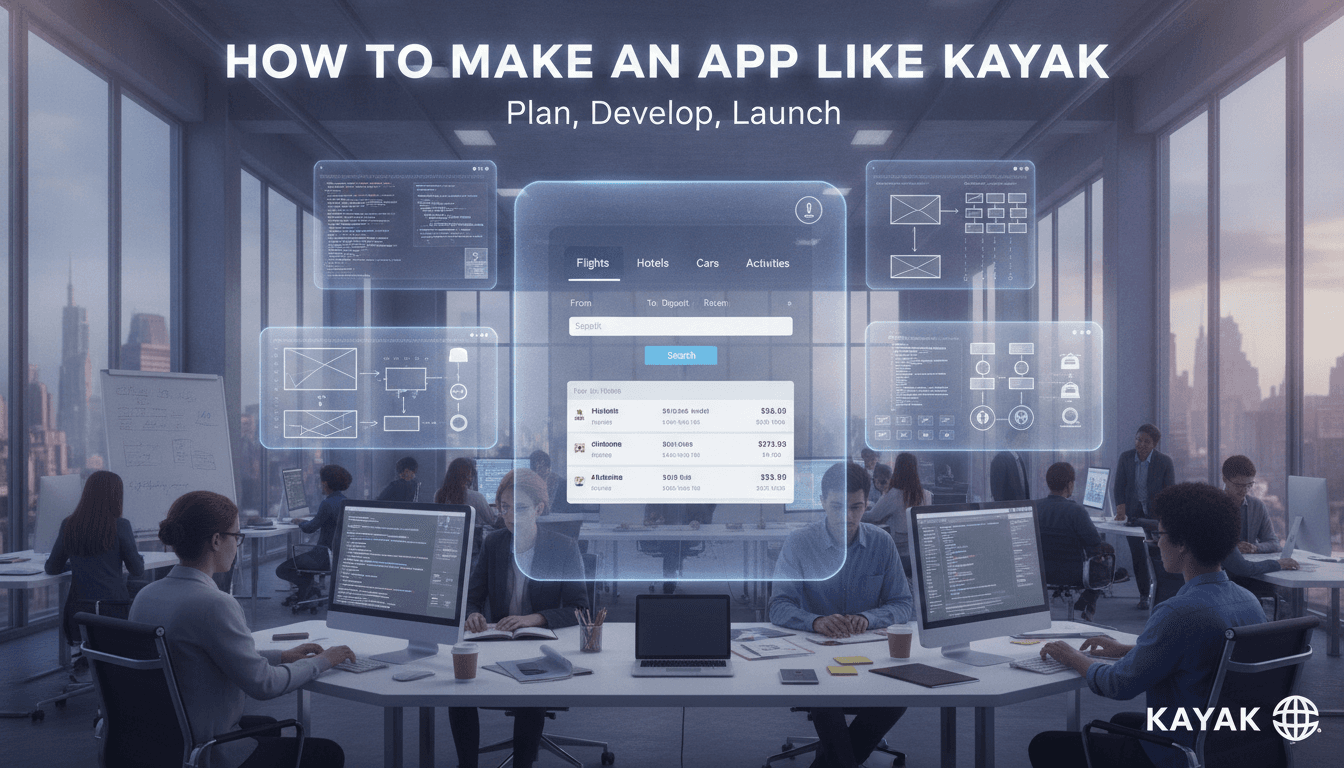
Building a travel aggregator like Kayak means stitching together live inventory from dozens of suppliers, running price comparison at scale, and delivering results fast enough that users don't abandon the page. This post walks through the architecture, the hard problems, and the choices that will define your build.
What Does Kayak Actually Do Under the Hood?
Most people think of Kayak as a search engine for flights. It's more accurate to call it a real-time data aggregation and normalisation layer sitting on top of hundreds of travel APIs.
When a user searches for a flight, Kayak fans out requests to GDSs (Global Distribution Systems) like Amadeus, Sabre, and Travelport, alongside direct airline NDC feeds and OTA partners. Responses come back in different schemas, at different speeds, with different pricing logic. The engine normalises all of that, deduplicates, ranks, and serves results, typically within 3–5 seconds.
Hotels follow a similar pattern using APIs from Expedia Rapid, Booking.com Affiliate, HotelBeds, and direct chain feeds. Car hire aggregation goes through suppliers like CarTrawler or individual rental company APIs.
The data volume is significant. Kayak processes roughly 2 billion travel queries per year. Your MVP won't start there, but your architecture needs to accommodate that trajectory if you're building something meant to scale.
How Should You Structure the Core Architecture?
The fetch, normalise, and serve pipeline is the heart of the system. Get this wrong and nothing else matters.
Search Fanout and Aggregation
You want an async fanout pattern. A user query hits your search service, which publishes a job to a message queue (Kafka works well here). Per-supplier workers pick up the job, call the relevant API, and push results back. The search service aggregates responses as they arrive and streams partial results to the frontend. This is why Kayak shows you results loading progressively rather than making you wait for all suppliers to respond.
The practical timeout question: if a supplier hasn't responded in 4 seconds, you drop them from this result set and optionally retry in the background. Setting this threshold too high kills your UX. Too low and you consistently miss suppliers with good inventory.
Data Normalisation
Every supplier returns data differently. IATA codes are consistent enough, but cabin classes, fare conditions, baggage allowances, and ancillary fees are not. You need a normalisation layer that maps each supplier's schema to your internal canonical model.
This is where most teams underestimate the effort. Budget at least 2–3 weeks per major GDS integration just for normalisation, not counting authentication and connectivity.
Caching Strategy
Not all searches are equal. A search for "London to New York, next month, flexible dates" is common enough to cache aggressively. A search for a specific routing on a specific day with 3 passengers in business class is not. Use a tiered cache: Redis for hot searches with a TTL of 60–120 seconds, a warm cache backed by something like DynamoDB for longer-tail queries, and always re-fetch for anything price-sensitive at the point of booking handoff.
Stale prices are a serious liability. If a user clicks through to book and the price has changed, trust drops immediately and is hard to recover.
/// Not sure where to start?
Get the architecture before you commit
Tell us what you're building and we'll map the technical approach, stack, and rough timeline. No cost, no obligation, no sales call required.
What Does the Tech Stack Actually Look Like?
There's no single right answer, but here's a stack that's proven at this kind of workload.
| Layer | Technology Choice | Why |
|---|---|---|
| API Gateway | Kong or AWS API Gateway | Rate limiting, auth, routing |
| Search Service | Go or Java (Spring Boot) | Throughput-critical, low GC pressure |
| Message Queue | Kafka | Fan-out, durability, replay |
| Supplier Workers | Node.js or Python | Fast to write, easy to maintain per-supplier |
| Cache | Redis Cluster | Sub-millisecond reads |
| Primary DB | PostgreSQL | Structured booking data, ACID |
| Search Index | Elasticsearch | Faceted filtering on results |
| Frontend | React + Next.js | SSR for SEO, fast hydration |
| Mobile | React Native or Flutter | Code reuse across iOS and Android |
Python is fine for supplier workers but watch your concurrency model. Use asyncio or run multiple worker instances per supplier. A single-threaded blocking implementation will bottleneck under load.
Metasearch vs. OTA: Which Model Are You Building?
This is a product decision that has major engineering implications.
A metasearch model (like Kayak's core) means you redirect users to the supplier to complete the booking. Your monetisation is cost-per-click or cost-per-acquisition. You never handle payment, you never own the booking. This is simpler to build and operate, but your margins are thin and you're completely dependent on supplier relationships.
An OTA model (like Expedia) means you handle the full booking lifecycle. You take payment, issue tickets, manage changes and cancellations. You own the customer relationship and the margin, but you're also on the hook for PCI DSS compliance, IATA accreditation if you're ticketing flights, and a much more complex customer support operation.
Most teams building a Kayak-like product should start with metasearch and move toward OTA selectively, perhaps for hotels or car hire first, where the operational complexity is lower.
Regulatory and Compliance Considerations
GDPR is table stakes if you're serving European users. Travel data is sensitive because it reveals location patterns, travel frequency, and associations. Minimise what you store, encrypt PII at rest, and build deletion workflows from day one.
If you move into the OTA model, PCI DSS compliance becomes mandatory the moment you touch card data. Use a tokenisation provider like Stripe or Adyen and keep raw card data off your infrastructure entirely.
IATA accreditation for flight ticketing requires financial guarantees and operational audits. Most startups should avoid this early and use an accredited consolidator instead.
Conclusion
The hardest part of building a travel aggregator isn't the search interface. It's maintaining reliable supplier integrations, keeping pricing accurate in near real-time, and building the normalisation layer that makes disparate data feel like one coherent product.
Start with two or three supplier integrations, get the architecture right, and expand from there. If you're planning to build this and want to talk through the integration approach or tech stack choices specific to your context, reach out to the team at Sodio.
FAQ
How long does it take to build an MVP travel aggregator? A focused team can ship a functional metasearch MVP in 4–6 months. That covers two or three GDS or OTA API integrations, a basic search UI, and the aggregation pipeline. Full-featured products with multiple verticals, mobile apps, and price alerts typically take 12–18 months to reach a stable v1.
Which GDS should I integrate with first? Amadeus is the most common starting point. Their NDC and REST APIs are well-documented, their sandbox environment is stable, and they have the broadest global airline inventory. Sabre is a strong second choice if your primary market is North America.
How do I handle real-time price accuracy? You can't guarantee it across all suppliers. The realistic approach is to cache aggressively for search results, clearly communicate that prices are subject to change, and always do a live price re-check before the user hits the booking confirmation step. Most established aggregators do exactly this.
Can I build this on a serverless architecture? Partially. Serverless works well for infrequent or bursty workloads, but the fan-out search pattern benefits from persistent worker processes and warm connections to supplier APIs. A hybrid approach where the search coordination layer is serverless and the supplier workers are containerised (ECS, GKE) tends to perform better than going fully serverless.
What's the biggest integration challenge with airline APIs? Fare rules and ancillary pricing. Seat selection, baggage, and change fees are returned inconsistently across suppliers and often require separate API calls after the initial search. Budget significant engineering time for this, and consider whether you need to surface this detail in your MVP or can defer it to a later iteration.
Have a project in mind? Contact Sodio Technologies to discuss your requirements and explore the right technology solution for your business.
/// Work with us
Talk to the engineers who'd build it
You'll get a technical scope, timeline and cost estimate from the people doing the work, not an account manager. In-house team, no subcontracting, since 2016.