

How to Make an App Like Trivago
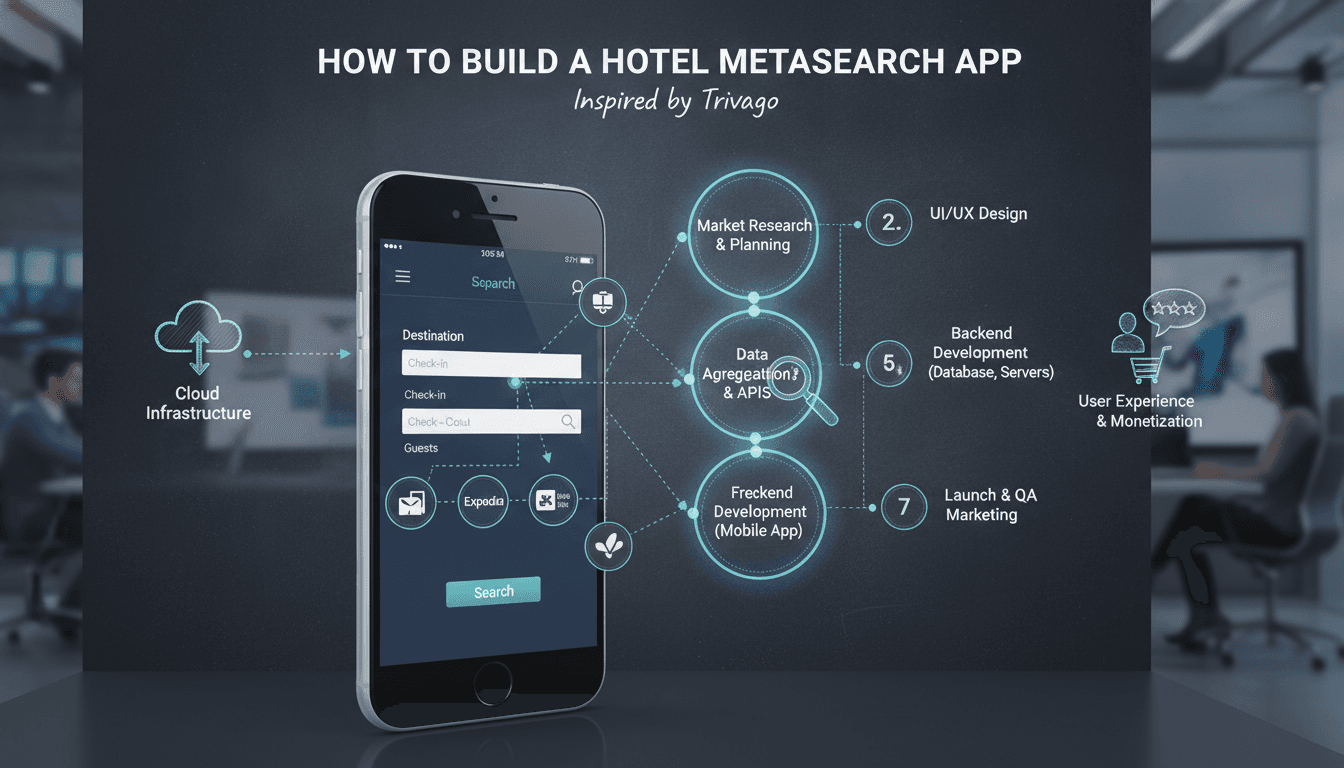
Building a hotel and flight comparison platform is not a simple CRUD app. Trivago indexes over 5 million hotels from 190+ booking sites, processes hundreds of millions of price queries daily, and serves results in under a second. This post breaks down the architecture, data challenges, and product decisions you'll face if you want to build something in the same category.
What Does a Platform Like Trivago Actually Do?
Most people think of Trivago as a search engine. It is, but the hard part is not the search — it's the data aggregation layer underneath it.
Trivago does not hold inventory. It does not process bookings. Its core product is a real-time price comparison across dozens of OTAs (Online Travel Agencies) and direct hotel channels. That means its engineering challenge is fundamentally different from building Booking.com or Expedia. You are building a meta-search platform, not a booking platform.
The distinction matters because your data model, your revenue model (cost-per-click vs commission), and your infrastructure costs are all driven by that choice.
How Do You Aggregate Hotel and Flight Data at Scale?
This is where most teams underestimate the problem.
Data Sources and Protocols
Travel inventory comes from multiple integration layers:
- GDS (Global Distribution Systems): Amadeus, Sabre, and Travelport are the traditional intermediaries. Amadeus alone processes over 600,000 transactions per second at peak. Connecting via their APIs gives you broad coverage but comes with licensing fees and query limits.
- Direct supplier APIs: Major hotel chains like Marriott and Hilton expose their own rates via XML or REST feeds. Direct connections give you better prices but require individual agreements with each supplier.
- OTA partner feeds: Booking.com, Expedia, and Hotels.com all offer affiliate or partner APIs. These are the easiest to integrate but add a middleman margin to the prices.
- Screen scraping: Some aggregators fall back to scraping when APIs aren't available. This is fragile, legally ambiguous in many jurisdictions, and breaks whenever the source changes its markup.
Handling Rate Freshness
Hotel prices change continuously. A rate valid at 10:00 AM may be gone by 10:05 AM. You have two broad approaches:
Pull-based: You query suppliers on demand when a user searches. Low latency for freshness, high latency for user response time. You need to fan out requests to 30+ suppliers in parallel and aggregate within roughly 800ms to stay competitive.
Push-based / cached: Suppliers push rate feeds to you on a schedule (often every 15–30 minutes). You store them and serve from cache. Response time is fast, but prices can be stale.
Most production systems combine both: a cached baseline for instant results, with real-time confirmations triggered before checkout. Trivago's architecture leans heavily on real-time querying with aggressive connection pooling and circuit breakers per supplier.
The Data Normalisation Problem
Each supplier sends data in a different format. Hotel names differ ("Taj Mahal Palace" vs "Taj Palace Hotel"). Room type descriptions are inconsistent. Amenity lists use different taxonomies. Before you can display a meaningful comparison, you need a canonical hotel entity that maps to dozens of supplier-specific IDs.
This is solved with a property matching pipeline. You build a golden record per property using a combination of geographic coordinates, phone numbers, and name fuzzy-matching (typically Levenshtein distance or TF-IDF similarity). Machine learning classifiers trained on labelled pairs improve accuracy over time. Expect to spend significant engineering time here. Getting deduplication accuracy above 95% on a corpus of millions of properties is genuinely difficult.
/// Not sure where to start?
Get the architecture before you commit
Tell us what you're building and we'll map the technical approach, stack, and rough timeline. No cost, no obligation, no sales call required.
How Should You Structure the Backend Architecture?
A monolith will not survive the traffic patterns of a travel meta-search platform. You need services that can scale independently because search load, pricing load, and content load spike at different times.
A workable architecture looks like this:
| Service | Responsibility | Typical Stack |
|---|---|---|
| Search Service | Query parsing, intent detection, geo lookup | Elasticsearch 8.x, FastAPI |
| Aggregation Service | Fan-out to supplier APIs, result merging | Go, gRPC, Redis for circuit state |
| Content Service | Hotel descriptions, images, amenities | PostgreSQL, CDN (CloudFront/Cloudflare) |
| Pricing Cache | Storing and serving cached rates | Redis Cluster, Apache Kafka for updates |
| Ranking Service | Sorting results by relevance + commercial signals | Python, scikit-learn or TensorFlow Serving |
| Analytics Pipeline | Clickstream, conversion attribution | Apache Flink, BigQuery |
The aggregation service is your most critical component. You are making network calls to external APIs that have variable latency. Use a hedged request pattern: send the request, and if it doesn't return within a threshold (say, 400ms), fire a duplicate request to the same endpoint. Return whichever comes back first. This reduces tail latency significantly.
Caching Strategy
Redis Cluster is the standard choice for rate caching. Key your cache entries by {supplier_id}:{property_id}:{checkin}:{checkout}:{occupancy}. Set TTLs based on supplier feed frequency, typically between 10 and 30 minutes. Cache hit rates above 70% meaningfully reduce your API call costs and supplier quota consumption.
What Does the Mobile and Frontend Layer Look Like?
Trivago's mobile apps account for a large portion of its traffic. For a new build, React Native is a practical choice if you want a single codebase across iOS and Android with near-native performance for the UI interactions involved (search, filter, list views, map views). Flutter is equally viable and gives you more control over custom rendering.
On the web side, Next.js with server-side rendering is the standard for travel platforms because page load speed directly affects conversion. Google's Core Web Vitals are a real ranking factor for travel queries. Aim for an LCP (Largest Contentful Paint) under 2.5 seconds on a 4G connection.
Map integration for geographic hotel search is almost always Google Maps Platform or Mapbox. Mapbox is cheaper at scale and gives you more control over styling. Google Maps has broader geocoding accuracy globally.
Monetisation and the CPC Model
Trivago earns on a cost-per-click basis. Every time a user clicks through to a booking partner, the partner pays Trivago a fee. This creates an interesting product tension: your ranking algorithm influences clicks, and partners bid for better placement, but if you rank purely by bid, result quality drops and users stop trusting the product.
The standard resolution is a blended ranking signal: price competitiveness, partner reliability (measured by price accuracy on landing page versus displayed price), historical click-through rate, and commercial bid. Weighting these correctly requires continuous A/B testing against conversion metrics.
Fraud is a real concern. Partners have incentive to display artificially low prices to win clicks, then show higher prices on the landing page. You need automated price accuracy monitoring that samples actual partner landing pages post-click and flags discrepancies above a defined threshold (typically 5%). Partners with persistent accuracy problems should be penalised in ranking or removed.
Conclusion
Building a Trivago-like platform is a data engineering problem as much as it is a product problem. The search UI is straightforward. The supplier integrations, property deduplication, real-time rate aggregation, and ranking model are where the work actually lives.
If you are starting from scratch, prioritise the aggregation and normalisation layer first. A fast frontend serving bad data will not retain users. Get your data clean and your prices accurate, then optimise for speed and relevance.
If you want to discuss the architecture specific to your use case, regions, or supplier mix, get in touch with the team at Sodio.
FAQ
How long does it take to build a travel meta-search platform? A production-ready MVP with 5–10 supplier integrations, a search interface, and basic mobile apps typically takes 9–14 months with a team of 6–8 engineers. The timeline is usually gated by supplier API agreements and legal review, not code.
What is the biggest technical challenge in building a platform like Trivago? Property deduplication and rate normalisation. Getting a clean, deduplicated property graph across millions of hotels, each described differently by different suppliers, requires significant ML and data engineering effort. Most teams underestimate this by a factor of two.
Do you need to build on top of a GDS, or can you go direct to suppliers? Both paths work. GDS connectivity gives you broad coverage quickly but adds cost and complexity. Direct supplier APIs give you better pricing and tighter relationships but require individual agreements. Most platforms start with a GDS for coverage and add direct connections for their highest-volume suppliers over time.
How do you handle currency and localisation at scale? Use a dedicated currency service that pulls exchange rates from a reliable source (ECB or Open Exchange Rates) and caches conversions. Store all prices in a base currency (usually USD or EUR) and convert at display time. Handle locale-specific formatting, date formats, and tax display rules as presentation-layer concerns, not data-layer ones.
Is building in-house or outsourcing the right call for this type of platform? It depends on your team's existing travel-tech experience. Supplier integration and GDS connectivity are specialised domains. If your engineering team has not done this before, working with a team that has built in this space reduces trial-and-error significantly. The core product logic, ranking, and UX should stay in-house where possible.
Have a project in mind? Contact Sodio Technologies to discuss your requirements and explore the right technology solution for your business.
/// Work with us
Talk to the engineers who'd build it
You'll get a technical scope, timeline and cost estimate from the people doing the work, not an account manager. In-house team, no subcontracting, since 2016.