

How to Make an App Like Lumosity
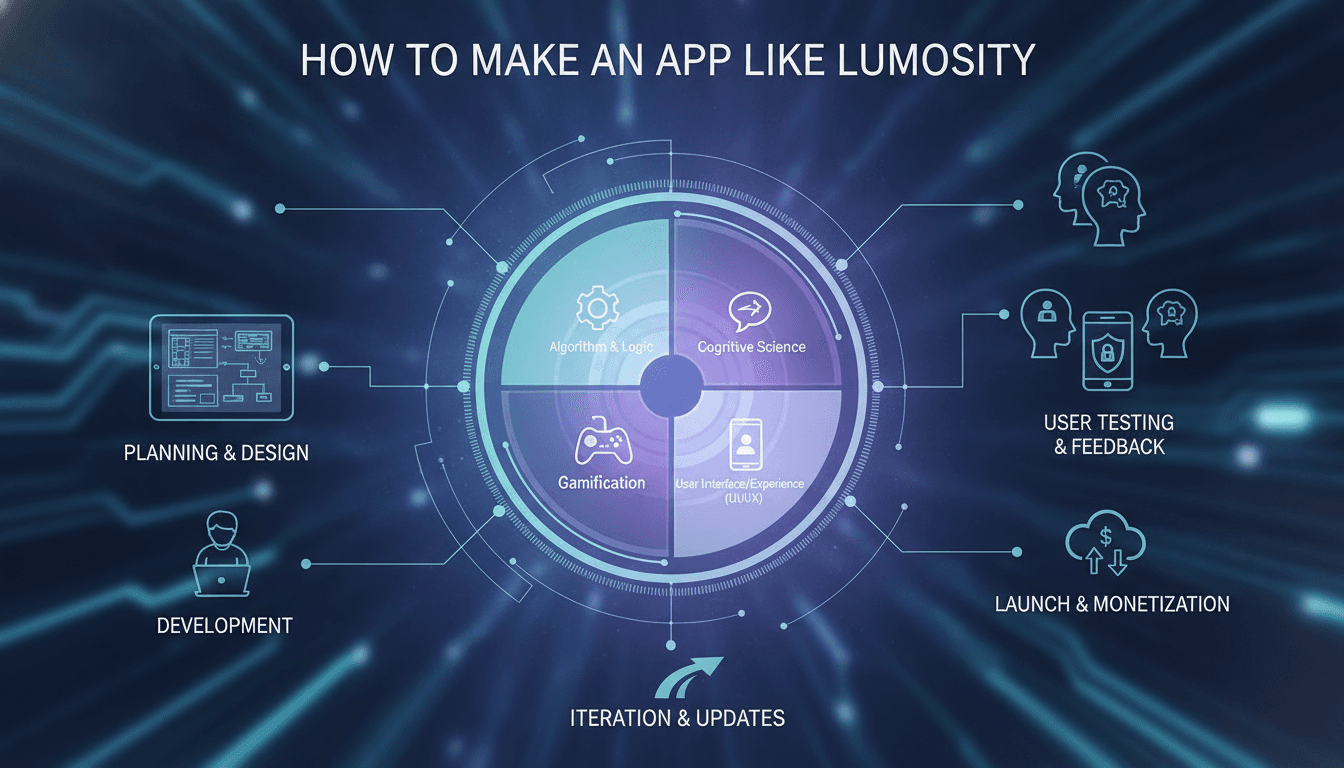
A practical breakdown of the architecture, tech stack, and product decisions behind building a brain-training app — from adaptive algorithms to subscription monetisation.
What Does Lumosity Actually Do Under the Hood?
Lumosity is, at its core, a personalised cognitive training platform. It serves timed mini-games, tracks performance across sessions, adjusts difficulty in real time, and surfaces progress data back to the user. The science behind neuroplasticity is contested, but the engineering behind apps like it is genuinely interesting and worth unpacking.
If you're planning to build in this space, the product has four distinct technical layers:
- A game engine or rendering layer for the mini-games themselves
- An adaptive difficulty system that responds to performance signals
- A user data pipeline that stores longitudinal cognitive metrics
- A subscription and entitlement layer that gates content
Each of these has different complexity and different build-vs-buy trade-offs.
What Tech Stack Should You Use to Build a Brain-Training App?
There is no single right answer, but the decisions you make early constrain you later. Here's how the main options compare:
| Dimension | React Native | Flutter | Native (Swift + Kotlin) |
|---|---|---|---|
| Code sharing | ~70–85% shared | ~95% shared | 0% — two separate codebases |
| Animation performance | Good, with Reanimated 3 | Excellent, Impeller renderer | Best ceiling |
| Game rendering | Limited — use WebGL bridge | Limited — use Flutter Flame | Full Metal / Vulkan access |
| Hire market | Large | Growing fast | Mature but expensive |
| Time to MVP | Fast | Fast | Slow |
For a Lumosity-style app, the games are typically 2D puzzles with tight timing — memory grids, pattern matching, reaction-time tasks. These are not GPU-intensive by gaming standards. Flutter with the Flame game engine handles this class of game well. React Native with a WebGL canvas works too but introduces more bridging complexity.
If you want to build games that eventually push into 3D or physics-heavy territory, native or Unity with thin native wrappers is worth the cost. For most cognitive training products at launch, it is overkill.
Backend: What You Actually Need
The backend is where cognitive training apps get non-trivial. You need:
- User authentication and profile management (Auth0 or Firebase Auth both work; the choice matters less than you think at this stage)
- A time-series store for raw game performance data — InfluxDB or TimescaleDB are purpose-built for this; PostgreSQL with a partitioned table works fine at under 10 million events
- An adaptive difficulty engine — this is custom logic; no off-the-shelf service does it well
- A content management layer for game configs and progression rules
- A subscription and entitlement service — RevenueCat is the pragmatic choice for mobile; it handles App Store and Play Store receipts, webhooks, and entitlement state without you having to build and maintain it yourself
For the API layer, a Node.js or Python (FastAPI) service behind an AWS API Gateway or a simple Nginx reverse proxy is sufficient. You do not need microservices at day one. A modular monolith with clear domain boundaries is easier to operate and refactor when you understand your actual load patterns.
How Does the Adaptive Difficulty System Work?
This is the part most teams underestimate. Adaptive difficulty in a cognitive training context is not the same as a game that gets harder when you win. You are modelling a user's cognitive baseline and adjusting stimulus parameters to keep them in a zone where they are challenged but not frustrated — roughly analogous to Vygotsky's zone of proximal development in educational psychology.
A practical implementation uses Item Response Theory (IRT), specifically a 3-parameter logistic model, to estimate a user's latent ability on each cognitive domain (working memory, processing speed, attention, and so on). Each game item has a difficulty parameter. After each session, you update the ability estimate using maximum likelihood estimation or a Bayesian update, then select items whose difficulty is within a target range of the current estimate.
You do not need a machine learning model for this at launch. Classical IRT runs fast enough to compute per-session updates synchronously. The edge case that trips teams up is cold-start: a new user has no ability estimate. Use a short onboarding calibration session, typically 3 to 5 minutes of adaptive probing across domains, to get an initial estimate before routing them into the main content.
The longitudinal data this produces is also what makes the product defensible. After six months of daily play, a user's performance history is not trivially portable. That data gravity is a retention mechanism, not just a UX feature.
/// Not sure where to start?
Get the architecture before you commit
Tell us what you're building and we'll map the technical approach, stack, and rough timeline. No cost, no obligation, no sales call required.
Monetisation: Subscriptions, Trials, and What Actually Converts
Lumosity uses a freemium model with a hard paywall after a few games per day. The conversion funnel is: install, play free games, hit the limit, see upgrade prompt. Standard for the category.
A few things matter technically here:
Receipt validation must happen server-side. Client-side validation is trivially bypassable. RevenueCat's SDK posts receipts to their servers and your backend gets a webhook on entitlement changes. This is the right architecture.
Free trial length is a product decision, but the data across subscription apps generally shows 7-day trials convert better than 14-day for productivity and wellness apps. Cognitive training sits in that neighbourhood.
Pricing localisation is often skipped and costs real revenue. App Store and Play Store both support price points by territory. A user in India paying ₹399/month and a user in the US paying $14.99/month can both be profitable at different margin profiles. Handle this in your entitlement config, not in code.
Yearly subscriptions dramatically improve LTV. If your monthly ARPU is $5 and your monthly churn is 8%, your average subscriber tenure is about 12 months. A yearly plan at a 30–40% discount captures that revenue upfront and reduces churn risk.
What Does It Actually Cost to Build?
Rough figures for a well-scoped first version, assuming a cross-platform Flutter app with five to eight mini-games, IRT-based adaptive difficulty, RevenueCat subscriptions, and a basic progress dashboard:
| Phase | Duration | Scope |
|---|---|---|
| Discovery and architecture | 3–4 weeks | Stack decisions, data model, game design specs |
| Core app and backend | 12–16 weeks | Auth, games, adaptive engine, subscriptions |
| Analytics and dashboard | 4–6 weeks | Progress charts, domain breakdowns, streaks |
| QA, App Store submission | 3–4 weeks | Device testing, compliance, review cycles |
Total: roughly 22 to 30 weeks for a production-ready v1. Budget accordingly for post-launch iteration — the adaptive algorithm will need tuning once you have real user data at scale.
Building in-house is viable if you have a mobile engineer with game experience, a backend engineer comfortable with statistical modelling, and a product manager who understands the cognitive science well enough to spec the games properly. If any of those are gaps, the time cost of ramping up exceeds the cost of bringing in a team that has built in this space before.
Conclusion
The technical surface area here is larger than it looks. The games themselves are the visible part. The adaptive engine, the longitudinal data model, and the subscription infrastructure are what determine whether the product works and whether users stay.
Start with a focused scope: two or three games, a single cognitive domain, IRT-based difficulty, and RevenueCat for subscriptions. Instrument everything from day one. The data you collect in the first three months will tell you which games retain users and which do not, and that is the input to every subsequent product decision.
If you want to talk through the architecture in more detail, reach out to the team at Sodio. We have built in adjacent spaces and are happy to get into specifics.
FAQ
How long does it take to build an app like Lumosity? A production-ready v1 with five to eight games, adaptive difficulty, and subscription monetisation takes roughly 22 to 30 weeks with a focused team. Scope is the main variable — more games and more cognitive domains add time linearly. Discovery and architecture work done properly upfront typically saves more time than it costs.
Do I need machine learning for adaptive difficulty? Not at launch. Classical Item Response Theory handles adaptive difficulty well for cognitive training apps and is far easier to implement and debug than a neural model. ML becomes relevant if you want to personalise content recommendations across a large catalogue or model multi-dimensional ability trajectories over years of data.
Which platform should I build on first — iOS or Android? Build cross-platform from the start using Flutter or React Native. The cognitive training demographic skews toward iOS in Western markets, but Android dominates in South and Southeast Asia, which are fast-growing markets for this category. Launching on one platform first and porting later costs more in total than building cross-platform from day one.
How do I handle the App Store review process for health or cognitive claims? Apple and Google both scrutinise cognitive and health benefit claims. Avoid phrases like "clinically proven" or "improves IQ" in your metadata unless you have peer-reviewed studies to support them. Frame the product as a training tool, not a medical device. Build your App Store listing with this in mind from the start — retroactive changes to categories and descriptions can trigger re-review delays.
What database should I use for storing game performance data? PostgreSQL with a partitioned table works well up to tens of millions of events. TimescaleDB, which is a PostgreSQL extension, adds time-series optimisations without requiring a new system to learn. InfluxDB is purpose-built for time-series but adds operational complexity and a different query language. Start with PostgreSQL and migrate only if query performance on the time-series data becomes a genuine problem.
Have a project in mind? Contact Sodio Technologies to discuss your requirements and explore the right technology solution for your business.
/// Work with us
Talk to the engineers who'd build it
You'll get a technical scope, timeline and cost estimate from the people doing the work, not an account manager. In-house team, no subcontracting, since 2016.