

How to Make an App Like HealthifyMe
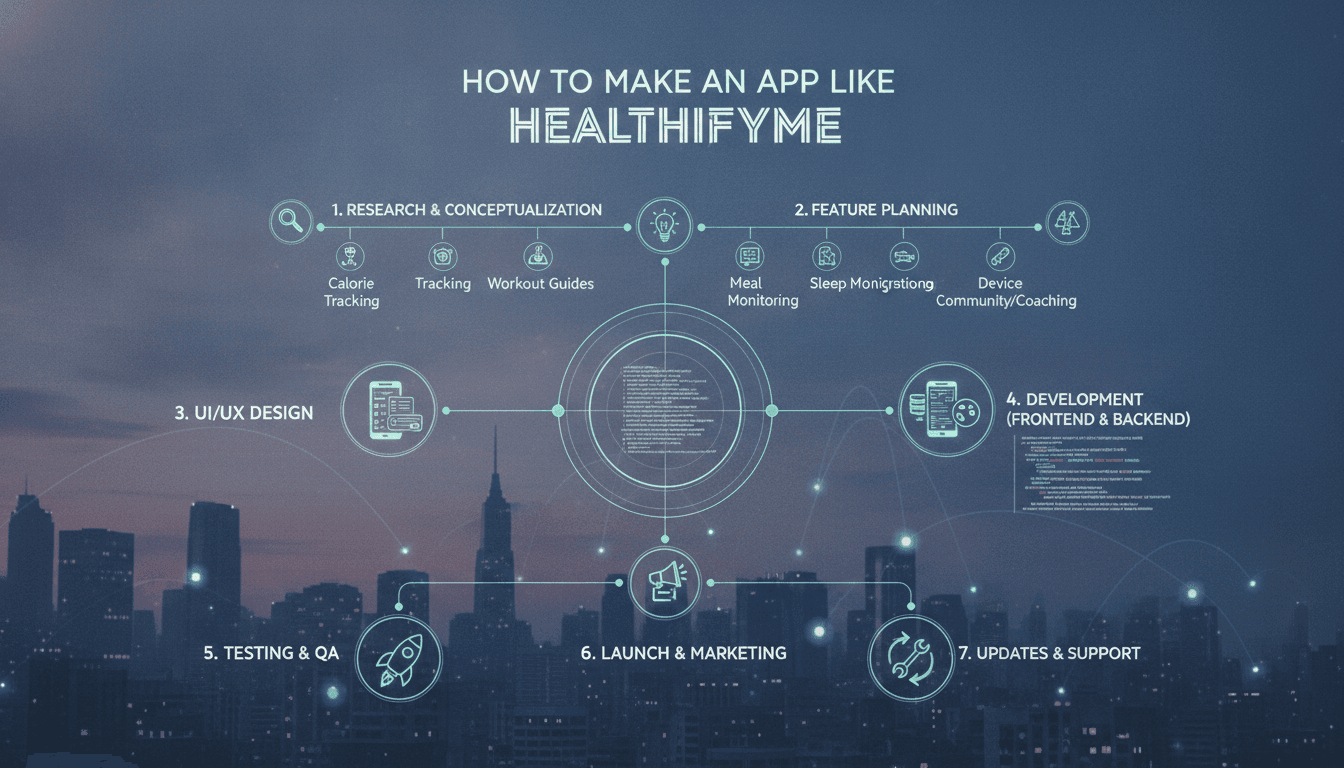
A practical breakdown of the architecture, features, and development costs involved in building a fitness and nutrition tracking app comparable to HealthifyMe — written for engineering teams who want to understand what they're actually signing up for.
What Does HealthifyMe Actually Do Under the Hood?
HealthifyMe is not a simple CRUD app with a calorie counter bolted on. At its core, it runs three distinct product surfaces: a food and water logging interface, a conversational AI coach (Ria), and a live human coaching layer. Getting these three to talk to each other cleanly is where most teams underestimate the work.
The food database is the first real challenge. HealthifyMe maintains a database of over 13 lakh Indian food items, which is a category most Western nutrition APIs like Nutritionix or Edamam do not cover adequately. If your target market includes South Asian users, you will need to either build and curate your own food database or partner with one that has regional depth. Plan for ongoing editorial work; food data goes stale and regional variations are significant.
The AI coaching layer (Ria) runs on NLP-driven intent classification, with a retrieval-augmented generation (RAG) layer sitting on top of a nutrition knowledge base. This is not a simple OpenAI wrapper. The prompts are domain-constrained, the outputs are validated against nutritional guidelines, and the system has guardrails to avoid giving advice that could cause harm. If you are building something similar, expect to spend significant time on evaluation pipelines and red-teaming, not just on model selection.
How Should You Architect a Health and Fitness App at Scale?
Backend and Data Layer
A microservices architecture makes sense here, but only if you have the team to operate it. If you are a small team, start with a modular monolith and extract services later. The services you will eventually want to separate are:
- User profiles and authentication (JWTs with refresh token rotation; consider AWS Cognito or Auth0 for managed identity)
- Food and nutrition data service (read-heavy; cache aggressively with Redis; use PostgreSQL for structured data)
- Activity and workout logging (time-series data; InfluxDB or TimescaleDB fits better than a relational store)
- AI coaching service (stateless inference endpoints; decouple from the main API so you can scale it independently)
- Notification service (push via FCM and APNs; use a queue like SQS to decouple from request cycles)
- Payment and subscription service (Razorpay or Stripe depending on geography; never roll your own)
The coaching session data is where most teams trip up. It mixes structured data (meal logs, weight entries) with unstructured data (chat transcripts, voice notes). You need a clear data model for this before you write a line of product code.
Mobile Architecture
HealthifyMe ships on iOS and Android. If you are building for both from scratch, React Native or Flutter are reasonable choices. React Native gives you a larger hiring pool in India; Flutter gives you better rendering performance for custom UI-heavy screens like workout animations and progress charts.
One decision that matters early: offline support. A fitness app that breaks when your user is at the gym with poor connectivity is a bad product. Implement a local SQLite layer (via WatermelonDB for React Native or Hive for Flutter) and design your sync logic before you design your screens.
/// Not sure where to start?
Get the architecture before you commit
Tell us what you're building and we'll map the technical approach, stack, and rough timeline. No cost, no obligation, no sales call required.
Wearable and Device Integration
HealthifyMe integrates with Apple Health, Google Fit, and several Bluetooth-connected devices. Apple HealthKit and Google Health Connect both have their own permission models and data schemas. Budget time for this; it is not a weekend integration. Apple's entitlement review process alone can add a week to your timeline.
What Does It Actually Cost to Build Something Like This?
Cost depends heavily on scope, but here is a realistic breakdown for a mid-fidelity v1 that covers food logging, AI coaching (text-only), basic workout tracking, and a subscription paywall.
| Component | Estimated Dev Time (person-weeks) |
|---|---|
| Backend API + DB schema | 8–10 |
| Mobile app (iOS + Android) | 14–18 |
| Food database setup + admin tools | 4–6 |
| AI coaching integration (RAG + LLM) | 6–8 |
| Wearable integrations | 3–5 |
| Payment and subscription flows | 2–3 |
| QA, DevOps, CI/CD setup | 4–5 |
| Total | 41–55 person-weeks |
This is a v1. It does not include a human coaching marketplace, video call infrastructure, live chat with coaches, or a web dashboard. Those add roughly 20 to 30 more person-weeks depending on depth.
Cloud infrastructure costs at moderate scale (50,000 MAU) will run between $2,000 and $5,000 per month on AWS, depending on how aggressively you cache and how often users invoke the AI coaching endpoint. LLM inference is the most expensive line item. At 10 AI interactions per user per month across 50,000 users, you are looking at 500,000 inference calls. At GPT-4o pricing (roughly $0.005 per 1K output tokens), that adds up fast. Use a smaller fine-tuned model for routine queries and reserve the frontier model for complex coaching conversations.
What Regulatory and Compliance Obligations Apply?
This depends on what claims you make and what data you store. If your app gives personalised dietary advice, some jurisdictions treat that as a medical service. In India, the DPDP Act (Digital Personal Data Protection Act, 2023) applies to health data and requires explicit consent and defined retention limits. If you are targeting European users, GDPR Article 9 applies specifically to health data as a special category.
Do not store raw health records longer than you need them. Anonymise or pseudonymise user data in analytics pipelines. If you integrate with clinical data (like HbA1c levels for diabetes management, which HealthifyMe's premium tiers do), you are moving into territory where you need a HIPAA-equivalent compliance posture for US users.
Build your consent management and data deletion flows before launch, not after. Retrofitting them is expensive and error-prone.
Conclusion
Building a fitness app that competes with HealthifyMe is achievable, but only if you treat the food database, AI coaching layer, and health data compliance as first-class engineering problems rather than afterthoughts. The mobile UI is the visible part; the work is in the data model, the inference pipeline, and the regional content.
The clearest next step is to define your scope honestly. A food logger with basic AI feedback is a 12-month build for a small team. A full coaching marketplace with wearable integrations and live video is closer to 24 months. Pick the version that solves a real problem for a specific user segment, ship it, and expand from there.
FAQ
How long does it take to build an app like HealthifyMe? A functional v1 covering food logging, AI coaching, and subscription billing takes roughly 41 to 55 person-weeks with a team of 4 to 6 engineers. A full-featured product with human coaching, live video, and wearable integrations is closer to 18 to 24 months depending on team size and scope.
Do I need to build my own food database? For Indian or South Asian markets, yes. Global nutrition APIs like Edamam or Nutritionix have poor regional coverage. You will need to curate a database with regional foods, local brand products, and recipe variations. Budget for ongoing editorial work, not just a one-time import.
What tech stack should I use for the mobile app? React Native or Flutter are both practical choices for a cross-platform build. React Native has a larger talent pool in India; Flutter has better performance for animation-heavy screens. Either way, implement offline support from the start using WatermelonDB or Hive.
How do I handle health data compliance? In India, the DPDP Act 2023 applies. In the EU, GDPR Article 9 covers health data as a special category. In the US, HIPAA applies if you handle clinical data. Build consent management and data deletion flows before launch. Do not treat compliance as a post-launch task.
What is the biggest technical risk in a project like this? The AI coaching layer. It is easy to wire up an LLM and call it a coach. It is hard to make it safe, accurate, and cost-efficient at scale. You need evaluation pipelines, domain-specific guardrails, and a cost model before you commit to an inference architecture. This is where most teams are surprised by both complexity and cloud spend.
Have a project in mind? Contact Sodio Technologies to discuss your requirements and explore the right technology solution for your business.
/// Work with us
Talk to the engineers who'd build it
You'll get a technical scope, timeline and cost estimate from the people doing the work, not an account manager. In-house team, no subcontracting, since 2016.