

How to Make an App Like Match.com
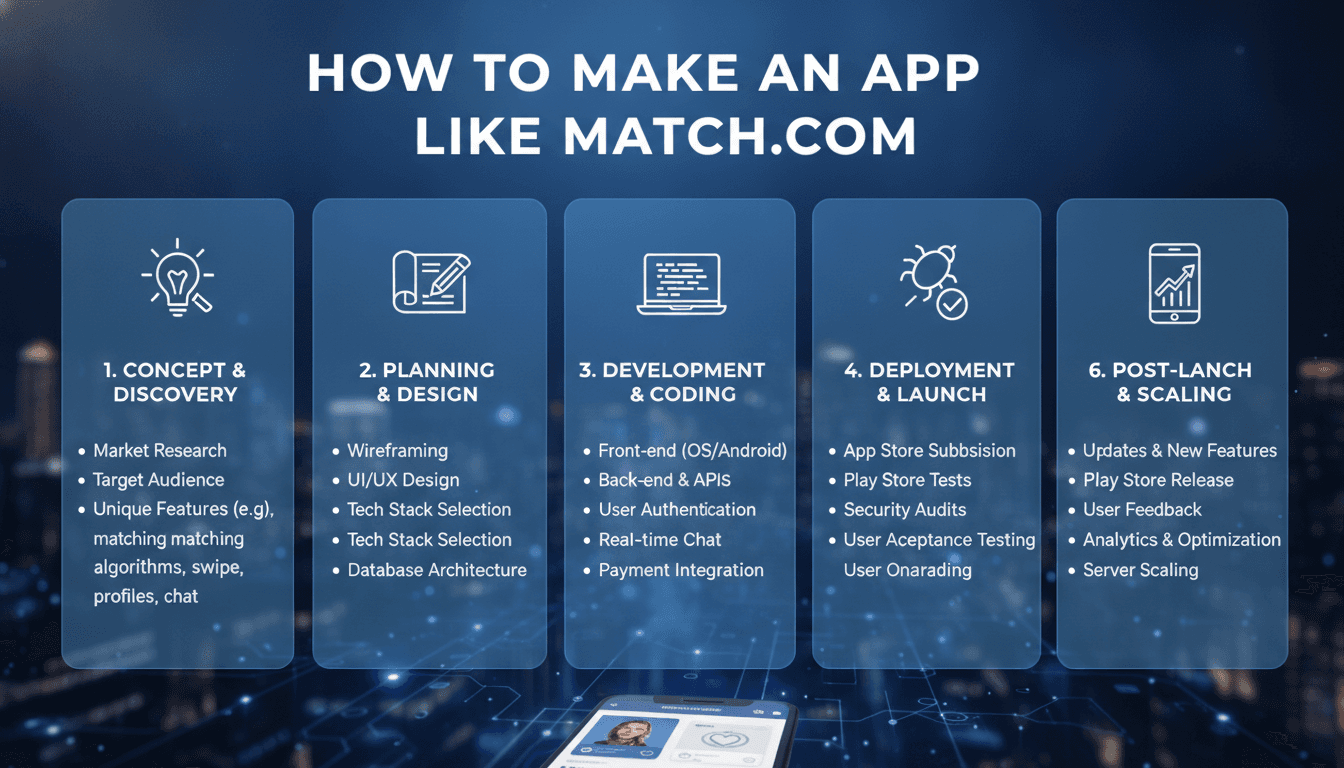
Building a dating platform that competes with Match.com means dealing with matchmaking algorithms, real-time messaging, trust and safety systems, and monetisation — all at once. This post breaks down what that architecture actually looks like, where the hard problems are, and what you should think carefully about before writing a line of code.
What Does a Platform Like Match.com Actually Do Under the Hood?
Match.com is not just a database of profiles with a search bar. At its core it is a recommendation engine wrapped in a social product. The main functional layers are:
- Profile ingestion and enrichment (photos, bios, preferences, behavioural signals)
- Matching and ranking (who gets shown to whom, and in what order)
- Communication (messaging, video, notifications)
- Trust and safety (identity verification, fraud detection, content moderation)
- Monetisation (subscriptions, boosts, premium features)
Each of these layers has genuine engineering complexity. The matchmaking layer alone involves building or integrating a recommendation system that balances mutual interest signals, geographic proximity, stated preferences, and implicit behavioural feedback. That is not a weekend project.
The Data Model
Your core entities are Users, Profiles, Preferences, Swipes or Likes, Matches, and Conversations. The relationship between Likes and Matches alone requires careful thought: a Match is typically a bi-directional Like, which means you need an efficient way to detect when two users have liked each other without scanning the entire Likes table on every write.
A common pattern is to write a Like record, then immediately query for a reciprocal Like using a composite index on (liked_user_id, liker_user_id). At low scale this is fine. At Match.com scale (roughly 9 million subscribers as of recent filings), you move this logic into a queue-based system with Redis pub/sub or a dedicated event stream to avoid hot rows in PostgreSQL.
How Do You Build the Matching Algorithm?
This is where most teams underestimate the problem. A basic matching system is straightforward: filter by age range, distance, and preferences, then return results sorted by recency. A good matching system is a machine learning problem.
Match.com and its competitors use collaborative filtering and learning-to-rank models to predict which profiles a given user is likely to engage with. The input features typically include:
- Explicit preferences (age, distance, gender)
- Profile completeness score
- Historical engagement rates (open rate, reply rate, time-to-reply)
- Mutual connection density if you have a social graph
- Session-level signals (how long did the user look at a profile before swiping)
For a new platform, start with a heuristic baseline: filter, then rank by a weighted combination of profile completeness, last active timestamp, and a compatibility score derived from preference overlap. Instrument everything. Once you have 50,000+ users, you have enough signal to train a two-tower retrieval model using TensorFlow Recommenders or a similar framework. The two-tower architecture gives you fast approximate nearest-neighbour lookup using tools like Faiss or ScaNN, which matters when your candidate pool is large.
One honest trade-off: ML-based ranking requires a cold-start solution for new users. You need a rule-based fallback until you have enough behavioural data on that user. Ignoring this makes the first-time experience bad, and first-time experience is everything in a consumer app.
/// Not sure where to start?
Get the architecture before you commit
Tell us what you're building and we'll map the technical approach, stack, and rough timeline. No cost, no obligation, no sales call required.
Real-Time Messaging: More Complex Than It Looks
Dating apps have a specific messaging pattern: low message volume per conversation, high connection count, and a strong expectation of delivery receipts and read indicators. WebSockets are the standard transport. The question is how you manage connection state at scale.
A single Node.js or Go WebSocket server can hold around 50,000 to 100,000 concurrent connections, depending on message frequency and payload size. Beyond that, you need a horizontally scaled WebSocket tier backed by a message broker. NATS or Redis Streams work well here. Each WebSocket server subscribes to a channel per user; when a message arrives, the broker fans it out to whichever server holds that user's connection.
For persistence, store messages in PostgreSQL with a conversation_id and a monotonically increasing sequence number per conversation. Do not rely on timestamps alone for ordering; clock skew between clients and servers will cause ordering bugs that are annoying to debug.
Push notifications (APNs for iOS, FCM for Android) are your fallback when the user is not connected. Keep notification payload minimal and fetch the full message from the API on open. This avoids stale notification content issues when messages are deleted or edited.
Video Calling
Match.com added video features during 2020 and has kept them. If you need video, WebRTC is the baseline protocol. You will need a STUN/TURN infrastructure to handle NAT traversal; Twilio or Daily.co are sensible managed options unless you have strong reasons to self-host. Coturn is the standard open-source TURN server if you go that route.
Trust, Safety, and Fraud: The Part Teams Always Underscope
Dating platforms attract fraud at a higher rate than most consumer apps. The main threat vectors are romance scammers (who often operate at scale using scripts), fake profiles harvesting contact details, and minors misrepresenting their age.
A baseline trust and safety stack includes:
- Photo verification: require a liveness check during sign-up. Onfido, Jumio, and AWS Rekognition all offer this. Match Group added photo verification to Tinder in 2019 and saw a measurable reduction in reported catfishing.
- Image hashing: run uploaded photos through PhotoDNA or a similar perceptual hash service to detect known CSAM or previously flagged content.
- Text moderation: a combination of keyword filters and an ML classifier (Perspective API is a reasonable starting point) on messages helps catch solicitation patterns.
- Rate limiting on outbound messages: scammers send identical messages to many users rapidly. Limiting message rate by account age and engagement history disrupts this without affecting legitimate users.
Fraud detection is an operational function, not just a technical one. You need a human review queue. Build it early, even if you start with a queue and a spreadsheet.
What Does It Cost to Build, and How Long Does It Take?
These are the questions that matter most for planning.
| Component | Realistic Timeline | Notes |
|---|---|---|
| Core profiles + matching (heuristic) | 10–14 weeks | Includes iOS + Android apps |
| Real-time messaging | 4–6 weeks | On top of core |
| Basic trust and safety | 3–4 weeks | Photo verification + moderation |
| ML-based ranking | 8–12 weeks | Requires training data; add after launch |
| Video calling | 4–6 weeks | Using managed WebRTC provider |
A full MVP, meaning the first four rows without ML ranking, takes roughly 6 to 8 months with a team of one product manager, two mobile engineers, two backend engineers, and one designer. These timelines assume experienced engineers; dating apps have enough domain-specific complexity (bi-directional match detection, connection state management, fraud patterns) that onboarding time is real.
On infrastructure, a starting configuration of two application servers, one managed PostgreSQL instance (RDS db.r6g.large), a Redis cluster, and a CDN for media will cost approximately $800 to $1,200 per month on AWS at low traffic. Media storage costs scale quickly; profile photos are typically 500KB to 2MB each, and a user base of 100,000 with an average of 5 photos each is 250GB to 1TB of storage before you account for processing.
Conclusion
The clearest next step is to define which of the five layers above you are actually building from scratch and which you will buy. Matchmaking logic and messaging are worth building. Identity verification, image hashing, and video infrastructure are almost always better as managed services. That decision shapes your team composition, your timeline, and your cost model more than any architectural choice.
If you are at the planning stage and want a technical review of your current spec or a realistic breakdown of what a custom build would cost, get in touch with the team at Sodio.
FAQ
How long does it take to build an app like Match.com? A functional MVP covering profiles, heuristic matching, real-time messaging, and basic trust and safety takes roughly 6 to 8 months with a team of five to six experienced engineers. ML-based ranking and video calling add another 3 to 6 months on top of that, depending on data availability and infrastructure choices.
What tech stack should a dating app be built on? There is no single correct answer, but a common and well-tested combination is React Native for mobile clients, Node.js or Go for the API and WebSocket layer, PostgreSQL for relational data, Redis for caching and pub/sub, and S3-compatible object storage for media. Use managed services for identity verification and video calling unless you have specific reasons not to.
How do dating apps make money? The dominant model is a freemium subscription. Match.com charges approximately $40 per month for full access. Secondary revenue comes from a la carte features like profile boosts and super likes. Advertising is a distant third and tends to hurt user experience on a product where trust is critical.
How do you handle fake profiles and scammers? A layered approach works best: liveness-check photo verification at sign-up, perceptual image hashing against known bad content, ML-based text classifiers on messages, and rate limiting on outbound messages by account age. Human review queues for flagged content are essential; automated systems alone are not sufficient at any scale.
Can you build a dating app without machine learning? Yes, and you probably should at first. A rule-based matching system, filtering by preferences and sorting by recency and profile completeness, works well enough to validate product-market fit. Add ML ranking once you have 50,000 or more active users and enough behavioural data to train and evaluate a model properly.
Have a project in mind? Contact Sodio Technologies to discuss your requirements and explore the right technology solution for your business.
/// Work with us
Talk to the engineers who'd build it
You'll get a technical scope, timeline and cost estimate from the people doing the work, not an account manager. In-house team, no subcontracting, since 2016.