

How to Make an App Like Moodpath
How to Make an App Like Moodpath
Mental health has moved from a whispered topic to a mainstream priority, and mobile apps are now one of the most accessible entry points to psychological support. Moodpath — a mood-tracking and depression-screening app — became a standout example of how thoughtful design, clinical credibility, and daily engagement can come together in a single product.
If you're planning to build something similar, this guide walks through what Moodpath actually does, the features you need, the technology behind it, the regulatory realities, and what it costs to bring to market.
What Is Moodpath and Why Did It Work?
Moodpath positioned itself as an "interactive screening tool" rather than a clinical diagnosis platform. Users answered three short questions a day about their emotional and physical state. After two weeks, the app generated an electronic assessment that could be shared with a doctor or therapist.
For a closer look at a related topic, read our guide on How to Make an App Like MindDoc.
Several things made it resonate:
- Low friction. Answering three questions takes under a minute. That's a habit people can actually keep.
- A clear payoff. The biweekly report gave users something tangible — a document they could bring to a professional.
- Clinical framing. Questions were grounded in established screening instruments, which built trust.
- Psychoeducation. Over 150 audio exercises and courses on mindfulness, CBT concepts, and sleep gave users something to do with their insights.
The lesson for your own app: mood tracking alone is a commodity. The value sits in what you do with the data.
Core Feature Set
1. Onboarding and Baseline Assessment
Start by capturing a baseline. Ask about sleep, stress, existing diagnoses, medication, and goals. Keep it short — no more than eight to ten screens — and explain why each answer matters. Onboarding is where the majority of drop-off happens in mental health apps.
2. Daily Check-Ins
The heart of the product. Design for brevity:
- Two to three questions per check-in, delivered at set times
- A mix of emotional state ("Have you felt down or hopeless today?") and physical state ("Did you sleep well?")
- Simple input: yes/no, sliders, or emoji scales rather than free text
- Optional note field for context
3. Mood Analytics and Visualisation
Turn raw entries into insight:
- Trend lines over weeks and months
- Correlations between sleep, activity, and mood
- Pattern callouts ("Your mood tends to dip on Sundays")
- Streaks and completion rates to reinforce the habit
4. Periodic Assessment Reports
Generate a summary every two weeks based on validated screening logic. Make the report exportable as a PDF so users can share it with a clinician. Be extremely careful with language here — "indications of" and "screening result" rather than "you have."
For a closer look at a related topic, read our guide on How to Make an App Like Happify.
5. Guided Content Library
Audio exercises, breathing sessions, sleep stories, and short courses on cognitive behavioural techniques. Structure content into pathways so users progress rather than browse aimlessly. Tag content so your recommendation engine can serve it based on tracked mood patterns.
6. Journaling
A free-form space with optional prompts. Journaling entries are among the most sensitive data in the app, so they deserve the strongest encryption treatment.
You may also find our article on How to Make an App Like Smiling Mind useful.
7. Reminders and Notifications
Smart, respectful nudges. Let users choose check-in times. Avoid guilt-based copy. Missing a day should never feel like failure.
8. Crisis Resources
Non-negotiable. Include an always-accessible screen with region-specific helplines, emergency contacts, and grounding exercises. Trigger it proactively if responses indicate risk of self-harm.
9. Optional: Therapist Connection
Many apps in this space now bridge to human support — directories, in-app messaging, or video sessions. This dramatically increases complexity and compliance burden, so treat it as a phase-two feature.
Technology Stack
Mobile front end
- Cross-platform: Flutter or React Native gets you to both stores faster with a shared codebase — ideal for MVPs.
- Native: Swift and Kotlin if you need deep HealthKit / Google Fit integration, advanced background processing, or best-in-class audio playback.
Backend
- Node.js with NestJS, Python with Django/FastAPI, or Go for the API layer
- PostgreSQL for structured user and assessment data
- Redis for session caching and rate limiting
- S3-compatible object storage for audio content, served via CDN
Analytics and intelligence
- Python with pandas and scikit-learn for pattern detection
- A recommendation service that maps mood states to content
- Event pipeline (Segment, or a self-hosted alternative) for product analytics — but strip identifiers before anything leaves your infrastructure
Infrastructure
- AWS, GCP, or Azure with a business associate agreement in place if you're handling US health data
- Containerised services on Kubernetes or a managed equivalent
- Automated CI/CD with staged environments
Privacy, Security, and Compliance
This is where mental health apps live or die.
Know your regulatory surface. HIPAA applies if you're a covered entity or business associate in the US. GDPR applies to EU users and treats mental health data as a special category requiring explicit consent. The EU's MDR may classify your app as a medical device if you make diagnostic claims — Moodpath deliberately avoided this by framing itself as a screening tool, not a diagnostic one.
Technical safeguards to build in from day one:
- Encryption at rest (AES-256) and in transit (TLS 1.3)
- End-to-end encryption for journal entries where feasible
- Biometric or PIN app lock
- Data minimisation — don't collect what you don't need
- Granular consent management with easy withdrawal
- Full data export and deletion on request
- Audit logging for every access to health records
- No third-party ad SDKs. None. Mental health apps have been publicly burned for leaking data to advertisers.
Be radically transparent. Write a privacy policy a human can read. Explain what's stored, where, for how long, and who can see it. Trust is your primary product feature.
Design and UX Principles
- Calm visual language. Muted palettes, generous white space, soft typography. Avoid alarming reds and aggressive contrast.
- Non-judgemental copy. Every string matters. "Let's try again tomorrow" beats "You broke your streak."
- Accessibility. Dynamic type, screen reader support, sufficient contrast, and reduced-motion options. Users in distress may be cognitively taxed.
- Progressive disclosure. Don't overwhelm. Reveal analytics depth as users accumulate data.
- Offline capability. Check-ins should work without connectivity and sync later.
Clinical Validity
Don't invent your own questionnaire. Build on validated instruments — PHQ-9 and GAD-7 are widely used and well documented, though you should verify licensing terms for commercial use. Better still, bring a clinical advisor onto the team early. A psychologist or psychiatrist reviewing your question logic, scoring thresholds, and risk-escalation rules is the difference between a credible product and a liability.
Monetisation Models
- Freemium: Free tracking and basic reports; paid tier unlocks the full content library and deeper analytics. This is the dominant model.
- Subscription: Monthly and annual plans, typically $8–$15/month with a discount for annual commitment.
- B2B2C: License to employers, insurers, or universities. Higher contract values, longer sales cycles, and a strong incentive to have clinical validation.
- Avoid: Advertising and data monetisation. Both are reputationally fatal here.
Development Roadmap
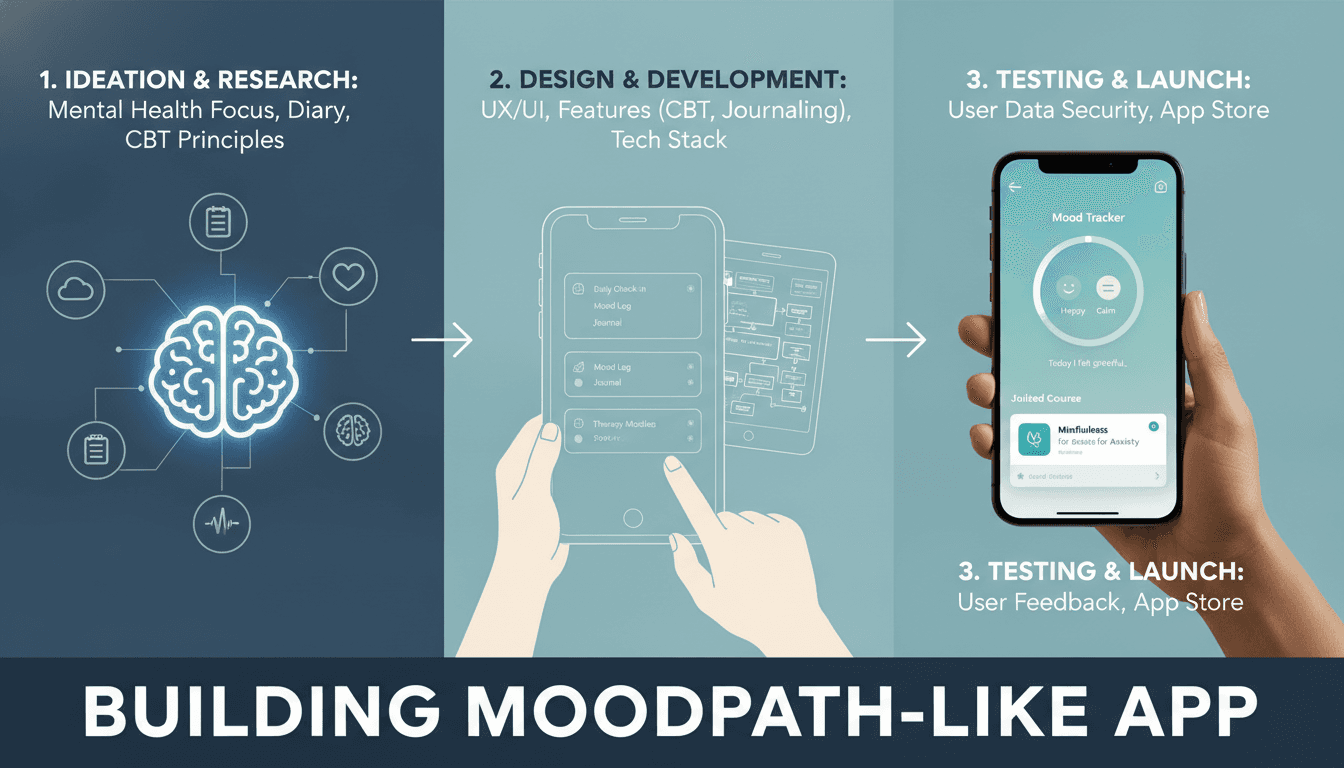
Phase 1 — Discovery (3–4 weeks). Market research, competitor teardown, clinical consultation, feature prioritisation, compliance scoping.
Phase 2 — Design (4–6 weeks). Information architecture, wireframes, design system, high-fidelity prototypes, usability testing with real users.
Phase 3 — MVP Build (12–16 weeks). Core tracking, analytics, reports, a starter content library, and authentication. Ship narrow and deep rather than broad and shallow.
Phase 4 — Testing (3–4 weeks). Functional QA, security penetration testing, accessibility audit, and a closed beta.
Phase 5 — Launch and Iterate (ongoing). App store optimisation, content expansion, retention experiments, personalisation, and — eventually — therapist integration.
What It Costs
Ballpark figures for an outsourced build:
| Scope | Timeline | Estimated Cost |
|---|---|---|
| MVP, cross-platform | 4–5 months | $45,000 – $80,000 |
| Full-featured, cross-platform | 6–8 months | $80,000 – $140,000 |
| Full-featured, native iOS + Android | 8–10 months | $130,000 – $220,000 |
Add-ons to budget for separately: original audio content production ($5,000–$25,000), clinical advisory retainer, security audit and penetration testing ($8,000–$20,000), and ongoing maintenance at roughly 15–20% of build cost annually.
Metrics That Actually Matter
Vanity downloads mean nothing in this category. Track:
- Day-7 and Day-30 check-in retention — the single best predictor of long-term value
- Check-in completion rate per active user
- Report generation rate — how many users reach the two-week payoff
- Content engagement depth — sessions completed, not just started
- Self-reported outcome change — score improvement over time
- Free-to-paid conversion at the 14-day mark
Final Thoughts
Building an app like Moodpath is less a technical challenge than a trust challenge. The engineering is well-trodden: a mobile client, an API, a database, some analytics. What's hard is earning the right to ask someone how they feel every single day, handling their answer with genuine care, and giving them something useful in return.
Start with a narrow, clinically grounded MVP. Get the daily habit loop right. Protect the data like it's your own. Then expand into content, personalisation, and human support once you've proven people keep coming back.
If you're weighing up a build, a discovery workshop with a team that has shipped in regulated health environments is a worthwhile first step — it will surface compliance and clinical questions long before they become expensive rewrites.
Have a project in mind? Contact Sodio Technologies to discuss your requirements and explore the right technology solution for your business.
/// Work with us
Talk to the engineers who'd build it
You'll get a technical scope, timeline and cost estimate from the people doing the work, not an account manager. In-house team, no subcontracting, since 2016.