

How to Make an App Like Happify
How to Make an App Like Happify
Mental wellness has moved from the margins to the mainstream. What was once a private struggle is now a category of software with millions of daily active users, and Happify sits near the front of that pack. Built on positive psychology, cognitive behavioral therapy (CBT), and mindfulness research, Happify turns evidence-based interventions into games, guided tracks, and daily activities that people actually want to open.
If you're planning to build something similar, the good news is that the technology is well within reach. The hard part — and the part most teams underestimate — is the science, the content, and the trust. This guide walks through what it actually takes to build an app like Happify, from feature set to architecture to budget.
We cover a closely related subject in How to Make an App Like Moodpath.
What Makes Happify Work
Before writing a single line of code, it helps to understand why the app succeeds. Happify isn't a meditation player with a nice UI. Its core loop is built around a few deliberate mechanics:
- Assessment first. New users complete a questionnaire that scores their current emotional state and identifies what they want to work on — stress, confidence, relationships, work-life balance.
- Personalized tracks. Based on that assessment, users get assigned a "track," a multi-week program of activities targeting their specific goal.
- Gamified activities. Interventions are delivered as short games and exercises — writing gratitude notes, popping negative-thought balloons, reframing scenarios — rather than as homework.
- Measurable progress. A "Happiness Score" gives users a number that moves, which turns an abstract goal into something trackable.
- Habit reinforcement. Streaks, daily prompts, and notifications keep people coming back.
Your app doesn't have to copy this structure, but it does need an equivalent: a clear path from "I feel bad" to "here is a specific thing to do today" to "here is proof it's working."
If this is relevant to your project, check out How to Make an App Like Smiling Mind.
Core Feature Set
Onboarding and Psychological Assessment
The assessment is the foundation of personalization. Most wellness apps adapt validated instruments — PHQ-9 for depression indicators, GAD-7 for anxiety, PANAS for positive and negative affect, or the WHO-5 Well-Being Index. Keep the initial version short (2–4 minutes) and save the deeper diagnostics for later check-ins.
Crucially, your assessment logic should include safety branching. If a user signals crisis-level distress, the app must immediately surface crisis resources and helpline numbers rather than routing them into a gratitude journaling exercise.
Personalized Program Engine
This is the heart of the product. A recommendation engine maps assessment results, stated goals, and behavioral history to a sequence of activities. Version one can be rules-based — a decision tree that assigns tracks by dominant score. Later versions can layer in collaborative filtering or reinforcement learning that optimizes for completion and outcome improvement.
Design the engine so content is data, not code. Activities, tracks, and sequencing rules should live in a CMS that your clinical and content teams can edit without a release cycle.
Activity and Game Library
Variety is what prevents churn. A strong library typically includes:
- Guided audio — meditations, body scans, breathing exercises
- Writing exercises — gratitude logs, thought records, expressive writing prompts
- Interactive games — attention-bias training, cognitive reframing, savoring exercises
- Micro-lessons — short educational cards on how emotions and habits work
- Reflection check-ins — mood logging with contextual tagging
Each activity should be tagged with the psychological mechanism it targets, expected duration, and difficulty, so the recommendation engine has something to reason about.
Mood and Progress Tracking
Give users a lightweight daily mood check-in and visualize the trend over weeks and months. Correlate mood data with activity completion so users can see statements like "You report better mood on days you complete a morning exercise." That insight is the single most persuasive retention feature you can build.
Community and Social Features
Happify includes community spaces where users share responses to prompts. Moderated sharing creates accountability and normalizes struggle. If you build this, budget for moderation — both automated content filtering and human review. An unmoderated mental health community becomes a liability fast.
Coaching and Professional Support
Many wellness apps layer a paid tier with access to certified coaches or licensed therapists via chat or video. This substantially increases revenue per user but also increases regulatory complexity, credential verification overhead, and support costs. Treat it as a phase-two decision.
Notifications and Habit Loops
Smart, adaptive reminders — timed to when a user historically engages — outperform fixed daily pings. Include streaks, milestone badges, and gentle re-engagement for lapsed users. Be careful: guilt-driven notifications backfire badly in mental health contexts. Tone matters.
Tech Stack Recommendations
Mobile Front End
For most teams, Flutter or React Native is the right call. A wellness app is largely content delivery, forms, charts, audio playback, and light animation — all well within cross-platform capability, and you halve your client-side cost. Go native (Swift / Kotlin) only if you're building graphically heavy games or need deep platform integrations like advanced HealthKit or Google Fit usage.
You may also find our article on How to Make an App Like Wysa useful.
Back End
A microservices or modular monolith approach on Node.js, Python (FastAPI/Django), or Go works well. Separate services for:
- Identity and authentication
- Assessment and scoring
- Content and program delivery
- Analytics and event ingestion
- Notification orchestration
- Payments and subscriptions
Data Layer
- PostgreSQL for user profiles, subscriptions, and structured assessment data
- Redis for sessions, streaks, and caching program state
- A time-series or event store (ClickHouse, BigQuery) for behavioral analytics
- S3 or equivalent for audio and video content, fronted by a CDN
AI and Personalization
Start with rules. Once you have data volume, add an ML layer for next-best-activity recommendations. Many teams also add an LLM-powered conversational companion for journaling reflection or psychoeducation. If you do this, put hard guardrails in place: the model must never diagnose, never advise on medication, and must escalate crisis language to human or emergency resources immediately.
Infrastructure
AWS, GCP, or Azure with containerized deployment, infrastructure-as-code, and automated CI/CD. Choose a region strategy that satisfies your data residency obligations.
Compliance, Privacy, and Safety
This is where wellness apps differ from consumer apps, and where shortcuts destroy companies.
Know your regulatory posture. If you handle protected health information in the US or integrate with providers and insurers, HIPAA applies — meaning encryption, audit logging, access controls, and Business Associate Agreements with every vendor. If you serve EU users, GDPR applies, and mental health data is a special category requiring explicit consent. If your app makes clinical claims, you may cross into medical device territory under FDA or MDR rules. Get legal counsel early; it's far cheaper than remediation.
Encrypt everything. TLS in transit, AES-256 at rest, field-level encryption for journal entries and assessment responses.
Minimize data. Collect only what your interventions actually require. Every extra field is risk without value.
Be honest about analytics. Third-party SDKs that leak mental health signals to ad networks have produced regulatory action and brutal press. Audit your SDKs.
Build a crisis protocol. Keyword detection, an always-accessible help screen, region-aware hotline directories, and a documented escalation path. This is non-negotiable.
Design and User Experience
Mental wellness UX has its own rules:
- Calm over clever. Soft palettes, generous whitespace, slow easing on animations. Avoid red badges and aggressive urgency patterns.
- Low cognitive load. Users arrive stressed. One clear action per screen.
- Accessibility is core. Proper contrast, dynamic type, screen reader labels, captions on video. Many users have accompanying conditions that make this essential rather than optional.
- Offline capability. Downloaded audio and cached activities matter when someone needs support on a plane or with poor connectivity.
- Respect the exit. Easy subscription cancellation and data deletion. Dark patterns in this category are ethically indefensible and increasingly illegal.
Monetization Models
- Freemium subscription — the dominant model. Free tier with limited tracks, paid tier for the full library, coaching, and advanced insights. Typical pricing runs $10–$15 monthly or $60–$100 annually.
- B2B2C / employer partnerships — Happify's own growth leaned heavily here. Selling seats to employers and health plans provides predictable revenue and dramatically lower per-user acquisition cost.
- Provider and insurer channels — higher contract values, longer sales cycles, and stricter compliance requirements.
- One-time program purchases — lower friction for users allergic to subscriptions.
For most startups, consumer subscription funds the early product while enterprise becomes the real business.
Development Timeline and Cost
A realistic MVP — onboarding, assessment, one or two personalized tracks, 20–30 activities, mood tracking, notifications, and subscriptions — typically takes 4 to 6 months with a team of a product manager, designer, two mobile developers, a backend developer, and QA. Budget commonly lands in the $70,000 to $150,000 range depending on region and scope.
A full-featured platform with community, coaching, advanced ML personalization, multi-language content, and HIPAA-grade infrastructure runs 9 to 14 months and $200,000 to $450,000+.
Content production is the line item teams forget. Scripting, recording, and clinically reviewing a library of audio sessions and exercises is a meaningful budget of its own, and it never really stops.
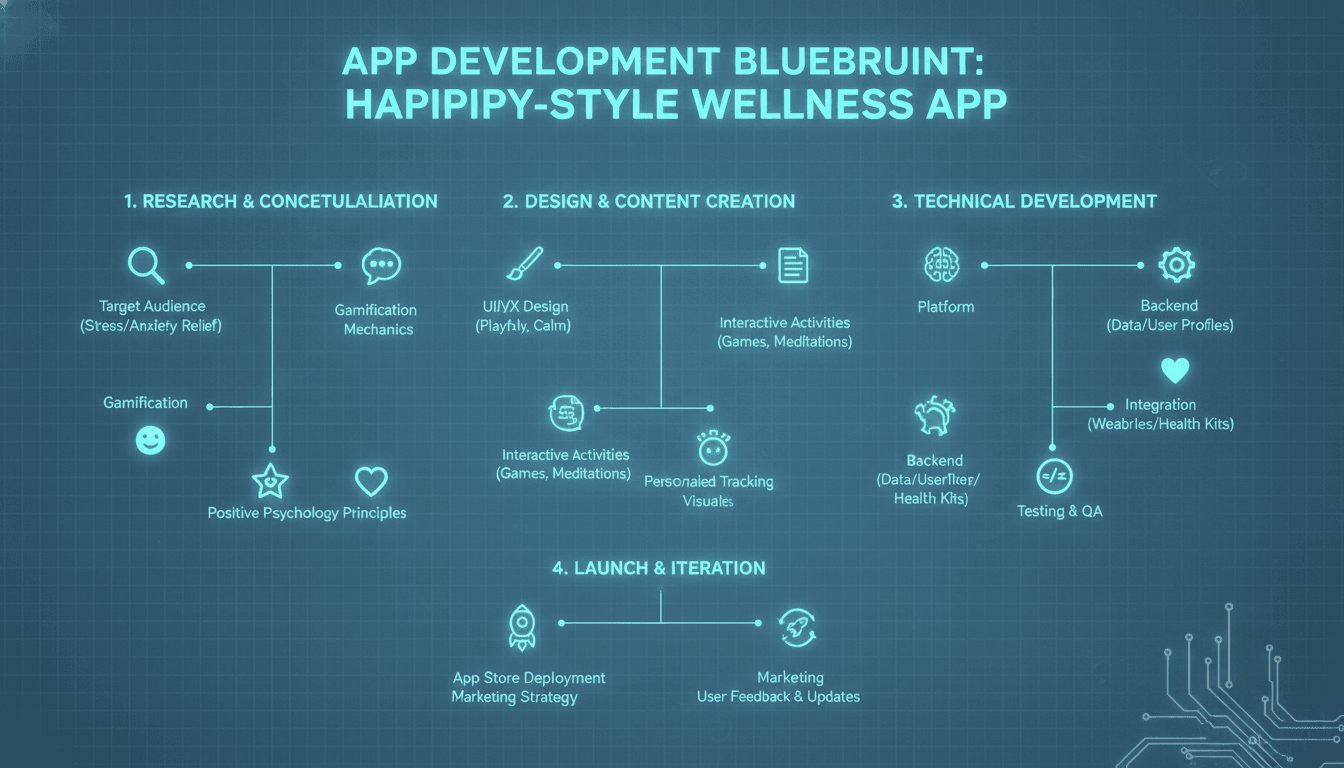
A Practical Build Sequence
- Validate the niche. "General happiness" is crowded. Narrow to a population — new parents, healthcare workers, people managing chronic illness, a specific cultural or language community.
- Recruit clinical advisors. A licensed psychologist on your advisory board shapes your content and gives your marketing legitimacy.
- Prototype the core loop. Assessment → track assignment → three activities → mood recheck. Test it with 20 real users before building anything else.
- Build the MVP. Ship narrow and deep rather than broad and shallow.
- Instrument obsessively. Track activation, day-7 and day-30 retention, activity completion rates, and self-reported outcome deltas.
- Prove outcomes. Publish your data. Run a study if you can. In this category, evidence is the moat.
- Expand. Add content, personalization depth, community, and enterprise features based on what the data tells you.
Final Thoughts
Building an app like Happify is less a technical challenge than an interdisciplinary one. The engineering is solved territory — cross-platform clients, a modular backend, a content engine, and a recommendation layer. What separates a product people trust from another abandoned wellness download is the quality of the psychology behind it, the care in the experience design, and the seriousness of your approach to privacy and user safety.
Get the science right, keep the daily loop short and rewarding, and be rigorous about proving that your app actually helps. Do those three things and the technology will carry the rest.
Have a project in mind? Contact Sodio Technologies to discuss your requirements and explore the right technology solution for your business.
/// Work with us
Talk to the engineers who'd build it
You'll get a technical scope, timeline and cost estimate from the people doing the work, not an account manager. In-house team, no subcontracting, since 2016.