

How to Make an App Like Overcast
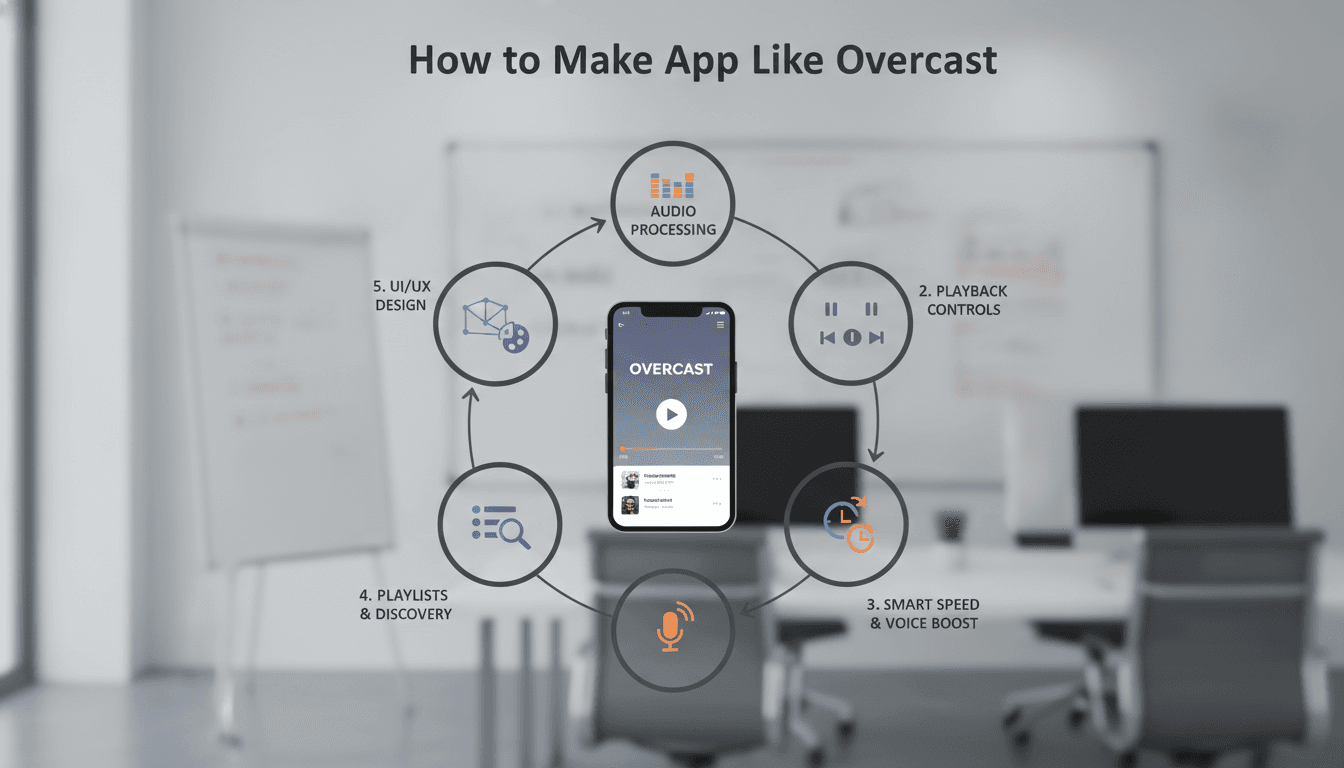
How to Make an App Like Overcast
Overcast is one of the most beloved podcast players ever built. It launched as a one-person project, competed against apps backed by Apple, Google, and Spotify, and still carved out a fiercely loyal audience. Its reputation rests on thoughtful audio engineering, a clean interface, and a refusal to bloat the experience with features nobody asked for.
If you're planning to build a podcast app like Overcast, this guide walks through the product thinking, feature set, technical architecture, monetization options, and realistic costs involved.
If this is relevant to your project, check out How to Make an App Like Stitcher.
What Makes Overcast Different
Before writing a line of code, it's worth understanding why Overcast earned its following. It isn't the podcast catalog — everyone pulls from the same open RSS ecosystem. The differentiation lives in the playback experience.
Smart Speed shortens silences in speech dynamically, saving listeners hours per month without the chipmunk effect of raw speed-up. Voice Boost normalizes and equalizes audio so a quiet indie show and a heavily produced network show sound consistent at the same volume. Together, these two features do more to retain users than any recommendation engine.
The lesson: in a category where content is commoditized, your audio processing and playback quality are the product.
Core Feature Set
Discovery and Subscription
- Search across a podcast directory (Apple's Podcast Search API, Podcastindex.org, or ListenNotes)
- Browse by category, charts, and curated collections
- Add podcasts manually via RSS URL — power users expect this
- OPML import and export so users can migrate in and out freely
Playback Engine
- Variable speed control with fine-grained increments
- Silence trimming (the Smart Speed equivalent)
- Dynamic range compression and volume normalization (the Voice Boost equivalent)
- Skip forward/back with configurable intervals
- Sleep timer, chapter support, and remembered playback positions per episode
- Gapless resume across devices
Library Management
- Playlists with sorting rules — by podcast, priority, newest or oldest first
- Episode-level actions: queue, download, delete, mark played
- Smart filters such as "unplayed only" or "shorter than 30 minutes"
- Storage management with automatic cleanup of played downloads
Sync and Cross-Device Continuity
Playback position sync is table stakes. A user who listens on their phone during a commute and switches to a tablet at home expects to resume at the exact second. This requires a lightweight server-side sync layer, not just local storage.
System Integration
- Lock screen and Control Center controls
- CarPlay and Android Auto
- Apple Watch / Wear OS playback and offline downloads
- AirPlay, Chromecast, and Bluetooth handling
- Siri Shortcuts and voice intents
Technical Architecture
Client Architecture
For a genuinely Overcast-class experience, native development is the honest recommendation. Audio processing, background playback, and OS media integration all sit close to the metal.
- iOS: Swift with AVFoundation and AVAudioEngine for playback and DSP; Core Data or SQLite for the local library; BackgroundTasks for refresh
- Android: Kotlin with Media3/ExoPlayer, MediaSessionService for background playback, Room for persistence, WorkManager for scheduled feed refreshes
Cross-platform frameworks like Flutter or React Native can work if your audio requirements are modest, but custom DSP, CarPlay, and watch apps will push you toward platform-specific modules anyway.
We cover a closely related subject in How to Make an App Like Podbean.
The Audio Processing Layer
This is where most clones fail. Silence trimming and voice boost are real signal processing problems.
Silence detection requires analyzing the audio buffer in short frames, computing RMS energy or a similar loudness measure, and shortening — not eliminating — frames below a threshold. Cutting silence entirely makes speech feel unnatural, so tune for compression ratios rather than removal. Do this in a real-time audio tap so it works on streams, not only downloaded files.
Voice boost is a chain: a high-pass filter to remove rumble, a mild EQ curve emphasizing speech frequencies around 1–4 kHz, and a compressor with a limiter to raise perceived loudness without clipping. Target a consistent LUFS level across episodes.
Both features should be toggleable per podcast, because users will want different settings for a heavily produced narrative show versus a two-person conversation recorded on laptop mics.
Backend Services
Even a client-heavy app needs a server:
- Feed crawler that polls RSS feeds on a schedule, parses them, and caches normalized episode data — never make every client hit every publisher's feed directly
- Search and directory service backed by Elasticsearch or a third-party API
- Sync service storing playback positions, subscriptions, and playlist state
- Push notifications for new episodes
- Analytics for retention and playback behavior
A typical stack: Node.js, Python, or Go services on AWS or GCP, PostgreSQL for relational data, Redis for caching hot feed data, S3 or CloudFront for artwork and cached assets, and Firebase Cloud Messaging plus APNs for notifications.
Handling the Messy RSS Reality
Podcast feeds are wildly inconsistent. You will encounter malformed XML, broken enclosure URLs, redirect chains from analytics prefixes, duplicate GUIDs, missing durations, and artwork in a dozen sizes. Budget real engineering time for a resilient parser and normalization pipeline. This is unglamorous work that directly determines whether your app feels reliable.
Related reading: How to Make an App Like Relax Melodies.
Design Principles
Overcast's interface is deliberately plain. Big touch targets, a prominent now-playing screen, high-contrast typography, and very little decoration.
Design for the actual listening context: people are driving, walking, cooking, or exercising. That means:
- Controls usable without looking closely at the screen
- A now-playing screen that dominates the hierarchy
- Gestures for skip and speed adjustment
- Excellent dark mode, since podcasts are often nighttime listening
- Full accessibility support — VoiceOver, Dynamic Type, and reduced motion
Resist the urge to build a social feed, a video tab, or an AI chatbot into version one. Overcast's restraint is a feature.
Monetization Models
Freemium with a premium tier. Overcast's own approach: the app is free with ads on the directory screens, and a modest annual subscription removes them and unlocks uploads. Simple, respectful, and predictable.
Subscription-only. Higher revenue per user, smaller funnel. Works if your differentiation is strong enough to justify payment up front.
Paid app. Increasingly rare on mobile, but viable in niche markets.
Creator marketplace. Take a cut of paid podcast subscriptions or exclusive episodes sold through your platform. This adds substantial complexity — entitlements, private feeds, payment processing — but creates a defensible business.
Avoid heavy advertising inside playback. Podcasts already carry ads, and users will punish an app that stacks more on top.
Development Roadmap
Phase 1 — MVP (10 to 14 weeks). Search and subscribe, feed parsing, downloads, basic playback with speed control, playlists, and local persistence. Single platform.
Phase 2 — Differentiation (8 to 12 weeks). Silence trimming, voice boost, cross-device sync, chapters, and CarPlay or Android Auto.
Phase 3 — Expansion (8 to 12 weeks). Second platform, watch app, sharing clips, transcripts and search-within-episode, and premium subscription infrastructure.
Cost Expectations
Costs vary widely by region and team composition, but a reasonable planning range:
- MVP, single platform: $40,000 – $75,000
- Both platforms with sync and custom audio processing: $90,000 – $180,000
- Full-featured product with watch apps, car integration, and a creator marketplace: $200,000+
Ongoing costs include feed crawling infrastructure, CDN bandwidth, search API fees, and continuous maintenance as OS versions and media frameworks change.
Common Pitfalls
- Treating audio as a solved problem. Off-the-shelf players won't give you Overcast-quality processing.
- Ignoring battery and data usage. Background refresh and aggressive downloading will drain devices and earn one-star reviews.
- Underestimating offline behavior. People listen on planes, subways, and trails. Every feature should degrade gracefully without a connection.
- Feature creep. Each added tab dilutes the core experience that made users choose you.
- Skipping the sync edge cases. Conflicting positions across devices, deleted episodes, and offline changes all need deterministic resolution rules.
Final Thoughts
Building an app like Overcast isn't about replicating a screen layout. It's about committing to audio quality, reliability, and restraint in a market full of bloated alternatives. The podcast ecosystem is open by design, which means the barrier to entry is low — and the barrier to being loved is entirely about craft.
Start narrow. Nail playback. Earn the right to add everything else later.
Have a project in mind? Contact Sodio Technologies to discuss your requirements and explore the right technology solution for your business.
/// Work with us
Talk to the engineers who'd build it
You'll get a technical scope, timeline and cost estimate from the people doing the work, not an account manager. In-house team, no subcontracting, since 2016.