

How to Make an App Like Relax Melodies
How to Make an App Like Relax Melodies
Sleep is big business. Millions of people scroll through their phones at midnight looking for something — anything — that will quiet their brain long enough to drift off. Relax Melodies (now branded as BetterSleep) answered that need with a deceptively simple idea: let people mix their own soundscapes, layer in guided meditations, and track how they actually sleep.
The app has crossed tens of millions of downloads. That success has a lot of founders asking the same question: how hard is it to build something similar, and what would it actually take?
For a closer look at a related topic, read our guide on How to Make an App Like Insight Timer.
Here's an honest, detailed breakdown.
What Makes Relax Melodies Work
Before writing a single line of code, it's worth understanding why this category of app retains users when most wellness apps churn brutally.
To explore this further, see How to Make an App Like Sleep Cycle.
It solves a nightly problem. Unlike a fitness app you might use three times a week, a sleep app gets opened every single night. That's a habit loop most products would kill for.
Mixing is the moat. Plenty of apps play rain sounds. Relax Melodies lets you combine rain with a distant thunderstorm, a crackling fire, and a low binaural tone — then save it as your sound. Personalization creates ownership, and ownership creates retention.
The content library keeps growing. Meditations, bedtime stories, breathing exercises, and sleep movements give users a reason to come back beyond the sounds themselves.
Freemium works here. A generous free tier gets people in the door. Premium unlocks the bigger library, offline downloads, and advanced features.
Core Features You'll Need
The Sound Mixer
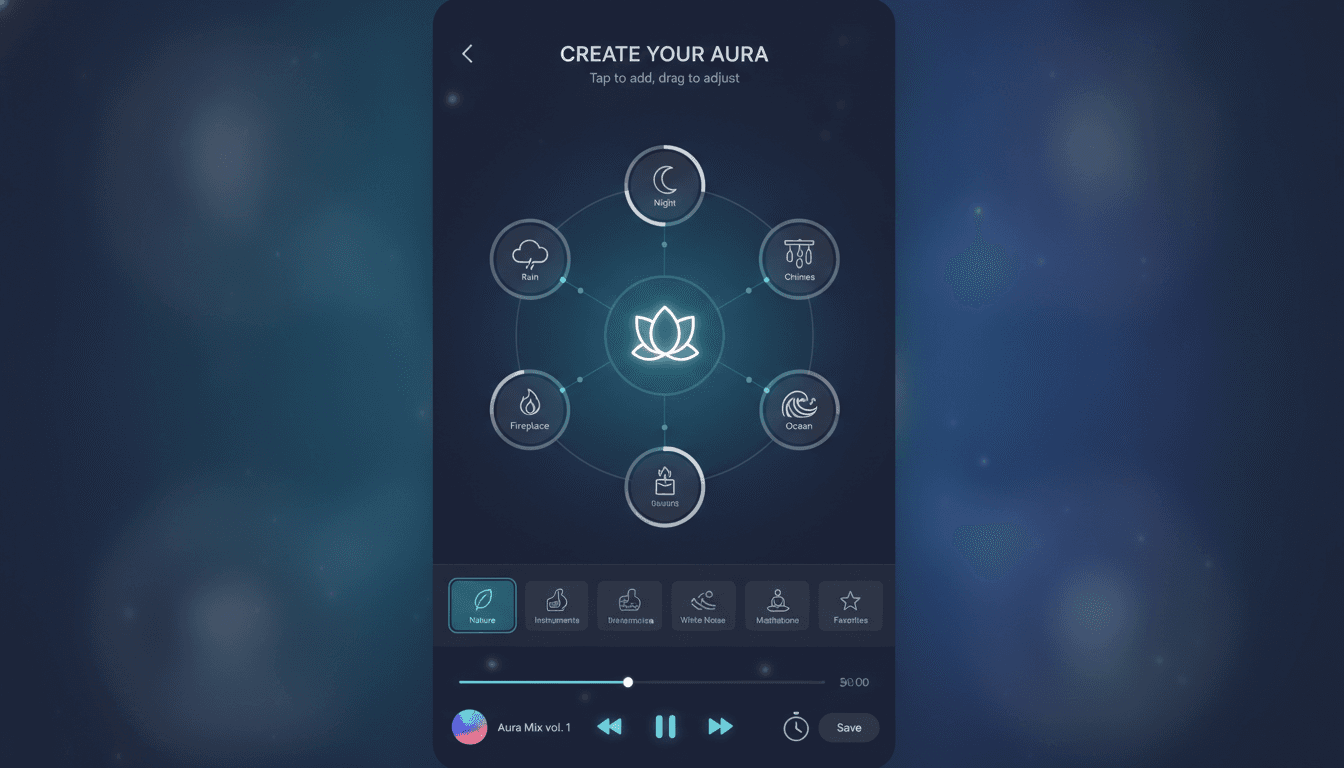
This is the heart of the product. Users pick from a catalog of ambient sounds — rain, ocean, white noise, fans, forests, city ambience, instruments — and layer them together with independent volume sliders for each track.
Technically, this means simultaneous playback of multiple audio streams with individual gain control, seamless looping without audible gaps, and smooth performance while the app is backgrounded and the screen is off. Gapless looping is harder than it sounds; poorly trimmed audio files produce a click at the loop point that users will notice at 2 a.m. in a silent bedroom.
You may also find our article on How to Make an App Like Overcast useful.
Saved Mixes and Presets
Let users name and save their combinations. Ship a set of curated presets ("Rainy Cabin," "Deep Focus," "Ocean Drift") so new users get value in the first ten seconds without having to build anything themselves.
Sleep Timer and Alarms
A fade-out timer that gradually lowers volume over the final minutes rather than cutting abruptly. Smart alarms that wake users during lighter sleep phases are a strong premium feature.
Guided Content
Meditations, breathing exercises, and sleep stories. This is where production cost lives — you need voice talent, scripts, recording, and mixing. Many apps launch with a modest library and expand monthly.
Sleep Tracking
Using the device microphone or accelerometer to detect movement, snoring, and sleep talking. This adds real stickiness because it generates personal data users want to check each morning. It also raises privacy obligations you cannot treat casually.
Personalization and Onboarding
A short intake quiz — what keeps you up, what's your goal, when do you sleep — that produces a tailored starting recommendation. This dramatically improves day-one activation.
Offline Mode
Sleep apps get used on planes, in cabins, and in places with bad signal. Downloadable content is nearly mandatory for premium tiers.
Subscriptions and Paywall
In-app purchase integration, trial handling, restore purchases, receipt validation, and a paywall you'll want to A/B test relentlessly.
Technical Architecture
Mobile Clients
You have three realistic paths:
Native (Swift + Kotlin). Best audio performance and deepest access to background playback, AVAudioEngine on iOS and ExoPlayer/AudioTrack on Android, plus HealthKit and Health Connect integration. Highest cost.
Flutter. Strong UI velocity and a single codebase. Audio mixing requires platform channels or well-chosen plugins, but it's very workable for this category.
React Native. Similar tradeoffs to Flutter with a larger JavaScript talent pool.
For an audio-centric product where background playback reliability is the entire value proposition, native gives you the fewest surprises. Flutter is the pragmatic middle ground for most budgets.
Audio Engine Considerations
- Use compressed formats (AAC or Opus) to keep download sizes reasonable, but test loop points carefully after encoding
- Implement proper audio session configuration so your app mixes or ducks correctly alongside other apps
- Handle interruptions gracefully — phone calls, alarms, headphone disconnects
- Support lock screen controls, CarPlay/Android Auto where relevant, and Bluetooth media keys
- Watch battery drain obsessively; an app that eats 20% of battery overnight gets deleted
Backend
A typical stack includes:
- API layer — Node.js, Python (FastAPI/Django), or Go
- Database — PostgreSQL for users, subscriptions, and mixes
- Object storage + CDN — S3 or equivalent behind CloudFront for audio delivery
- Auth — email, Apple, and Google sign-in at minimum
- Analytics and experimentation — event tracking plus a feature flag system
- Push notifications — bedtime reminders are a major retention lever
Keep audio delivery CDN-first. Streaming media bills add up fast and you want caching doing the heavy lifting.
AI Opportunities
Modern entrants differentiate with intelligence rather than a bigger sound library:
- Generative soundscapes that evolve rather than loop
- Recommendation engines that learn which mixes precede your best sleep scores
- On-device audio classification for snoring and sleep-stage estimation
- Personalized meditation scripts generated and voiced dynamically
These are real differentiators, not gimmicks, provided they're grounded in actual user data.
Content: The Part People Underestimate
You cannot ship a sound app with sounds you found online. Licensing matters enormously.
Options include commissioning original field recordings, licensing from royalty-free libraries with commercial redistribution rights, or producing synthesized audio in-house. Get the license terms reviewed — many "royalty-free" libraries explicitly prohibit use in apps where the audio is the product.
Budget for ongoing content production. A static library goes stale, and subscription churn follows.
Privacy and Compliance
Sleep apps handle sensitive data. Take this seriously from day one:
- Microphone-based tracking requires explicit, clearly explained consent
- Process audio on-device wherever possible and avoid uploading raw recordings
- If you market wellness or health claims, understand where the line sits with medical device regulation
- GDPR, CCPA, and the app stores' own health data policies all apply
- Apple and Google both scrutinize health-adjacent apps more closely during review
Transparency here is also a marketing asset. Users increasingly choose products that are explicit about what happens to their data.
Monetization
The dominant model is freemium subscription:
- Free tier — a limited set of sounds, basic mixing, a handful of meditations
- Monthly — typically $9.99–$14.99
- Annual — $59.99–$79.99, heavily promoted because it improves LTV and reduces churn management overhead
- Lifetime — a one-time option that converts hesitant users surprisingly well
Additional levers include family plans, B2B licensing to employers and insurers, and partnerships with hotels or wellness brands.
Expect conversion rates in the 2–5% range for a decent funnel. Your paywall placement, trial length, and onboarding quality move that number more than almost anything else.
Rough Timeline and Cost
A realistic MVP — sound mixer, saved presets, timer, a small meditation library, subscriptions, and basic accounts — typically runs three to five months with a small team.
Indicative ranges:
- MVP, single platform: $40,000–$70,000
- MVP, both platforms via cross-platform framework: $55,000–$90,000
- Full-featured build with sleep tracking and AI personalization: $120,000–$250,000+
Content production, licensing, and ongoing infrastructure sit on top of those figures. So does marketing, which in this category is usually the largest line item of all.
A Sensible Build Order
- Weeks 1–2: Research, competitive teardown, feature scoping, and audio format decisions
- Weeks 3–5: UX and visual design, with heavy attention to dark mode and one-handed nighttime use
- Weeks 6–14: Core development — audio engine first, then content, then subscriptions
- Weeks 15–17: QA across devices, battery profiling, long-session playback testing
- Weeks 18–20: Beta, store submission, and launch
Test the audio engine on old, cheap Android devices early. That's where mixing performance falls apart.
How to Actually Compete
Relax Melodies, Calm, and Headspace have enormous head starts. Competing on "more sounds" is a losing strategy. What tends to work:
Pick a niche. Sleep for shift workers. Sleep for new parents. Sleep for people with tinnitus. Sleep for children with sensory sensitivities. Narrow audiences are cheaper to reach and more loyal.
Go deeper on one feature. Best-in-class snore detection. The most sophisticated generative audio. Genuinely useful sleep coaching rather than a dashboard.
Own a distribution channel. Partnerships with sleep clinics, employers, or a creator audience beat paid acquisition economics every time.
Be better at the boring things. Faster launch, smaller download, lower battery drain, no ads interrupting a sleep session. These win reviews.
Final Thoughts
Building an app like Relax Melodies is not technically exotic — the hard parts are gapless audio, reliable background playback, honest privacy handling, and a content pipeline you can sustain. The genuinely hard part is standing out in a crowded, well-funded category.
Start narrow, nail the audio experience, and earn the right to expand. If you're weighing the technical approach or scoping a build, it's worth mapping the feature set against your budget before committing to a platform — that decision is expensive to reverse.
Have a project in mind? Contact Sodio Technologies to discuss your requirements and explore the right technology solution for your business.
/// Work with us
Talk to the engineers who'd build it
You'll get a technical scope, timeline and cost estimate from the people doing the work, not an account manager. In-house team, no subcontracting, since 2016.