

How to Make an App Like Peapod
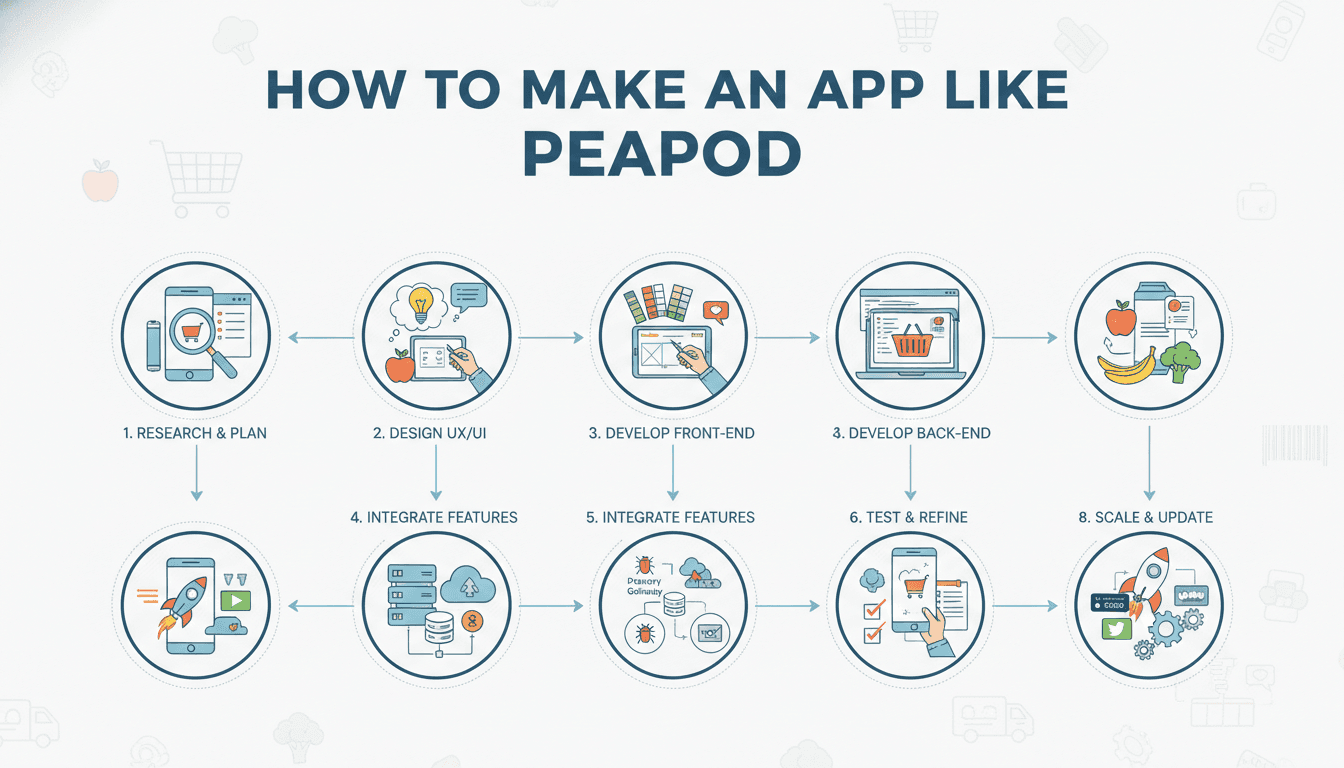
How to Make an App Like Peapod
Online grocery shopping has moved from convenience to expectation. Peapod, one of the earliest online grocery delivery services in the United States, proved that people will happily trade a Saturday morning in the supermarket aisles for a scheduled delivery window and a saved shopping list.
If you're planning to build a grocery delivery app of your own, this guide walks through the product thinking, feature set, technology choices, and cost realities involved in shipping something that can actually compete.
If this is relevant to your project, check out How to Make an App Like Walmart Grocery.
What Makes Peapod Work
Before writing a line of code, it's worth understanding why Peapod succeeded where many grocery startups burned out.
- Inventory depth over speed. Peapod built around full weekly shops, not five-item convenience runs. That shapes everything from cart UX to warehouse logistics.
- Scheduled delivery windows. Instead of promising 15-minute delivery, Peapod let customers pick a slot. This drastically improves route density and margin per delivery.
- Repeat purchase behaviour. Groceries are the ultimate recurring purchase. Features like saved lists, reorder buttons, and purchase history do more for retention than any discount campaign.
- Retail partnerships. Peapod grew through its relationship with Ahold Delhaize's store network, giving it supply chain leverage from day one.
Your app doesn't have to copy this model exactly, but you should consciously choose a position: rapid convenience delivery, full weekly shops, specialty/organic, or a marketplace aggregating local stores.
You may also find our article on How to Make an App Like Amazon Fresh useful.
Core Features for the Customer App
Onboarding and Location Detection
Grocery availability is hyperlocal. Capture the delivery address or zip code early, validate it against your service area, and show only what's genuinely available. Nothing kills conversion faster than a full cart that can't be delivered.
Catalog and Search
Grocery catalogs are large, messy, and full of near-duplicate products. You'll need:
- Category and subcategory browsing
- Fast, typo-tolerant search with synonym handling (e.g., "cilantro" and "coriander")
- Filters for dietary preferences, brand, price, and unit size
- Rich product data: images, nutrition, ingredients, allergens, unit pricing
Smart Cart
A grocery cart behaves differently from a retail cart. Support quantity by weight, item substitutions, "out of stock" preferences, and running totals that include estimated taxes, fees, and bag deposits.
Shopping Lists and Reorder
Let users save lists, favourite products, and reorder a previous basket in one tap. This is the single highest-leverage retention feature in grocery apps.
Delivery Scheduling
Show real available slots with live capacity. Support express windows at a premium and off-peak discounts to smooth demand.
Payments and Checkout
Integrate card payments, digital wallets, and where relevant, EBT/SNAP support. Handle pre-authorisation correctly since final totals change when weighted items are picked or substitutions are applied.
Order Tracking
Live status through picking, packing, out-for-delivery, and delivered, with driver location on a map and push notifications at each stage.
Substitution Approval
Real-time substitution requests from the picker, with in-app approve/reject, is a hallmark of a mature grocery app.
Ratings, Support, and Refunds
Damaged produce and missing items are inevitable. A self-serve refund flow for individual line items prevents support tickets from overwhelming your team.
The Apps You Also Have to Build
A grocery delivery product is rarely one app. Budget for at least three surfaces:
- Customer app (iOS, Android, and web)
- Picker/shopper app — used inside the store or warehouse for batch picking, barcode scanning, weight capture, and substitution requests
- Driver app — route assignment, navigation, proof of delivery, and earnings
- Admin dashboard — catalog management, pricing, inventory sync, slot capacity, promotions, analytics, and dispute resolution
Underestimating the picker and admin tooling is the most common planning mistake in this category.
Technology Stack
Mobile: React Native or Flutter if you want one codebase across iOS and Android with near-native performance. Native Swift/Kotlin if you need deep hardware integration such as high-volume barcode scanning in the picker app.
Frontend web: React or Next.js, with server-side rendering for SEO on product and category pages — important because grocery searches often start on Google.
Backend: Node.js, Python (Django/FastAPI), or Go. A microservices approach works well here because catalog, ordering, logistics, and payments have very different scaling profiles.
Database: PostgreSQL for transactional data, Redis for cart state and slot caching, Elasticsearch or Algolia for product search.
Real-time: WebSockets or a managed service for order status and driver tracking.
Maps and routing: Google Maps Platform or Mapbox, plus a dedicated route optimisation engine once volume grows.
Infrastructure: AWS or GCP with containerised deployment, autoscaling around peak evening and weekend order windows.
Payments: Stripe, Braintree, or Adyen with support for authorisation adjustments.
The Hard Problems Nobody Warns You About
Inventory Accuracy
Store shelf counts drift constantly. Whether you're syncing with a retailer's ERP or running your own dark store, you need near-real-time stock levels or your substitution rate will destroy customer trust.
Unit Economics
Delivery costs are brutal. Average order value, items per basket, route density, and picking speed determine whether you have a business. Instrument all four from day one.
Slot Capacity Management
Overselling a delivery window creates a cascade of late orders. Capacity must account for picking labour, driver availability, and geographic clustering — not just a flat order count.
Catalog Data Quality
Product images, sizes, and nutritional data are expensive to maintain. Plan for a data pipeline, supplier feeds, or a third-party catalog provider.
Cold Chain
Frozen and chilled goods require insulated handling and shorter routes. This affects both operations and app logic around what can be ordered together.
Development Timeline and Cost
A realistic MVP covering a customer app, a basic picker app, and an admin panel typically takes four to seven months. Costs vary widely by region and team composition, but planning ranges look roughly like this:
- Lean MVP (single city, limited catalog): $60,000 – $110,000
- Full-featured platform (multi-store, driver app, route optimisation): $150,000 – $350,000+
- Ongoing: budget 15–25% of build cost annually for maintenance, plus infrastructure and third-party API fees
Cross-platform frameworks, a phased rollout, and using proven third-party services for search, payments, and mapping are the most effective ways to control spend without gutting the product.
For a closer look at a related topic, read our guide on How to Make an App Like FreshDirect.
A Sensible Build Sequence
- Validate the market. Pick one neighbourhood, define your catalog, and confirm demand — even with a manual, spreadsheet-driven pilot.
- Design the experience. Wireframe the shop-to-delivery flow and test it with real grocery buyers.
- Build the MVP. Customer app plus the minimum internal tooling to fulfil orders.
- Launch small. One zone, limited delivery windows, tight feedback loop.
- Instrument everything. Basket size, fill rate, substitution rate, on-time delivery, repeat rate.
- Scale deliberately. Add zones, stores, and features only when unit economics hold.
Final Thoughts
Building an app like Peapod is only partly a software problem. The interface is the visible tip of a logistics operation, and the winners in this space are the teams that treat inventory accuracy, picking efficiency, and route density as product features rather than back-office concerns.
Start narrow, obsess over the repeat-purchase loop, and build the internal tooling with the same care you give the customer app. Do that, and you'll have a platform that can genuinely grow rather than one that simply launches.
Have a project in mind? Contact Sodio Technologies to discuss your requirements and explore the right technology solution for your business.
/// Work with us
Talk to the engineers who'd build it
You'll get a technical scope, timeline and cost estimate from the people doing the work, not an account manager. In-house team, no subcontracting, since 2016.