

How to Make an App Like Amazon Fresh
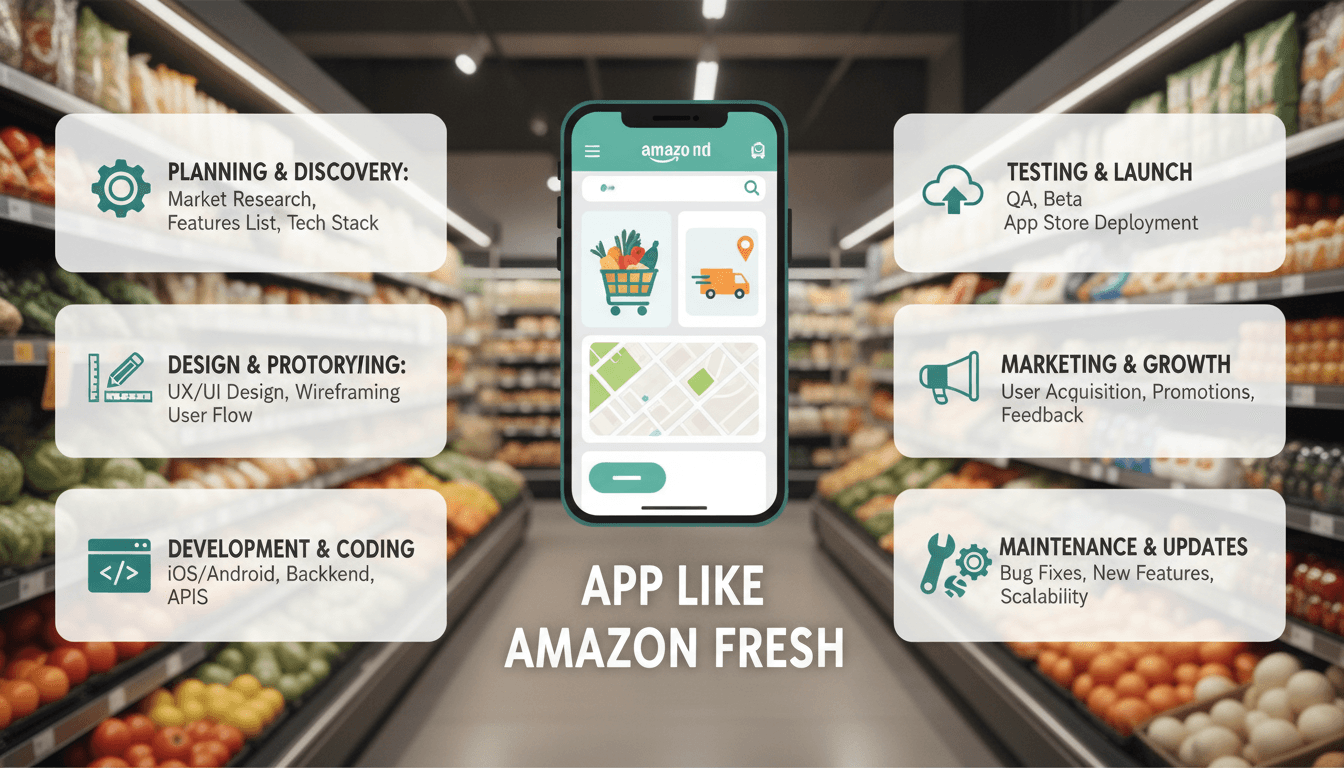
How to Make an App Like Amazon Fresh
Grocery shopping has changed forever. What used to mean pushing a cart through crowded aisles on a Saturday morning now happens in a few taps on a phone screen, with fresh produce arriving at the door within hours. Amazon Fresh sits at the center of this shift, and it has become the benchmark that every online grocery startup measures itself against.
If you're planning to build a grocery delivery app of your own, the good news is that the playbook is well understood. The hard part isn't the idea — it's executing the logistics, the inventory accuracy, and the user experience well enough that customers come back week after week. This guide walks through what it actually takes.
Related reading: How to Make an App Like Kroger.
Why the Online Grocery Market Is Worth Entering
Online grocery is one of the few e-commerce categories with genuine repeat behavior built into it. People buy groceries every single week, which means customer lifetime value is high and retention curves flatten out in a way most retail apps never achieve.
Related reading: How to Make an App Like Instacart.
A few forces are driving continued growth:
- Habit formation post-pandemic. Millions of shoppers tried online grocery out of necessity and simply never went back.
- Quick commerce expectations. Sub-hour delivery has moved from novelty to expectation in dense urban markets.
- Dark store economics. Purpose-built micro-fulfillment centers make fast delivery viable without the overhead of full retail stores.
- Subscription stickiness. Membership models bundle grocery delivery with other perks and dramatically reduce churn.
That said, margins in grocery are famously thin. Success depends far more on operational discipline than on flashy features.
Understanding the Amazon Fresh Model
Before you build, it's worth breaking down what Amazon Fresh actually does well.
Massive catalog with reliable availability. Fresh carries tens of thousands of SKUs, and inventory data is tightly synced so customers rarely order something that's out of stock.
Flexible delivery windows. Shoppers pick a two-hour slot that fits their schedule, or pay for faster delivery when they need it.
Deep personalization. Reorder lists, "buy it again" prompts, and recommendations based on purchase history remove most of the friction from weekly shopping.
Integrated ecosystem. Prime membership, Alexa voice ordering, and Whole Foods pickup all reinforce each other.
You don't need to replicate all of this on day one. But understanding which pieces drive retention helps you prioritize.
Choosing Your Business Model
Not every grocery app works the same way under the hood. Pick the model that matches your capital, your market, and your operational appetite.
To explore this further, see How to Make an App Like Peapod.
Inventory Model
You buy stock, store it in your own warehouses or dark stores, and fulfill orders directly. This gives you full control over quality, pricing, and delivery speed. It's also the most capital-intensive path and requires real supply chain expertise.
Marketplace Model
You aggregate local grocery stores onto a single platform and take a commission on each order. Capital requirements are far lower and you can launch faster, but you're dependent on partner stores for inventory accuracy and product quality.
Hybrid Model
Stock high-velocity essentials yourself while listing long-tail items from partner stores. Many of the most successful regional players operate this way.
Shopper-as-a-Service Model
Independent shoppers pick and deliver orders from existing retail stores. Extremely asset-light, though unit economics get tricky at scale and inventory data is often unreliable.
Core Features for the Customer App
Onboarding and Accounts
Keep registration minimal — phone number or social login, then address capture. Ask for everything else later. Serviceability checks should happen early so users aren't disappointed after browsing.
Product Catalog and Search
This is where most grocery apps live or die. Your catalog needs clean categorization, high-quality imagery, and search that tolerates typos, understands synonyms, and handles brand names alongside generic terms. Filters for dietary preferences, brands, price ranges, and organic labels are essential.
Smart Cart and Reordering
Grocery carts are large — 30 to 50 items is common. Make it easy to adjust quantities, swap items, and save a cart as a template. A well-implemented "reorder my last shop" feature can cut checkout time from fifteen minutes to thirty seconds.
Substitution Preferences
Out-of-stock items are unavoidable with perishables. Let customers specify upfront whether they want a substitute, a refund, or a call from the picker. This single feature prevents an enormous amount of support volume.
Delivery Slot Selection
Show real-time slot availability with clear pricing. Surge pricing for peak slots and discounts for off-peak windows help balance demand across your fleet.
Payments and Wallets
Support cards, digital wallets, UPI or local payment rails, cash on delivery where relevant, and in-app credit for refunds. Tokenized card storage speeds up repeat checkout significantly.
Live Order Tracking
Customers want to see picking progress, packing confirmation, and then live driver location on a map. Push notifications at each stage reduce "where is my order" support tickets dramatically.
Ratings, Returns, and Support
Perishables mean quality complaints. Build a fast, low-friction path to report a damaged item and receive an instant credit. Making this painless is often what turns a bad experience into loyalty.
The Delivery Partner App
Your driver-facing app needs to be fast, battery-efficient, and usable one-handed.
- Order acceptance and batching logic
- Turn-by-turn navigation with optimized multi-stop routing
- Proof of delivery via photo, OTP, or signature
- Earnings dashboard with per-trip and daily breakdowns
- Shift scheduling and availability toggles
- In-app chat or masked calling with customers
The Picker and Warehouse App
This is the piece most teams underestimate. In-store or dark store pickers need:
- Optimized pick paths that walk them through aisles efficiently
- Barcode scanning for verification
- Weight capture for loose produce and deli items
- Real-time substitution prompts routed to the customer
- Batch picking across multiple orders simultaneously
Picking efficiency directly determines your cost per order. A few seconds saved per item compounds into enormous savings at volume.
The Admin and Operations Dashboard
Behind the apps sits the control center:
- Catalog and pricing management with bulk upload tools
- Real-time inventory across all locations
- Order lifecycle monitoring and manual intervention
- Fleet management and live dispatch view
- Promotions, coupons, and loyalty configuration
- Analytics covering basket size, repeat rate, fill rate, and delivery SLA performance
- Vendor and partner store management
Technology Stack Recommendations
Mobile front end: React Native or Flutter for shared codebases across iOS and Android. Native Swift and Kotlin are worth it if you're pushing heavy performance requirements or deep platform integrations.
Backend: Node.js, Go, or Python with a microservices architecture. Grocery platforms have very different scaling profiles across catalog, order, and dispatch services, so separating them early pays off.
Databases: PostgreSQL for transactional data, Redis for caching and cart sessions, Elasticsearch for catalog search, and a time-series store for fleet telemetry.
Real-time infrastructure: WebSockets or MQTT for location streaming, plus a message broker like Kafka or RabbitMQ for event-driven order processing.
Cloud: AWS, Google Cloud, or Azure with containerized deployment via Kubernetes. Grocery demand is spiky — weekend mornings and evening rushes — so autoscaling matters.
Third-party services: Mapping and routing APIs, payment gateways, SMS and push providers, and analytics tooling.
Where AI Actually Helps
Skip the buzzwords and focus on the applications that move real numbers:
Demand forecasting. Predicting SKU-level demand reduces both stockouts and spoilage — the two biggest margin killers in grocery.
Intelligent substitutions. Machine learning models that suggest replacements customers actually accept, based on past behavior and product similarity.
Route optimization. Dynamic batching and routing that accounts for traffic, order density, and delivery windows.
Personalized merchandising. Surfacing the right products to the right shopper increases basket size measurably.
Dynamic slot pricing. Balancing fleet utilization by nudging flexible customers toward quieter delivery windows.
Development Process and Timeline
A realistic path from concept to launch looks roughly like this:
Discovery and strategy (2–4 weeks). Market research, business model selection, competitor teardown, feature prioritization.
UX and UI design (4–6 weeks). Wireframes, user flows, design system, and high-fidelity prototypes for all four applications.
MVP development (12–20 weeks). Core customer app, driver app, basic picker tooling, and admin panel.
Testing and pilot (4–6 weeks). Functional, performance, and security testing, followed by a limited pilot in one neighborhood or zone.
Launch and iteration (ongoing). Scale zone by zone, refining operations before expanding geographically.
Expect an MVP to land somewhere in the range of six to nine months, with costs varying widely based on team location, scope, and whether you're building a marketplace or a full inventory operation.
Cost Factors to Plan For
Development cost is only part of the picture. Budget realistically for:
- Catalog creation — photographing and cataloging thousands of SKUs is genuinely expensive
- Cold chain infrastructure if you're handling perishables
- Delivery fleet acquisition and driver incentives
- Customer acquisition, which is brutal in grocery
- Ongoing maintenance, typically 15–20% of initial build cost annually
Common Mistakes to Avoid
Launching too broadly. Dominate one dense zone before expanding. Grocery economics only work with order density.
Neglecting inventory accuracy. Nothing destroys trust faster than repeatedly ordering items that aren't actually available.
Ignoring the picker experience. A beautiful consumer app paired with a clumsy picking workflow will bleed money on every order.
Underestimating perishable handling. Cold chain failures generate refunds, waste, and churn all at once.
Competing purely on price. Amazon can outspend you indefinitely. Win on curation, local selection, service quality, or speed instead.
Finding Your Angle
You almost certainly won't beat Amazon Fresh at being Amazon Fresh. But there's meaningful room in hyperlocal specialization, ethnic and specialty grocery, organic and farm-direct sourcing, ultra-fast convenience delivery, B2B supply for restaurants and offices, and regional markets where the giants haven't invested in real operational depth.
The technology is a solved problem. What differentiates winners is a sharp understanding of a specific customer segment and the operational rigor to serve them better than a generalist ever could.
Getting Started
Building a grocery delivery platform means shipping four interconnected applications, integrating with payment and mapping infrastructure, and designing operations that hold up under real-world pressure. It's a substantial undertaking — but it's also a well-mapped one.
Start with a tightly scoped MVP in a single zone, obsess over fill rate and delivery reliability, and let real customer behavior guide what you build next. The apps that win in grocery aren't the ones with the most features. They're the ones customers trust enough to make part of their weekly routine.
Have a project in mind? Contact Sodio Technologies to discuss your requirements and explore the right technology solution for your business.
/// Work with us
Talk to the engineers who'd build it
You'll get a technical scope, timeline and cost estimate from the people doing the work, not an account manager. In-house team, no subcontracting, since 2016.