

How to Make an App Like Rec Room
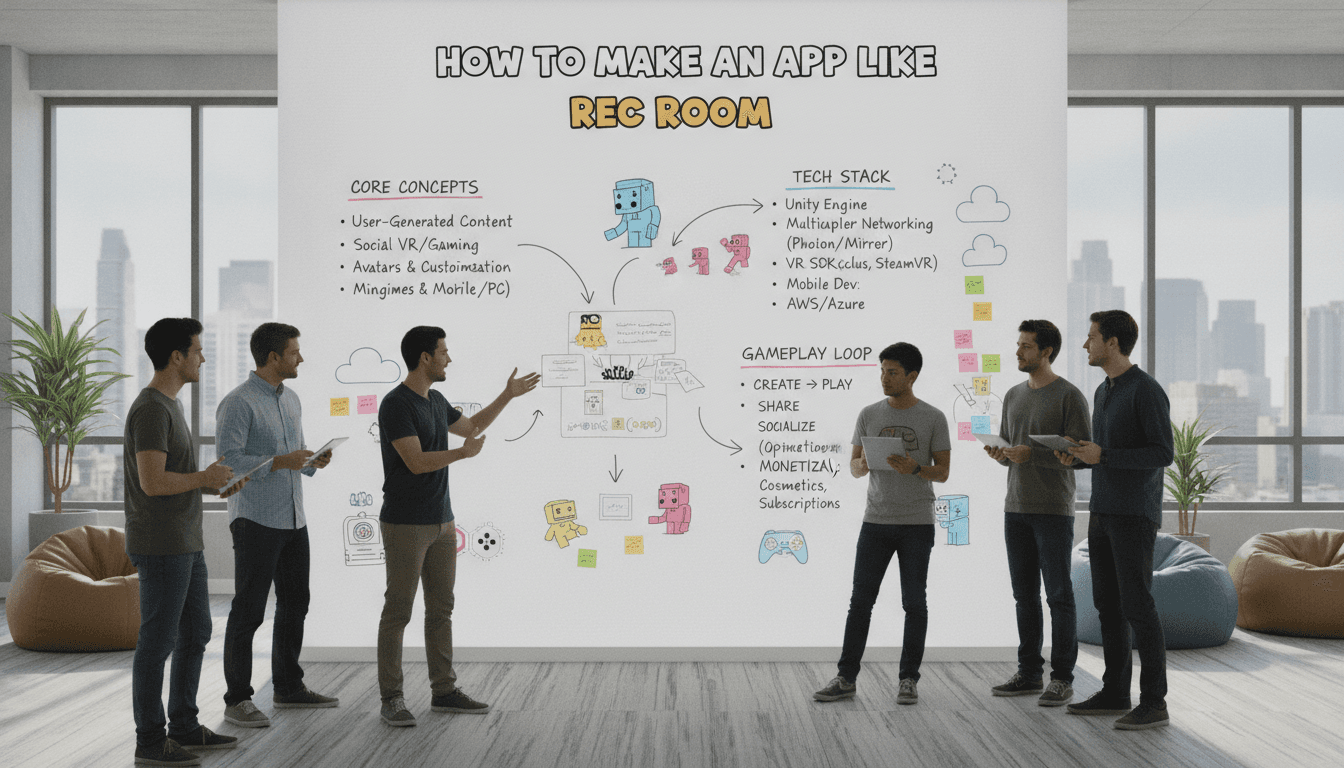
How to Make an App Like Rec Room
Rec Room didn't become a household name in gaming by accident. With tens of millions of players building, playing, and socialising inside a single shared universe, it proved that user-generated content plus social presence is a formula with staying power. If you're planning to build something similar — a social gaming metaverse where players create their own rooms, games, and experiences — this guide walks you through what it actually takes.
What Makes Rec Room Work
Before writing a single line of code, it's worth understanding why Rec Room succeeded where dozens of "metaverse" apps stalled.
Related reading: How to Make an App Like Pokémon Go.
- Cross-platform from day one. Rec Room runs on VR headsets, PC, consoles, iOS, and Android — and all of those players share the same rooms. That reach is the product.
- Creation is the content. The platform ships with a maker toolkit instead of a finished game. Players build the experiences that keep other players coming back.
- Social first, game second. Avatars, voice chat, emotes, and hangout spaces mean there's always something to do even when you're not playing a game.
- A real creator economy. Tokens, in-app purchases, and revenue sharing give builders a financial reason to keep creating.
Any clone that skips one of these pillars tends to feel hollow. Your job is to decide which pillar you'll lead with.
Core Feature Set
1. Avatar System and Identity
Players need a body before they need a game. Build a character creator with modular parts — heads, hair, outfits, accessories — plus full-body or upper-body tracking depending on the platform. Keep the art style stylised and low-poly; it's cheaper to produce, easier to moderate, and renders smoothly on mobile hardware.
2. Shared Rooms and Worlds
Rooms are the fundamental unit. Each one needs:
- A persistent identity (name, thumbnail, description, tags)
- An owner with permission controls
- Instancing so a popular room can spin up multiple copies
- A discovery surface — trending, new, staff-picked, and friends-are-playing feeds
3. In-App Creation Tools
This is the hardest and most valuable part. At minimum you'll need object placement with snapping, a library of primitives and props, and a visual logic system (node-based "circuits" or trigger-action chains) so non-programmers can build interactive games. Ship a save/version system and a publish flow with a review step.
4. Real-Time Multiplayer
Low-latency networking is non-negotiable. You'll need authoritative or hybrid server logic, client-side prediction, interest management so clients only receive nearby state, and regional server deployment to keep ping under control.
5. Voice Chat and Social Graph
Spatial voice chat transforms presence into something that feels alive. Layer on friends lists, parties, invites, DMs, and player profiles with stats and created rooms.
6. Monetisation and Virtual Economy
Plan a soft currency, a premium currency purchasable with real money, a cosmetics store, room passes or subscriptions, and — crucially — a creator payout system.
7. Safety, Moderation, and Trust
A platform with young users and open voice chat lives or dies on safety. Budget for it properly: age gating, parental controls, real-time voice moderation, report and block flows, automated content scanning, human review queues, and mute-by-default settings for minors.
Tech Stack Recommendations
Game engine. Unity is the pragmatic choice — Rec Room itself is built on it. Its XR toolkit, mobile and console export targets, and asset ecosystem are hard to beat. Unreal Engine gives you better out-of-the-box visual fidelity if you're targeting PC and console first.
Networking. Photon Fusion, Unity Netcode for GameObjects, Normcore, or a custom layer built on top of a dedicated server framework. For voice, look at Vivox, Agora, or Photon Voice.
Backend services. A microservices architecture behind an API gateway works well here — separate services for accounts, social graph, inventory, economy, room metadata, UGC storage, and moderation. Node.js, Go, or Python for services; PostgreSQL for relational data; Redis for presence and sessions; S3-compatible object storage for user-generated assets.
Infrastructure. Containerised game servers on Kubernetes with an orchestrator like Agones, deployed to multiple regions. A CDN for asset delivery is essential once UGC volume grows.
Analytics and AI. Event pipelines for retention and funnel analysis, plus machine learning models for content recommendation, toxicity detection in voice and text, and automated UGC screening.
Development Roadmap
Phase 1 — Discovery (2–4 weeks). Define your target platforms, audience age range, and the one thing your app does better than Rec Room. Nail down monetisation assumptions early because they shape the economy design.
Phase 2 — Prototype (6–10 weeks). Avatars, one hangout room, movement, spatial voice, and four to eight concurrent players. Test it with real users in headsets and on phones. If hanging out isn't fun yet, no amount of feature work will fix it later.
Phase 3 — MVP (4–6 months). Add the creation toolkit, room publishing, discovery feed, friends system, store, and moderation basics. Launch into a closed beta or a single region.
Phase 4 — Scale (ongoing). Console and VR platform certification, creator payouts, seasonal events, live-ops tooling, and continuous performance work as room complexity grows.
Cost and Team
A credible MVP for a cross-platform social gaming app typically lands in the $150,000 to $400,000 range, with full-featured platforms including VR support and a creator economy climbing well past that. The variables that move the number most are the depth of the creation tools, the number of launch platforms, and how much original 3D content you produce in-house.
For a closer look at a related topic, read our guide on How to Make an App Like AltspaceVR.
A lean core team looks something like: a Unity/gameplay engineer or two, a backend engineer, a network engineer, a 3D artist, a UI/UX designer, a QA engineer with device coverage, and a product owner. Trust and safety becomes a dedicated role faster than most founders expect.
Mistakes to Avoid
- Building the editor before the hangout. If the base social experience isn't compelling, creators won't show up to fill it.
- Ignoring mobile performance. Player-built rooms will be unoptimised by definition. Enforce budgets on poly counts, draw calls, and object limits at publish time.
- Treating moderation as a phase-two problem. App stores and console platforms will reject you, and early communities calcify around whatever behaviour you tolerate.
- Launching an economy without a sink. Currency needs somewhere to go, or cosmetics lose value fast.
- Empty-world syndrome. Seed your platform with polished first-party rooms and run creator programmes so new users always land somewhere populated.
Getting Started
The realistic path isn't to out-build Rec Room feature for feature — it's to pick a niche it serves poorly. A social creation platform for classrooms, for fitness communities, for a specific fandom, or for a region with underserved language support all give you a defensible wedge with a fraction of the scope.
For a closer look at a related topic, read our guide on How to Make an App Like VR Karts.
Start with the smallest version of that vision that people can actually hang out in, get it in front of players, and let their behaviour tell you which tools to build next.
Have a project in mind? Contact Sodio Technologies to discuss your requirements and explore the right technology solution for your business.
/// Work with us
Talk to the engineers who'd build it
You'll get a technical scope, timeline and cost estimate from the people doing the work, not an account manager. In-house team, no subcontracting, since 2016.