

How to Make an App Like Reflectly
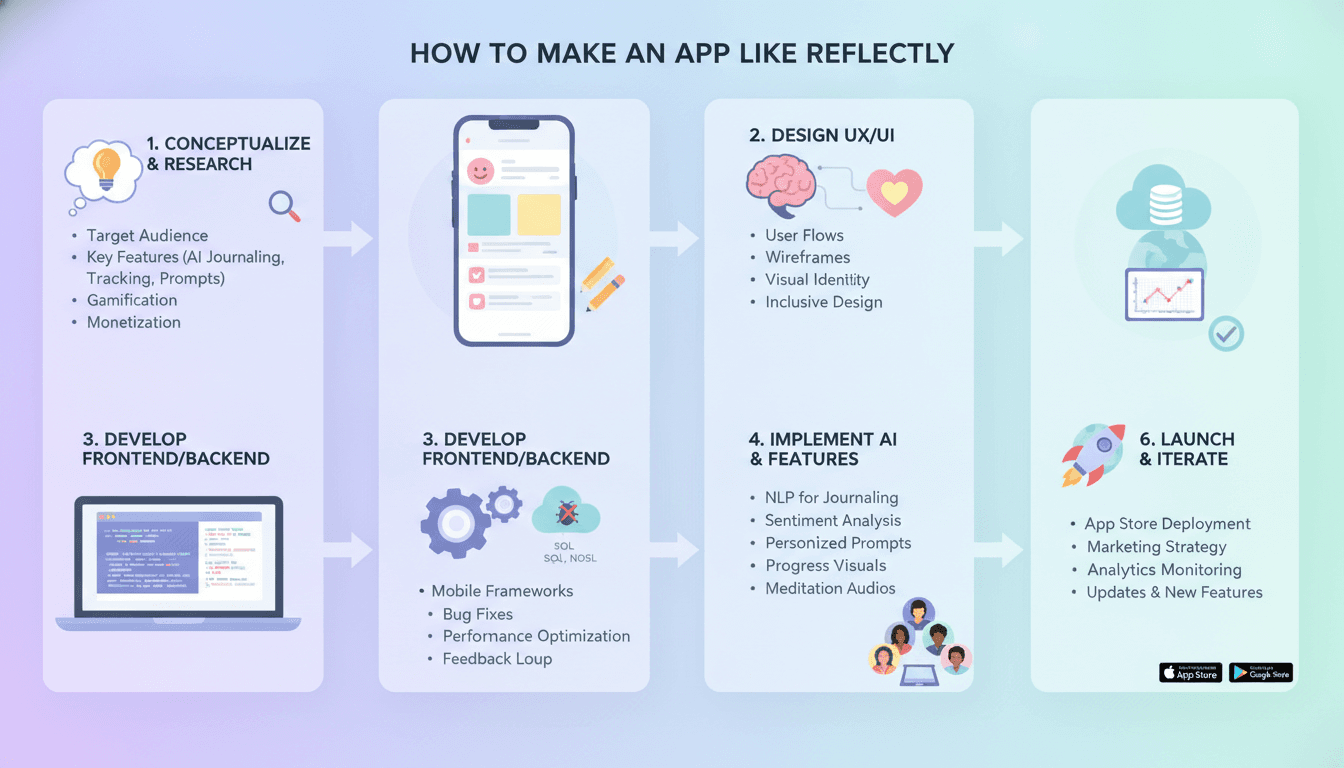
How to Make an App Like Reflectly
Journaling used to mean a leather-bound notebook and a pen that always went missing. Today, it means opening an app that greets you by name, asks how your day went, and turns your scattered thoughts into a beautiful, searchable record of your life. Reflectly pioneered that shift — blending AI-driven prompts, mood tracking, and gorgeous visual design into one of the most downloaded wellness apps in the world, with over 10 million users.
If you're planning to build something similar, this guide walks you through what Reflectly actually is, why it works, what it costs to build, and how to approach development without burning your runway.
What Is Reflectly?
Reflectly is an AI-powered personal journal and mental wellness app. Instead of presenting users with a blank page — the single biggest reason journaling habits fail — it acts like a conversational companion. It asks questions, adapts to the user's mood, and gently guides them toward reflection.
You may also find our article on How to Make an App Like Remente useful.
The core experience looks something like this:
- The user opens the app and logs their mood for the day
- Reflectly asks contextual follow-up questions based on that mood
- The user writes freely, adds photos, and tags what influenced their day
- Over time, the app surfaces patterns, streaks, and insights
- Daily reminders and motivational quotes keep the habit alive
It's simple on the surface and deceptively sophisticated underneath.
Why the Market Is Worth Entering
The mental wellness app market has been on a steep climb, driven by rising awareness of burnout, anxiety, and the value of daily self-care. A few factors make this space attractive:
Sustained demand. Mental health is no longer a niche concern. Employers, schools, and healthcare providers are all funding wellness tools.
High retention potential. Habit-based apps, when designed well, achieve retention rates that most categories envy. A journal that someone uses for 90 days becomes part of their identity.
Proven monetization. Reflectly and its competitors — Daylio, Journey, Day One, Stoic — all run successful subscription models. Users pay for self-improvement.
Room for differentiation. Most journaling apps serve a general audience. There's meaningful whitespace in apps built for specific niches: new parents, people in recovery, students, remote workers, athletes.
Core Features Your App Needs
Think of features in three tiers: the non-negotiables, the differentiators, and the delighters.
Tier 1: The Non-Negotiables
Onboarding and personalization First impressions decide whether someone becomes a user or a bounce. Ask a few questions about goals, preferred journaling time, and tone of voice, then use those answers to shape the experience immediately.
Mood tracking A simple, tappable scale — emoji, sliders, or color-coded cards. Keep it to one tap. Every additional step kills completion rates.
Guided journal entries The heart of the product. Serve dynamic prompts based on mood, time of day, recent entries, and streak status. "You mentioned work stress three times this week — what's driving it?" is far more engaging than "Write something."
Rich text and media Let users attach photos, voice notes, and tags. Memory is multisensory; the journal should be too.
Search and timeline Entries lose value if they can't be revisited. Build full-text search, calendar views, and filtering by mood or tag from day one — retrofitting search is painful.
Reminders and notifications Smart, respectful nudges. Learn when each user typically journals and time reminders accordingly. Avoid generic 9 PM blasts to everyone.
Privacy controls PIN codes, biometric locks, and end-to-end encryption. People write their most private thoughts here. Trust is the product.
Tier 2: The Differentiators
AI-generated insights Analyze entries to surface trends: "Your mood is consistently higher on days you exercise." This is where an LLM earns its keep — summarizing weeks, identifying recurring themes, and reflecting them back to the user.
Sentiment analysis Automatically detect emotional tone in written entries and compare it against self-reported mood. The gap between what people say and what they feel is fascinating and useful.
Streaks and gamification Streaks, milestones, and gentle recovery mechanics ("You missed two days — that's okay, let's start again"). Punitive gamification drives churn in wellness apps.
Statistics dashboard Charts showing mood over time, most frequent tags, word counts, and correlations. Users love seeing their own data.
Data export Let people take their journal with them as PDF or plain text. Counterintuitively, easy export increases trust and retention.
Tier 3: The Delighters
- Themed journal templates (gratitude, CBT-style thought records, goal setting)
- Widgets for home screen quick-entry
- Apple Health / Google Fit integration to correlate mood with sleep and steps
- Voice-to-text journaling for hands-free entries
- Wearable companion apps
- Shareable mood cards for social media
- Offline-first functionality with background sync
The Technology Stack
Your stack choices should follow your timeline, budget, and long-term ambitions.
Frontend
Flutter is a strong default for this category. A single codebase ships to iOS and Android, animations are smooth, and the widget system suits the highly visual, card-based UI that journaling apps rely on.
React Native works equally well if your team already lives in the JavaScript ecosystem and you want easier code sharing with a web app later.
Native (Swift / Kotlin) makes sense if you're leaning hard into platform-specific features — advanced widgets, Live Activities, deep HealthKit integration — or if animation fidelity is your primary competitive advantage.
Backend
- Node.js with NestJS or Python with FastAPI for the API layer
- PostgreSQL for structured data (users, entries, moods, tags)
- Redis for caching, session management, and streak calculations
- Object storage (S3 or equivalent) for images and audio attachments
- Firebase as a fast path for authentication, push notifications, and analytics
AI Layer
- An LLM API (OpenAI, Anthropic, or an open-weight model you host) for prompt generation and entry summarization
- A sentiment analysis model — either an API or a fine-tuned lightweight model
- On-device inference via Core ML or TensorFlow Lite for privacy-sensitive processing
A note on this: journaling data is deeply personal. Be explicit in your architecture about what leaves the device, what's encrypted, and what your AI provider retains. Many users will choose a less capable app that guarantees privacy over a smarter one that doesn't.
Related reading: How to Make an App Like 7 Cups.
Infrastructure
AWS, GCP, or Azure with containerized services, CI/CD pipelines, and automated backups. Start simple — a monolith on managed infrastructure — and break out microservices only when scale demands it.
Design: Where Reflectly Actually Wins
Reflectly's real moat isn't its AI. It's how the app feels. Soft gradients, playful illustrations, satisfying micro-interactions, and typography that makes writing feel inviting rather than clinical.
To explore this further, see How to Make an App Like Thrive Market.
Priorities for your design team:
Reduce friction to near zero. From app open to first word typed should take under five seconds.
Use motion purposefully. Transitions should feel like turning a page, not loading a screen.
Design for emotional range. The app will be opened on terrible days. Your visual language needs to hold sadness as comfortably as it holds joy — avoid relentless cheerfulness.
Respect accessibility. Dynamic type, screen reader support, sufficient contrast, and reduced-motion options are baseline requirements, not nice-to-haves.
Build a real design system. Components, tokens, and states documented properly. It will save months across the product's life.
Monetization Models
Freemium subscription is the dominant model and the one Reflectly uses. Free users get core journaling; subscribers unlock AI insights, unlimited entries, themes, statistics, and cloud backup. Typical pricing runs $5–10/month or $30–60/year, with annual plans driving the majority of revenue.
Lifetime purchase as a secondary option converts users who are allergic to subscriptions. Price it at roughly three years of annual subscription.
Free trial mechanics matter enormously. A 7-day trial with a clear reminder before charging builds trust and reduces refund requests and chargebacks.
Avoid ads. Interrupting someone mid-reflection with a banner ad is brand-destroying in this category.
B2B licensing is an underrated path. Corporate wellness programs and therapy practices will pay per-seat for a white-labeled journaling tool.
Development Timeline and Cost
Rough estimates for a cross-platform build:
MVP (3–4 months) Onboarding, mood logging, guided entries, basic prompts, timeline, reminders, authentication, and subscription plumbing. Expect somewhere in the range of $40,000–$70,000 depending on team location and design ambition.
Version 1.0 (5–7 months total) Adds AI insights, sentiment analysis, statistics, media attachments, biometric lock, and polished animations. Typically $70,000–$130,000.
Full-featured product (8–12 months) Everything above plus widgets, wearables, health integrations, web app, and multi-language support. Often $130,000–$250,000+.
Then budget 15–20% of build cost annually for maintenance, OS updates, AI API usage, and server costs.
A Practical Build Sequence
- Validate first. Interview 20–30 people who currently journal or have tried and quit. Find out exactly where they dropped off.
- Pick a wedge. Don't build "a journal for everyone." Build the best journal for one specific group, then expand.
- Prototype the core loop. Mood → prompt → write → save. Test it in Figma before writing code.
- Build the MVP. Ruthlessly cut anything not in the core loop.
- Beta test with 100+ real users. Watch retention at day 7 and day 30. If day 30 retention is below 15%, fix the loop before adding features.
- Layer in AI. Once people are journaling consistently, insights become genuinely valuable.
- Launch with a content engine. ASO, App Store feature pitches, wellness newsletters, and creator partnerships.
- Iterate on retention, not acquisition. In subscription apps, retention is the growth lever.
Common Pitfalls
Over-engineering the AI before proving the habit. A clever model can't save an app people don't open.
Treating privacy as a checkbox. One data incident in this category ends the business.
Notification fatigue. Aggressive reminders feel like nagging and drive uninstalls.
Ignoring the empty state. A brand new user with zero entries sees the least interesting version of your app. Design that screen with as much care as any other.
Skipping onboarding personalization. Generic first-run experiences correlate strongly with day-one churn.
Final Thoughts
Building an app like Reflectly is less about replicating a feature list and more about engineering a habit. The technology — mobile framework, backend, AI layer — is well-trodden ground. The hard part is crafting an experience so frictionless and emotionally intelligent that people return to it on the days they least feel like writing.
Start narrow, obsess over the first 30 seconds of the experience, treat user data as sacred, and let AI amplify reflection rather than replace it. Do that, and you'll have something worth building.
Have a project in mind? Contact Sodio Technologies to discuss your requirements and explore the right technology solution for your business.
/// Work with us
Talk to the engineers who'd build it
You'll get a technical scope, timeline and cost estimate from the people doing the work, not an account manager. In-house team, no subcontracting, since 2016.